
Tuscany rewards the traveller who knows where to look without breaking a sweat. For those aged 50 to 70 who prefer strolling to exertion, the region offers a network of flat vineyard lanes, bus-served panoramic terraces, and roadside viewpoints that deliver the iconic postcard scenery with minimal physical demand. The secret lies in choosing the right base and knowing which famous views come with a gentle approach.
The most defensible low-strain Tuscany plan, according to senior travel guides, is to base yourself in Lucca or Florence, use the flatter Chianti valley towns as intermediate stops, and treat the Val d'Orcia, Crete Senesi, Siena, and San Gimignano mainly as scenic excursions rather than walking destinations. This approach lets you absorb the landscape from a seat at a winery, a farmhouse restaurant, or a carefully chosen overlook, saving your energy for the moments that truly require it.
 AI-edited
Where are the flattest bases for gentle walking?
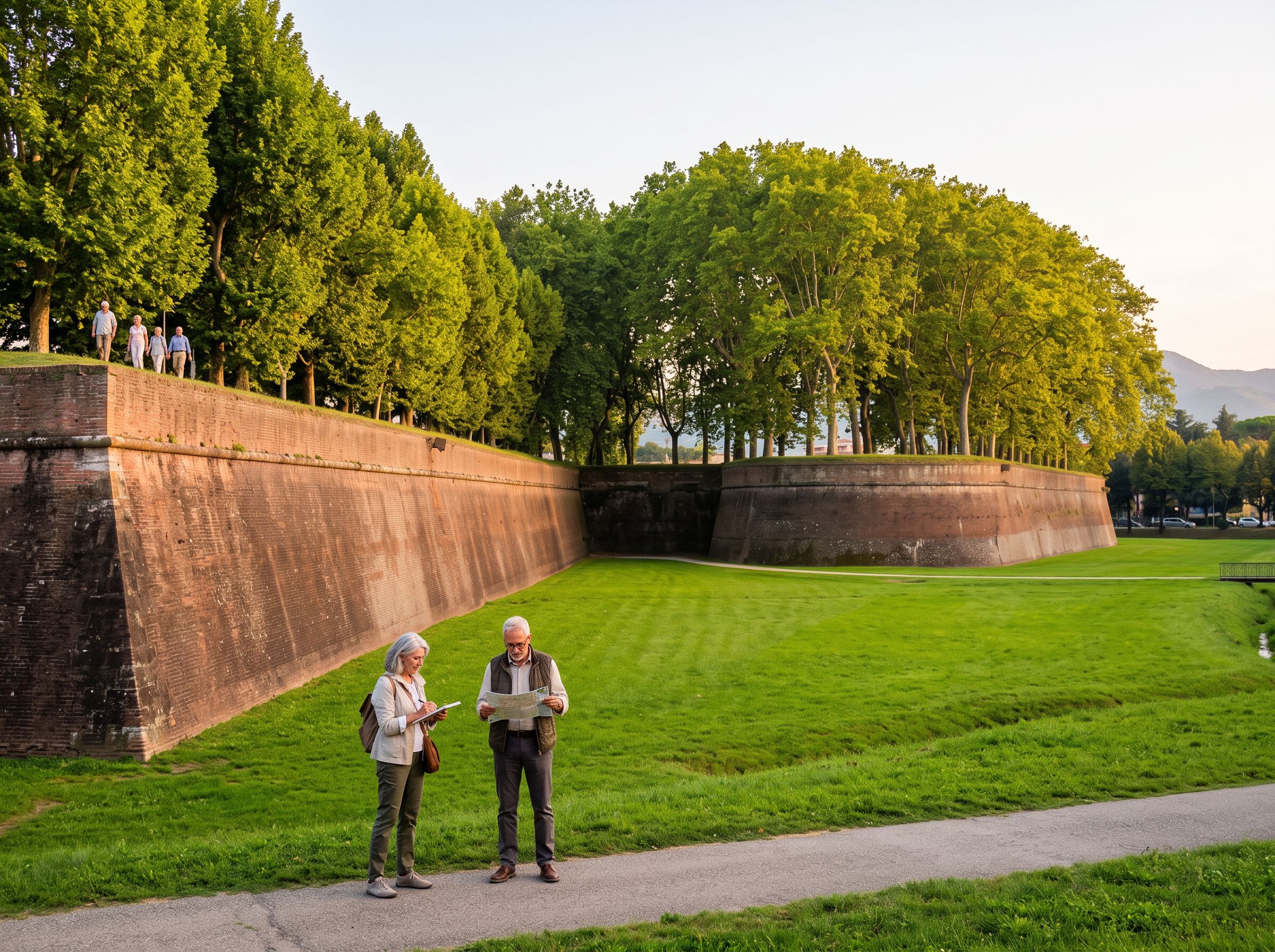
Lucca and Florence offer the most manageable walking terrain in Tuscany, with Lucca's Renaissance walls forming a flat, tree-lined promenade of about 2.6 miles that circles the historic centre. Florence's core is relatively flat, though paving can be uneven and crowds intense during peak hours.
Lucca stands out as the region's most senior-friendly city. Its Renaissance walls, adapted as a pedestrian promenade, provide a level, paved circuit shaded by trees, ideal for a gentle morning stroll. The city itself is flatter than most Tuscan towns, and walking there "won't be a problem," as one Rick Steves forum contributor noted. The walls offer a unique perspective: you circle the city at elevation without ever climbing a stair.
Florence's historic centre is also described as relatively flat and manageable, with the Uffizi, the Accademia, and the Duomo reachable on a walking scale that suits most visitors. The caveat is surface quality: many buildings in the historical centre are not accessible and may have one or two steps, and restrooms are often in basements. Uneven paving and dense crowds can make walking more tiring than the terrain alone suggests. For a deeper look at which towns suit older travellers best, our guide to the hill towns of Tuscany and which are easiest underfoot compares the options in detail.
How do I reach Piazzale Michelangelo without climbing?
Piazzale Michelangelo is a flat panoramic terrace with the classic Florence skyline view, but the walk from the centre is mostly uphill with many steps. City buses 12 and 13 serve it directly, and taxis offer a no-climb alternative that places you on the terrace without exertion.
The piazzale itself is flat and completely free, with no hazards on the terrace. Created in 1869 by Florentine architect Giuseppe Poggi as part of a major restructuring of the city walls, it offers sweeping views across the historic centre. The building at its heart, which never fulfilled its original purpose, now houses the restaurant La Loggia, featuring a coffee bar open daily from 10 am to midnight and a full restaurant with panoramic terrace from noon to 11 pm.
The approach matters more than the destination. From the city side, the walk is a 20 to 25 minute uphill effort. The official Visit Florence page notes you can also follow the shady via Michelangelo from Piazza Ferruccio for 1 km, or take the 3 km route from Porta Romana along viale Machiavelli, both frequently used by joggers. For those who prefer not to climb, bus 12 or 13 from the centre, the red two-level sightseeing tour bus, or a taxi places you directly on the terrace. The road to the piazzale sits outside the ZTL and is technically drivable, but parking is very limited and often full early. A paid lot in front of the piazza offers 72 spots at 1 euro for the first hour and 2 euros per hour thereafter, paid daily from 8 am to midnight. Shady paid parking can be found on the road to San Miniato along via delle Porte Sante.
Almost no shade covers the piazzale itself, so early morning or evening is recommended in summer. The Rose Garden below offers some shade, and the nearby Iris Garden provides a cooler retreat. In 2016, the piazza was restructured to emphasise the simple beauty of its spaces, removing most of the parking that had taken over the terrace.
What are the easiest Chianti walks for vineyard views?
Castellina in Chianti offers the Vineyard Road, a walk of just over 6 miles (10 kilometres) with no particular difficulty and an average walking time of about 3 hours and 30 minutes. The route forms part of the Chianti Classico Hiking Network, linking paths across the Chianti municipalities.
The Vineyard Road sets out from the village of San Martino in Cispiano, a few miles outside Castellina in Chianti, a village named for the ancient church dedicated to Martin of Tours. The official Tuscany tourism page describes the walk as passing through vineyards with points of interest including the cypress grove of the Sant'Agnese Forest Nature Reserve, naturalised for more than ten centuries, and the ancient Pieve di Santa Cristina in Lilliano, a Romanesque parish church dating to the 11th century. The route concludes at Rocca delle Macie, where a farm of the same name houses a museum dedicated to the film "They Call Me Trinity."
For those who want even less distance, the Chianti valley towns of Greve, Radda, and Castellina are described as largely flat and navigable, making them stronger choices than the steeper hill towns. Greve in Chianti is called "for sure flat" in forum discussions. Panzano has a split personality: the newer section is easier, but the older part climbs toward the church, so it is best to plan where to park and how far to walk.
The published page for the Vineyard Road does not specify surface type, shade, or bench locations. The route is best tackled all year round, according to the official source, which is useful if avoiding summer heat is a priority. For a broader view of low-exertion options across the region, our guide to seeing Tuscany with little walking covers the seated-viewpoint approach in more depth.
Which Val d'Orcia viewpoints need only short strolls?
The Val d'Orcia is best treated as a driving landscape with brief stops on foot. Iconic photo spots such as Podere Belvedere and the cypress stands near San Quirico d'Orcia sit beside the road, while the chapel of Vitaleta requires a walk of about 15 minutes from parking.
The Val d'Orcia rewards those who drive between viewpoints and spend only brief periods on foot. Forum contributors describe the region as offering "beautiful landscapes to drive to and just walk around for a minute" with "no major hiking." The key is knowing which spots allow a short stroll from the car.
Podere Belvedere, positioned along the road toward Pienza just outside San Quirico d'Orcia, is one of the valley's iconic photo subjects and is described as an easily accessible roadside position. The Cappella della Madonna di Vitaleta, between San Quirico d'Orcia and Pienza, sits on a dirt lane with access by a walk of about 15 minutes from parking, according to published guidance. The Cipressi di San Quirico d'Orcia, a named cypress stand near the old Via Cassia, is seen from the road, with guidance emphasising staying on the verge or marked pull-offs. Poggio Covili, sometimes called the "Gladiator Road" for its cypress-lined approach, is a photo spot reached from the road network rather than a strenuous hike.
Pienza itself is repeatedly described as a good low-effort base. Forum posts say it is "not too hilly" and that "Pienza too" is flat. The town is practical if you can park close, with a free 30-minute drop-off near some hotels and a COOP parking area about a 3-minute walk away. San Quirico d'Orcia, Bagno Vignoni, and Buonconvento are grouped together as places that are "easy to access and mostly flat." The road distance from San Quirico d'Orcia to Pienza is 10 km, about 10 minutes with clear roads.
Where can I find shade and benches on these routes?
Shade and bench availability varies significantly by location. Lucca's wall promenade offers tree cover along its circuit, while Piazzale Michelangelo has almost no shade on the terrace itself. The Rose Garden below and the shady via Michelangelo provide cooler alternatives in Florence.
Planning for comfort means knowing where the sun will find you. Lucca's Renaissance walls, converted into a pedestrian promenade, are lined with trees that provide dappled shade for much of the circuit. The flat, paved surface makes it one of the most comfortable walking environments in Tuscany.
In Florence, the approach to Piazzale Michelangelo offers more shade than the destination. The via Michelangelo from Piazza Ferruccio is described as shady for its 1 km length, and the road to San Miniato along via delle Porte Sante offers shady paid parking. The Rose Garden below the piazzale provides some shade, as does the nearby Iris Garden. The terrace itself, however, has almost no shade, which is why early morning or evening visits are recommended in summer.
For the Chianti countryside routes and Val d'Orcia viewpoints, the published sources do not document bench counts or shade availability. The Vineyard Road page does not specify surface type, shade, or benches. In the Val d'Orcia, the roadside nature of most viewpoints means you will likely be standing briefly rather than sitting. The Cicerone guidebook covering the region focuses on mostly easy walking with clear paths and some brief climbs and descents, but it does not document shade or seating for the specific photo spots.
What accessible options exist in Chianti for reduced mobility?
Visit Tuscany documents three accessible looped routes in the historic Via Romea Sanese area, starting from Castellina in Chianti, Barberino Tavarnelle, and Castelnuovo Berardenga, with two more being completed in San Casciano in Val di Pesa and Tavarnelle. These routes can be followed independently by people with mobility issues using off-road wheelchairs.
The Via Romea Sanese Accessible Association provides Joëlettes and electric-powered Trirides free of charge by reservation, according to Visit Tuscany. The same official source highlights an accessible nature site in Chianti with a tactile and auditory pathway and an electric kart available free of charge on advance reservation. Mobility aids can be used on gradients up to 20 percent.
For those who prefer to stay seated, the Chianti countryside is best experienced from a winery, farmhouse restaurant, or scenic overlook rather than by extensive walking. The region's accessible loop routes and vineyard and woods itineraries offer views without summit-style climbing. One accessible countryside tour between San Gimignano and Siena is described as step-free and using a wheelchair-accessible van, though hills in San Gimignano and Siena may still be challenging. The tour runs 8 to 9 hours with pricing from 980 euros for 1 to 2 people up to 1,150 euros for 7 to 8, with 20 euros off if booked as part of an accessible Florence travel package.
What should I know about transport and parking?
Parking matters as much as terrain in Tuscany. Several forum contributors stress that the easiest towns become much easier if you park close to the centre or choose lots near lifts, escalators, or level entries. Check ZTL restrictions before driving into historic centres.
The distinction between "top of town" and "approach to town" is crucial. A place may be walkable once you are there, but the climb from the parking area can be the real challenge. Older-traveller forum contributors consistently separate these two experiences, recommending that you "take a taxi or drive to the highest point of the town and walk downhill" when visiting hill towns.
For Florence, public transport and taxis are repeatedly recommended over self-powered climbing, especially for Piazzale Michelangelo and Fiesole. The 2.5 km T2 tram extension to Piazza San Marco opened to service after an official ceremony in January 2025, with free travel for two weeks, and construction has started on the T3 line to Bagno a Ripoli. Work on the new underground AV station at Belfiore was continuing as of July 2025, with trains expected to use the underground line by 2029.
Regional press in July 2026 reported service suspensions on key Florence rail routes during scheduled engineering works, affecting national and high-speed services through the city. For a fuller picture of train, bus, and driving options, see our guide to getting around Tuscany by train, bus, or car.
What are the calmest times to visit these viewpoints?
The only explicit seasonal comfort advice in the sources concerns Piazzale Michelangelo, where early morning or evening is recommended in summer because the terrace has almost no shade. The Chianti Vineyard Road is published as suitable all year round.
For Lucca, the sources support a gentle morning stroll on the wall promenade, when the light is soft and the crowds have not yet gathered. The Chianti countryside routes are best enjoyed seated at wineries and farmhouse restaurants, where the pace is set by the meal rather than the clock.
The Val d'Orcia, being primarily a driving landscape, rewards early starts when the light rakes across the cypress-lined roads and the pull-offs are empty. The region's official guidance does not document seasonal crowd-light periods for specific viewpoints, but the roadside nature of most spots means you can time your brief stops to avoid tour groups.
What health and safety information should I know?
The emergency number in Tuscany is 112 for serious medical emergencies. For non-emergency medical care, the Tuscany region documents 116117 for continuità assistenziale, or guardia medica, with service hours on weekday nights, weekends, and public holidays.
A Tuscany-focused source documents a 24/7 pharmacy hotline at 800 420 707 and an SMS service at 320 204 3490 for finding open pharmacies. For transport assistance, Autolinee Toscane gives a people-with-reduced-mobility number at 800 14 24 25 and a Tuscany region contact line at 800 57 05 30.
For the specific walking routes and viewpoints covered here, no local emergency-number statement specific to those areas is documented in the gathered sources. The regional numbers above apply throughout Tuscany. No senior or over-65 fare details are documented for the specific walking routes or viewpoint sites in Tuscany. The only explicit reduced-fare information surfaced is for AT bus in Tuscany, which says reduced-fare passes exist for people with disabilities or invalidity and for elderly people over 65 according to income, with some cases receiving a 40 percent discount.
What else should I consider when planning?
For gentle walking in Tuscany, the sources support choosing short routes, bus-served viewpoints, and accessible loop routes rather than exposed hiking trails. Rates for tours and stays are indicative and vary by season and booking channel.
The Cicerone guidebook describes 43 mostly easy walks in Tuscany, including the Chianti vineyards and the UNESCO Val d'Orcia scenery, with routes typically 3 to 18 km and 2 to 7 hours, graded 1 to 3. This confirms that gentle options exist throughout the region, but the specific routes named in this guide are the best documented for low exertion.
Several properties in the Tuscan countryside receive consistent praise for quiet settings and panoramic views. Guests at Hotel Tenuta il Burchio in Figline e Incisa Valdarno described a "supercomfortable quiet location" and "stunning views of the typical Tuscan landscape." At Agri Resort & Spa Le Colline del Paradiso in Vaglia, reviewers mentioned "incredible views across the Tuscan countryside." Monteverdi Tuscany in Castiglioncello del Trinoro and Agriturismo San Sano in Gaiole in Chianti drew similar comments about peaceful, beautiful settings.
Service attentiveness is a recurring strength, with guests describing staff as "available at every request" and "going above and beyond." Breakfast quality is often praised as generous, with "varied breakfast from sweet to savory" and "great breakfast, plentiful and quality" appearing in reviews for these properties.
Some practical caveats apply. Night-time noise or poor acoustics is the most repeated downside in older buildings, with some guests saying sound carried easily and that they needed earplugs. This was documented at Hotel Roma in Florence and Florence Old Bridge B&B. Sleep quality problems are sometimes tied to room placement, including "footsteps overhead" and elevator noise. Beds and shower comfort are mixed rather than uniformly excellent, with one rural property review noting a shower that was not hot enough and a bath and shower setup that splashed water. Accessibility and arrival logistics can be a problem at some rural villas and agriturismi, especially where there are no always-staffed reception desks or difficult access roads. Villa LeonLori in Impruneta was specifically described as having "difficult" access and no 24/7 reception. Ask for a room away from the bar and confirm shower configuration when booking.


