
Venice rewards slow mornings, but the wider Veneto rewards a train ticket. Four outings sit within reach of Venezia Santa Lucia without a car, a long coach ride or an overnight bag: Padua for Giotto's frescoes, Verona for Roman stone and opera, the Brenta Canal for Palladian villas seen from the water, and the Lido for a flat, car-free walk beside the Adriatic. Each suits a different kind of day, and each asks a different amount of your legs.
The lagoon islands have their own dedicated guide, so this piece stays on the mainland and the Lido. What follows is transport, terrain, booking and pacing, drawn from operator timetables, official ticket pages and aggregated guest feedback, for travellers who would rather know the shape of a day before committing to it.
Which day trips from Venice are worth the journey?
Padua is the shorter, lower-friction outing; Verona is the fuller cultural day. The Brenta suits anyone who wants the scenery delivered seated, and the Lido is the flattest option of the four.
Padua sits closest and asks least of you. Verona takes longer but delivers a compact historic centre built around a Roman arena. The Brenta Canal is a water-borne route with villa stops, and the Lido is a Venice island reachable on the ordinary waterbus network.
One planning rule recurs across traveller forums: choose one major city per day. Padua or Verona, not both, unless the aim is a brief look rather than a visit. Venice itself and its islands can absorb a full day, so day-trippers should not assume they can fold a second city into an afternoon without cutting something short.
 AI-edited
Is Padua the easiest day trip from Venice?
Padua is the closest and simplest of the four, reached by regional train from Venezia Santa Lucia in about 30 minutes with no change, according to the published weekday timetable measured on 1 October 2026. The city is described as flat and walkable, and the historic area sits a short walk from the station.
The train is the supported way to do it. Regional services between Venezia Santa Lucia and Padova Centrale run frequently, and one source notes that regional trains do not require advance booking. Tickets can be bought at the station machine or on the Trenitalia app.
By road, Padova station is about 40 km from Piazzale Roma, the last point in Venice that cars can reach. That figure is for drivers, and it explains why the train is the sensible choice.
Once in Padua, the classic route runs from the chapel area south toward the Basilica di Sant'Antonio, then on to the Orto Botanico or Prato della Valle. The basilica area and the garden or Prato della Valle sit about 10 minutes apart on foot. Some travellers take the tram into the centre to avoid a dull walk from the station; the left-luggage facility at Padua station is useful if you are using the city as a stop between Venice and Verona.
How do you book the Scrovegni Chapel, and what should you expect?
The Scrovegni Chapel holds Giotto's fresco cycle of 1304 and requires advance reservation. Online bookings must be made at least 24 hours before the visit, and card payment allows reservation until the day before. Visits last 15 minutes, with entry every 15 minutes and last admission at 6.45pm.
Opening hours are 9.00am to 7.00pm all year round, according to the chapel's own information page. The official Padua tourism page for the Scrovegni Chapel states that the chapel is open to the public all year, with daytime visits from 9:00 to 19:00, and that official closing days are 1 May, 25 and 26 December, and 1 January. From 25 March to 1 November the chapel can also be visited in the evening from 7.00pm to 10.00pm, and evening tickets include only the chapel.
Daytime tickets include the Eremitani Civic Museum on non-holiday Mondays, and the Eremitani Civic Museum plus Zuckermann Palace from Tuesday to Sunday. The ticket office sits about 100 metres from the chapel, at the entrance of the Eremitani Museum, 8 Eremitani Square. Visitors should reach the air-conditioned waiting room outside the chapel five minutes before the time printed on their ticket. Those booked for 9.00 should arrive at 8.45, not earlier.
Bags, backpacks, food, drinks and pets are not allowed inside. Bags must be checked into the cloakroom or lockers before visiting the museum and chapel, and trolleys and suitcases are not permitted in the museum. Photography for personal use is allowed from a distance, without flash, lamps or tripods.
Guest feedback is consistent on two points. Reviewers describe the frescoes as exceptionally well preserved and vividly coloured, with the starry blue vaulted ceiling singled out, and the introductory film shown before entry is widely praised as useful preparation. Groups are limited to roughly 25 to 30 people per slot, which most visitors report keeps the chapel quiet. The 15-minute limit, however, is described by many as too short to see everything. As of September 2026, the chapel holds a Google rating of 4.8 out of 5 from 19,220 reviews.
"The ceiling, scattered with golden stars, creates the sensation of standing beneath eternity itself. In such an intimate space, every expression feels personal :tender, real, and profoundly moving. A masterpiece that stays with you long after you leave." (Google, February 2026)
On mobility, the chapel's official ticket page states that people with disabilities and one accompanying person enter free, and the official site lists concessions for over-65 EU citizens. The official material does not document step-free access for the chapel route itself, and a practical guide notes steps and uneven flooring. Mobility-limited visitors should confirm access with the chapel before booking.
Is Verona worth a full day from Venice?
Verona is a full-day trip rather than a quick hop. The published weekday timetable measured on 1 October 2026 gives about 80 to 90 minutes by train from Venezia Santa Lucia to Verona Porta Nuova, with no change or one change. The city is described as compact, which makes the historic centre workable on foot once you arrive.
Verona's draw is Roman and performance heritage: the Arena, the historic centre, and the opera season. Travellers repeatedly call it worth an overnight or a good day trip, and several warn that it is a longer journey than Padua and deserves a fuller day. One forum contributor describes it as at least one train-hour from Venice and says it should usually get a day of its own.
On accessibility, an accessibility guide for Verona states that the main stations, including Verona Porta Nuova and Verona Porta Vescovo, have lifts, tactile paths and accessible toilets. The same guide states that Frecciarossa and Italo trains have dedicated wheelchair spaces and trained staff, and recommends notifying the operator in advance for help with platforms or boarding via mobile ramps.
For organised options, the picture is mixed. One operator prices a Verona day trip from Venice at €195 per person and notes that some parts may not be easily accessible for people with reduced mobility, advising travellers to contact the operator if unsure. A separate private-trip listing states that its Verona day trip is wheelchair accessible and for private groups. A third listing for the reverse route states that its trip is not wheelchair accessible. Check the specific product before booking rather than assuming.
The sourced material does not document a Verona day-trip sightseeing pass, a senior fare, or specific maintenance closures for the city centre. Verona is also not documented with route-by-route official day-trip details, so exact frequencies and fares should be checked with the rail operator before travelling.
What is the Brenta Canal boat trip like?
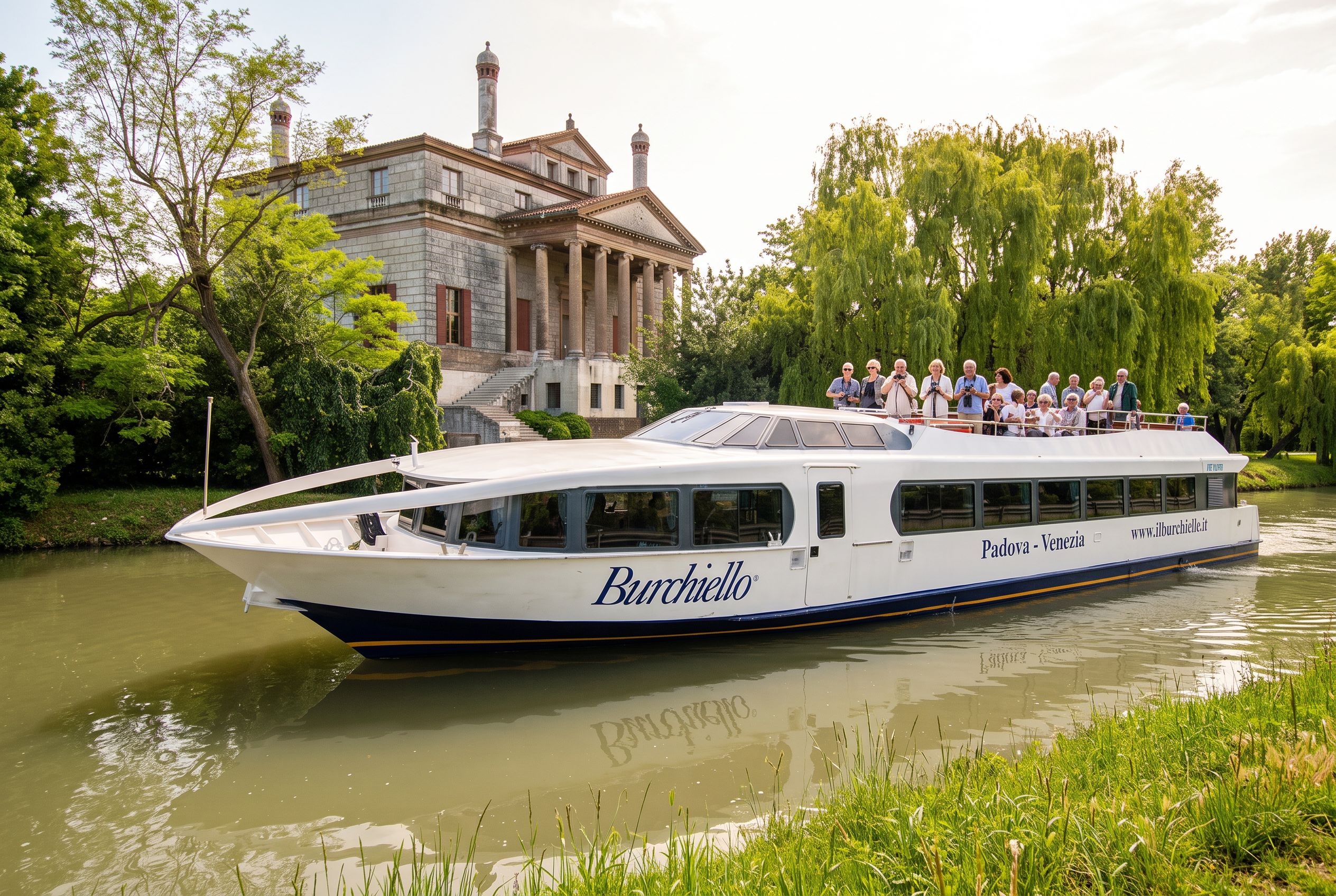
The Brenta Canal is the most effort-free scenic outing of the four, because the route is water-based. The operator I Battelli del Brenta runs guided public cruises from Venice to Padua or the reverse along the canal, with stops including Fusina, Malcontenta, Oriago, Mira, Dolo, Strà and Padua.
The cruises include visits to Villa Gradenigo, Villa Widmann or Barchessa Valmarana, Villa Pisani and Villa Foscari (Malcontenta). The official tourism site for the Riviera del Brenta states that the Burchiello sails from March to October from Padua to Venice and vice versa. The operator's group-rate page gives a wider window, stating that cruises run from March to November, and that short cruises last about one hour on selected stretches such as Padua to Strà, Strà to Dolo, Dolo to Mira, Mira to Oriago, or the reverse.
On price, the operator's group-rate page publishes a sample short-cruise fare of €22 midweek and €27 on weekends and holidays. The material gathered does not document senior discounts for the Brenta boat experience itself, and the operator does not publish cancellation terms in the pages reviewed. Ask when booking.
For onward travel, ACTV and AVM publish a Riviera del Brenta Pass priced at €33 in the published fare table, which includes a return bus ticket from Stra, Fiesso d'Artico, Dolo, Mira or Oriago to Venice, plus 24 hours of waterbus access covering Venice, Murano, Burano, Torcello and the Lido. ACTV also publishes a Venezia Daily Pass at €25, covering urban waterbus services, the Lido and Pellestrina bus network, the mainland bus and tram network, the People Mover, and Trenitalia regional services inside the municipality of Venice.
By road, Padova station to Strà measures 13 km, about 20 minutes with clear roads and no stops. That is useful only if you are joining a cruise at Strà rather than sailing the full route.
Is the Lido good for a flat, car-free seaside walk?
The Lido is the right Venice district for a low-effort seaside stroll, and the published weekday timetable measured on 1 October 2026 gives about 50 minutes by ferry from Venezia Santa Lucia with no change, operated by ACTV. It is covered by the ordinary Venice urban fare structure rather than a separate ticket.
ACTV's published urban fare structure includes the Lido in the mainland road network and within the Venezia Daily Pass coverage area. The pass, at €25, also covers the Lido and Pellestrina bus network, which matters if you want to move along the island rather than walk its length.
The safe planning position is that the Lido is a Venice island destination suitable for low-effort strolling, while precise transport and beach-service details should be confirmed from ACTV or the Comune di Venezia before you travel.
For anyone building a low-walking Venice itinerary around boats rather than bridges, the Lido fits naturally alongside the city's waterborne routes. Our guide to seeing Venice with little walking covers that approach in more detail, and getting around Venice by vaporetto and water taxi explains how the ticketing works.
What tickets and passes should you buy?
ACTV and AVM are the key operators for Venice local transport. Their own pages document the standard adult fare, a 72-hour youth discount, and disability-related reduced fares. No general tourist over-65 fare is documented in the official pages gathered here.
Children under 6 travel free on urban services. A 72-hour discounted "Rolling Venice" ticket exists for ages 6 to 29, but no general tourist over-65 fare appears on the official pages reviewed. The Visit Venice vaporetto planning page sets out the fare structure and the disability fare summary.
On accessibility, the official Venice transport pages state that the network has accessible services and that reduced fares apply for eligible disabled travellers, with one companion travelling free. A dedicated Accessible Venice page exists within the Venezia Unica and Visit Venice portal.
For senior-targeted outings, the most directly relevant operator page gathered is Destination Venice's senior page, which advertises senior-friendly tours on the lagoon and in the city. Our own guide to small-group and guided tours of Venice covers how to judge those products.
One practical warning. The Venice Marathon has twice caused major transport disruption, in October 2024 and again in October 2025, with road closures and diversions across Venice, Mestre, Marghera, Tronchetto and San Basilio, and suspended or altered vaporetto calls at San Marco Vallaresso, Giardini, San Basilio, Spirito Santo and Tronchetto. If your dates overlap, check the operator's notices before planning a transfer.
When should you go, and how should you pace the day?
Book the 9.00am Scrovegni Chapel slot if you can, since one source suggests it as the calmest planned start. Treat Verona as a full day and avoid peak opera nights if you want quieter conditions. The chapel's evening openings run only from 25 March to 1 November.
An early start and a late-afternoon or early-evening return is the pattern forum contributors recommend for seeing the highlights without the worst of the crowds. That suits older travellers who prefer calmer conditions over compressed sightseeing.
Several travellers say they would choose Padua over Verona if forced to pick just one day trip from Venice. Others say that if time is short, it is better to stay longer in Venice and treat Padua or Verona as a secondary excursion rather than trying to cover too much ground.
A few forum posts suggest using Padua or Verona as a base if the itinerary includes multiple side trips, because both connect well by train and reduce backtracking. That is a reasonable move for a longer stay, and it removes the daily return to Venice.
What else should over-50s know before booking?
Book the Scrovegni Chapel first, because timed entry and limited daily capacity make it the one fixed point in the plan. Everything else, including the train to Padua and the waterbus to the Lido, can be arranged on the day. Verona is the exception: give it a full day and check the specific tour product's accessibility claims.
The sourced pages do not publish local emergency numbers for these destinations, and no health or safety provisions are documented for the specific sights named here. Travellers should carry the standard European emergency number and check with their accommodation on arrival.
On senior fares, no over-65 fare for Venice, Padua or Verona transport was documented. The Scrovegni Chapel is the one clear exception, with concessions listed for over-65 EU citizens and free entry for people with disabilities and one companion.
Finally, the lagoon islands are covered separately in our guide to Murano, Burano and Torcello, and they deserve their own day rather than a slot squeezed between a train and a dinner reservation.


