
Venice has no cars, no buses and no bicycles in its historic centre. Movement happens on water or on foot, and for most visitors the workhorse is the vaporetto, the public water bus run by ACTV. It is cheap by Venetian standards, it runs late, and it doubles as one of the great sightseeing rides in Europe. The alternative, a private water taxi, costs many times more but delivers you to a hotel door with the luggage handled. Choosing between them, and knowing how each one actually works at the dock, is the single most useful piece of planning a traveller aged 50 to 70 can do before arriving.
This guide covers the water buses, the passes, the boarding realities, the taxi option, the traghetto crossings and the question of wheeled luggage. Arriving from abroad, by air, rail or road, is a separate subject and has its own dedicated guide.
How does the vaporetto system work?
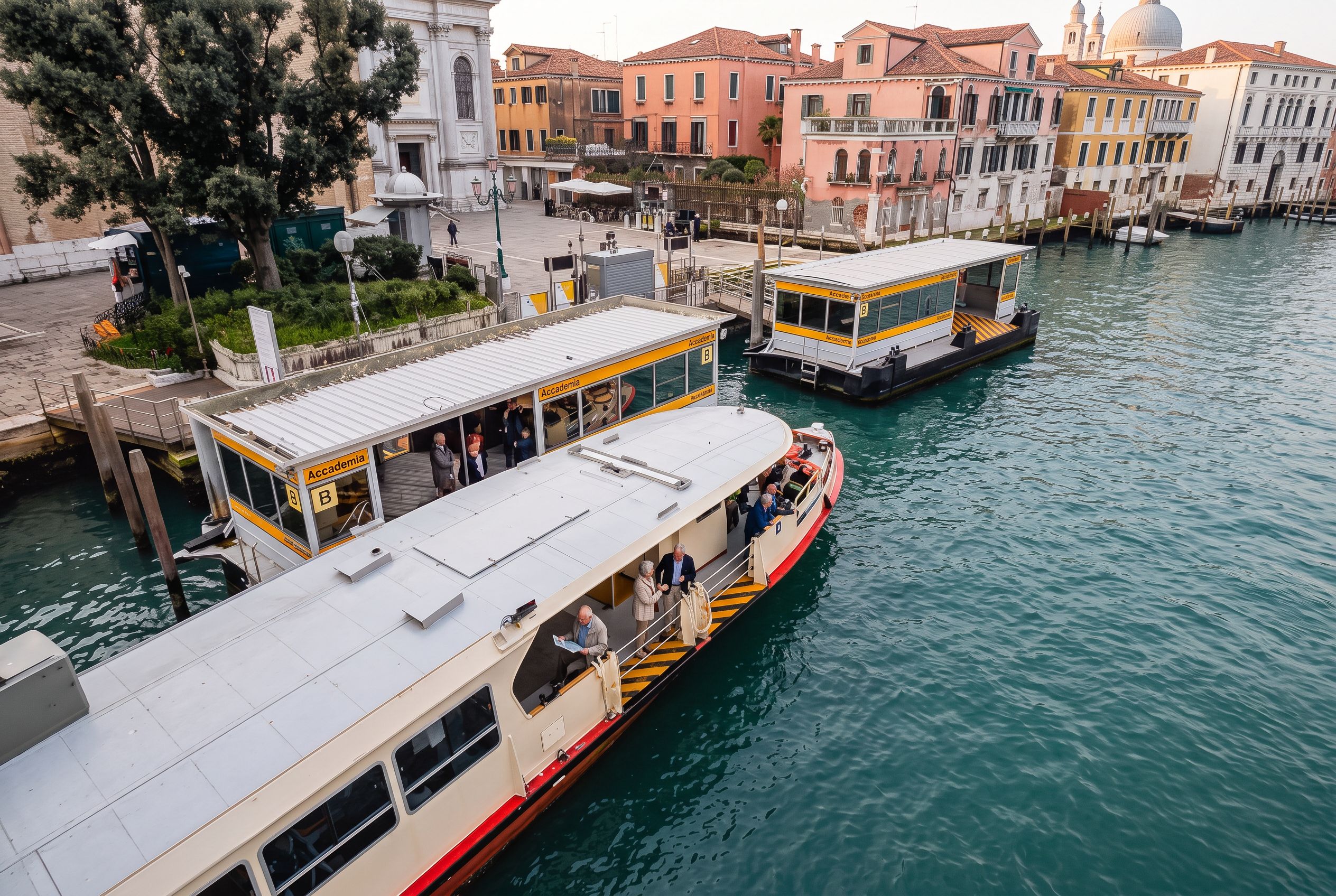
The vaporetto is Venice's public transport, operated by ACTV, with numbered lines on the urban network and the same ticketing across them. You buy or hold a ticket or pass, validate it at the dock-side reader before stepping onto the floating pontoon, and board. Line 1 is the classic Grand Canal service, Line 2 the faster cross-city route.
The system is organised around numbered water routes. Line 1 follows the Grand Canal and is the slower, more scenic option; one Venice fare guide identifies it as the line that calls at Sant'Angelo on the Grand Canal. Line 2 also serves the central Venice network and is the faster cross-city service, though the full published stop list was not documented in the material gathered here.
If your question is which route shows you the most of Venice, the published material supports Line 1, precisely because it traces the Grand Canal. Travellers on the water repeatedly describe the ride itself as part of the experience rather than a means to an end.
ACTV publishes sales points at Piazzale Roma, the railway station, San Marco Vallaresso, Rialto, Lido and the airport, plus ticket machines at larger landing stages and many tabacchi and newsagents displaying the ACTV sign.
What does a vaporetto ticket cost, and which pass makes sense?
A single ACTV waterbus ticket costs €9.50 for 75 minutes, valid after validation and usable with transfers within that window on the urban network. Official passes are €25 for 24 hours, €35 for 48 hours, €45 for 72 hours and €65 for seven days. Every pass starts on first validation, not at purchase.
The arithmetic is simple and worth doing before you arrive. A single ride is €9.50, so a 24-hour pass at €25 pays for itself on the third journey. Travellers on Venice forums make exactly this point, and it is the reason most visitors who plan more than a couple of water hops should buy a pass rather than singles.
| Product | Price | Validity |
|---|---|---|
| Single ticket | €9.50 | 75 minutes from validation, transfers included |
| 24-hour pass | €25 | 24 hours from first validation |
| 48-hour pass | €35 | 48 hours from first validation |
| 72-hour pass | €45 | 72 hours from first validation |
| 7-day pass | €65 | 7 days from first validation |
Two groups pay less, and neither is the general visitor. Children under 6 travel free on the urban services of the Municipality of Venice, according to the vaporetto pass FAQ. Holders of an EU Disability Card and passengers using a wheelchair pay €1.50 for a 75-minute ticket, valid on ACTV waterborne services except routes 16, 19 and Casino, and an accompanying person travels free.
There is no senior discount for tourists. ACTV's own fare pages state that reduced tariffs for older people apply only to Venice residents, not to visitors. From age 75, residents of the Comune di Venezia with valid ISEE documentation may receive annual-pass reductions. Visitors aged 50 to 70 should plan on the standard fares above.
 AI-edited
How do you validate a ticket, and what happens if you don't?
Validate at the pontoon entrance before stepping onto the floating stop, because the readers are on the dock, not on the boat. For the urban network, tickets must be validated before boarding and again at each change of service. One official page states that unvalidated travel is fined at €50 plus fare and fees.
This is the rule that catches first-time visitors. The validator is not inside the cabin and not at the gangway of the boat; it sits at the entrance to the floating landing stage. You touch the ticket or pass to the reader there, then walk down onto the pontoon and wait for the vessel.
If you hold a multi-day pass, the first validation starts the clock. Subsequent boardings within the validity window do not need revalidation, but a change of service does. Keep the ticket or card accessible rather than buried in a bag, because inspectors board and check.
The fine for travelling unvalidated is published as €50 plus the fare and fees. That is more than five times the cost of a single ticket, and it is applied to locals and visitors alike.
Where are boarding gaps and crowded decks a problem?
Boarding quality differs by stop. Most pontoons in the historic centre are described as flat or step-free, with staff deploying ramps where needed, but some stops are not accessible. The documented easier boarding points include Piazzale Roma, Ferrovia, Rialto, San Zaccaria and Zattere, and Lines 1, 2 and 12 are cited as wider-access routes.
The operator and Venice tourism pages both describe the vaporetto as the most accessible way around Venice, with floating landings, ramps, level entry from the pontoon and space for wheelchairs on board, as set out on the vaporetto accessibility page. The same material notes that not every stop is accessible, so route choice matters rather than being a detail.
The documented major hubs that are generally wheelchair-accessible are Piazzale Roma, Ferrovia (the Santa Lucia station area), Rialto and San Marco. San Zaccaria is cited as a stop with better boarding conditions and barrier-free access on some services, and Zattere is cited as often offering better boarding conditions for seniors and mobility-impaired passengers.
Crowding is the other half of the picture. Reviews of the ACTV vaporetto consistently note crowding and long waits, even while valuing the convenience and the views. A mobility-focused discussion online notes that crowded vaporetti can be hard to move through and uncomfortable, even where boarding itself is easier than on a water taxi.
No advance booking is needed for standard wheelchair access on ACTV. Staff assist at the pontoon gate, and groups of three or more wheelchair users are advised to call ACTV the day before. Seating, lifts and formal assistance services are not documented in the material gathered for the exact Venice urban network; ask at the ticket office if you need a specific arrangement.
How late do vaporettos run, and how often?
Venice travel information published in 2026 says vaporetti generally run from around 5:00 a.m. to midnight, with the night line N taking over afterward, usually every 30 to 60 minutes. Lines 1 and 2 on the Grand Canal typically run every 10 to 15 minutes in the day and 15 to 20 minutes in the evening.
The night line matters for anyone with an early station transfer. Night vaporetto lines run from midnight to 5 a.m. and are marked with an N.
Service is not uniform across the year. Vaporetto Line 8 was in service from 31 May to 13 September 2026, then suspended until the end of May 2027, according to a 2026 transport notice. A 2026 timetable page also notes that the Grand Canal may be completely closed for a period in the afternoon or evening, and that Bacino San Marco from San Marco Vallaresso to Giardini may also be closed, with Lines 1 and 2 not running through the city during that window. Check the timetable before a fixed appointment.
ACTV's fare and service pages publish prices and ticket conditions but do not document a seasonal operating calendar or planned closure days for the network. Maintenance or revision closures for specific lines or stops were not documented for Venice.
Is a private water taxi worth it?
A water taxi is a private speedboat transfer, published as serving Marco Polo Airport, Santa Lucia Station and the Port, and it is the practical choice for door-to-door transfers and heavy luggage. It costs many times the vaporetto fare. The official tariff shows a meter with a €15 starting charge and €2 per minute on urban routes, plus €5 when pickup or drop-off is away from a taxi stand.
The official tariff lists fixed fares inside the historic centre from €40 for Tronchetto to Piazzale Roma or the railway station, up to €70 from a central stand to Lido Santa Maria Elisabetta. The municipal tariff adds €3 for each bag beyond the first four and beyond the number of passengers, so four passengers with four bags pay no extra baggage charge. A night supplement of €10 applies between 22:00 and 06:00.
Public fare guidance shows higher prices than the vaporetto throughout, including quoted examples such as around €65 from Santa Lucia or Piazzale Roma to Piazza San Marco. Venice tourism information published in 2026 says water taxis cost roughly €50 to €70 within the city and €100 to €130 from the airport, per boat for up to five passengers, with 24-hour service. Rates are indicative and vary by operator, season and booking channel.
Sources differ on the starting charge: the official municipal tariff states €15, while one taxi operator states €13. Confirm the meter or the fixed fare with the operator before boarding.
Guest feedback is mixed in a specific and useful way. Venice Water Taxi reviews describe the ride as much faster than the water buses and one arrival as exhilarating, and a Tripadvisor review notes that a shared water taxi dropped guests right into the hotel entrance area. The same body of reviews repeatedly warns that boarding is difficult, especially for elderly passengers or anyone with a disability, and one review calls it impractical with a lot of luggage. A hotel-arranged water-taxi arrival was reported as late and expensive.
Cancellation terms are operator-specific. One source says booked services can be cancelled with at least two days' notice for a 70% refund; another says a different taxi product can be cancelled free up to 24 hours before departure.
What about traghetto gondola crossings?
Traghetti exist as a separate gondola-crossing option across the Grand Canal, distinct from both the vaporetto network and private water taxis. The material gathered here does not document specific traghetto routes, seasons or fares for the city crossings themselves, so treat the detail as something to confirm locally rather than plan around.
That is the honest position. The crossings are a recognised part of how Venice moves, and they are neither the public water bus nor a private taxi. Beyond that, the route-by-route facts were not documented in the surfaced official material.
If a short hop across the canal would save you a long walk, ask at your hotel or at a landing stage which crossing is nearest and whether it is operating that day. Do not build an itinerary around an unverified crossing.
Why do wheeled cases and bridges not mix?
The practical issue in Venice is not that wheeled cases are banned, but that bridges and steps make them cumbersome. The accessibility material says ramps help at docks, and one vaporetto page explicitly notes that wheeled suitcases can board without lifting at step-free pontoons.
What is documented is that luggage is regulated on board, and that only limited baggage is carried free on ACTV water services.
The operational reality is that the dock edge, the boarding line and the gap between pontoon and vessel all have to be managed before you get on, not after. That is where a wheeled case becomes an obstacle rather than a convenience, and it is why the vaporetto is easier for a traveller with one small bag than with two large ones.
For the broader question of what to pack and how to move it, our guide to packing for Venice, shoes, bridges and acqua alta covers the footwear and tide side of the same problem.
What should travellers aged 50 to 70 plan around?
Plan around four things: mobility, health, safety and booking. The documented easier boarding stops are Piazzale Roma, Ferrovia, Rialto, San Zaccaria and Zattere. Tourist first-aid points are documented at Piazza San Marco and Piazzale Roma, both open daily from 08:00 to 20:00 in one source, and the hospital is reachable by vaporetto at the Ospedale stop.
A senior visitor should not assume uniform step-free access across the city.
On health, the documented tourist first-aid points are at Piazza San Marco and Piazzale Roma, open daily from 08:00 to 20:00 in one source. Ospedale SS. Giovanni e Paolo is reachable by vaporetto, with the stop named Ospedale, served by lines 5.1, 5.2, 4.1 and 4.2. Emergency numbers documented for the area are 112 for emergency calls, 118 for ambulance, 113 for police and 115 for the fire brigade.
On booking, no advance booking is needed for standard wheelchair access on ACTV, and water-taxi cancellation terms vary by operator.
For the wider picture of how the days fit together once you have the transport sorted, our three-day Venice itinerary for the over-50s builds the stops around the documented hubs.
What are the practical rules of thumb?
Use the vaporetto as your default and a water taxi for one key transfer. Buy a pass if you will make more than two rides. Validate at the pontoon entrance every time you change service. Check which stop is closest to your accommodation before booking, and expect a short walk from the stop to the door.
Several forum posts advise checking which vaporetto stop is nearest the accommodation and then expecting a short walk from the stop to the hotel. One Tripadvisor review of a Venice hotel notes the water bus stop is just a minute's walk from the hotel, which is the kind of detail worth hunting for in reviews before you book.
If you are considering a guided element to your stay, our guide to small-group and guided tours of Venice covers how organised touring interacts with the water network. For a sense of what a top-end base looks like when the water taxi arrives at the door, see our closer look at the Belmond Hotel Cipriani on Giudecca.
The blunt summary from travellers who have done it: there are no roads, no bicycles and no cars in the main city, so even with boats you still walk a lot. The vaporetto plus walking is the best combination for comfort and savings, especially on routes to Rialto, Santa Lucia, San Marco or the islands. A water taxi earns its price on the one transfer where luggage, mobility limits or tired legs make the convenience real.


