
Venice is 121 islets linked by 435 bridges, as the city's own tourism authority notes, and that arithmetic shapes everything about how a visitor with tired knees should plan a day here. The good news is that the city's finest spectacle, the Grand Canal, is viewed from a seat. Almost 70% of the historic centre is accessible to people with impaired mobility, according to the same municipal source, and the vaporetto network turns a bridge-laced maze into a series of short, flat hops. This guide is about seeing Venice by water, with the walking kept to a minimum.
The strategy is simple: treat the boat as the sight, not just the transport. Line 1 runs the full length of the Grand Canal from Piazzale Roma and Ferrovia to the Lido, calling at 21 stops over about 65 minutes end to end. That single ride passes Rialto, Ca' Rezzonico, Accademia, Salute, San Marco Vallaresso, San Zaccaria, Giardini and Sant'Elena. For a traveller who would rather sit than stride, it is the best-value hour in the city.
Why is a vaporetto the best way to see Venice with little walking?
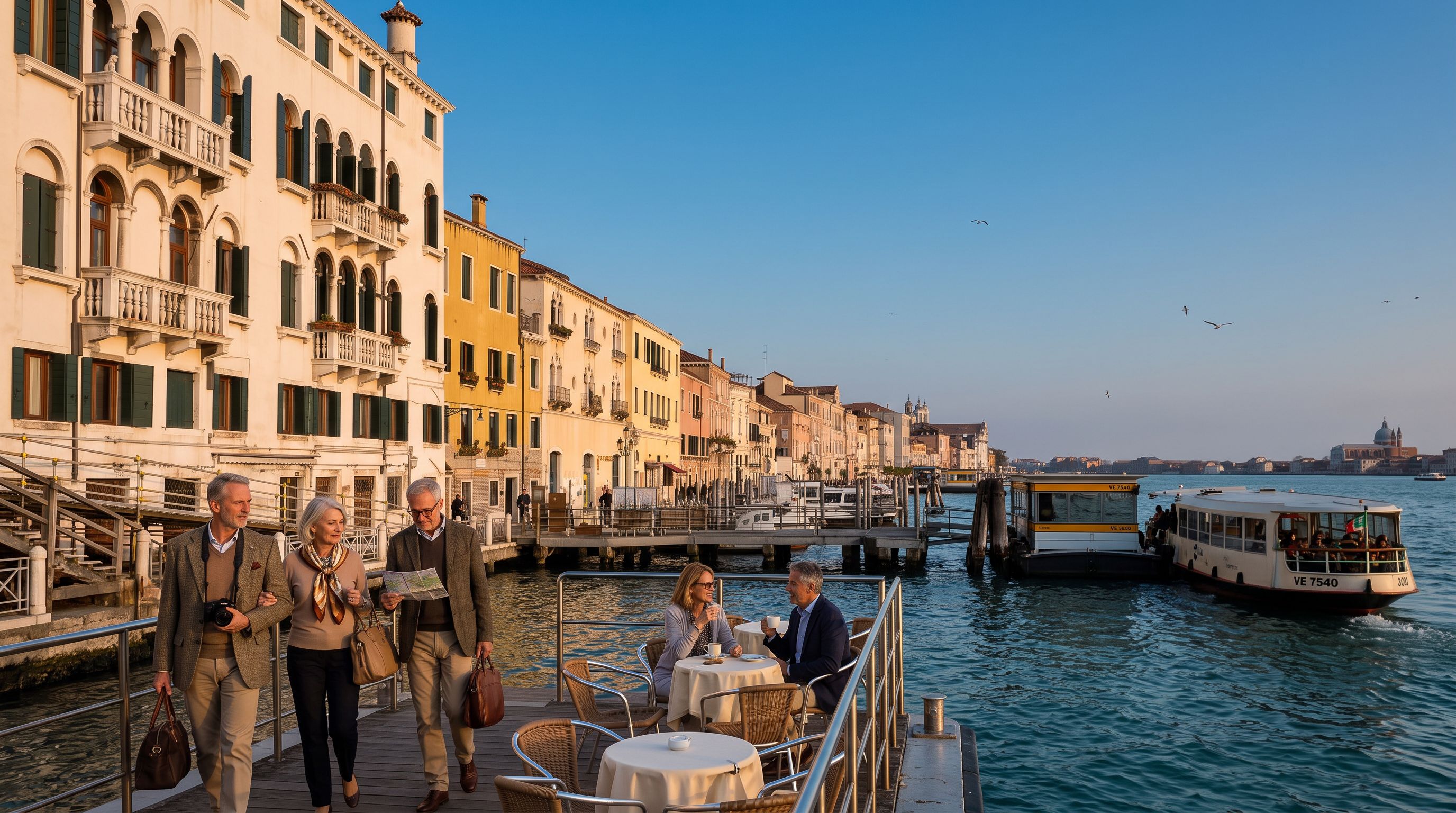
A vaporetto ride replaces hours of bridge climbing with a seated cruise past the same palaces and churches. Line 1 covers the Grand Canal end to end in about 65 minutes across 21 stops, and the city's public-transport page states that all vaporetto landing stages are accessible, so boarding rarely involves stairs.
The city itself frames the problem plainly. Its accessible-Venice pages note that the bridges make the city difficult to move about in not only for people with reduced mobility but also for the elderly carrying shopping, parents with prams and visitors with luggage. Boats sidestep that entirely.
Line 1 is the classic full-length canal ride, stopping at every landing stage. Line 2 uses the same axis with fewer stops and is described as the quicker choice for reaching San Marco from Piazzale Roma, taking roughly 35 to 40 minutes. Both lines admit up to four wheelchairs at a time on the Grand Canal, according to the municipality's public-transport page.
For a fuller picture of routes, passes and water-taxi etiquette, our guide to getting around Venice by vaporetto and water taxi covers the practical detail.
 AI-edited
What does the vaporetto cost, and which ticket makes sense?
A single ACTV waterbus ticket is €9.50 and valid for 75 minutes. The 24-hour pass is €25, 48 hours €35, 72 hours €45 and seven days €65. For a low-walking trip built on repeated short hops, a multi-day pass usually pays for itself within three rides.
Those are the published 2026 fares. The arithmetic favours passes for anyone planning to use the boat as their primary transport rather than an occasional treat, which is exactly the pattern this style of trip produces.
One point worth knowing before you budget: the city's FAQ states there is no senior discount for tourists on vaporetto services. Reduced fares apply to wheelchair users and disability-card holders, not to age alone. A special price of €1.50 applies for wheelchair users and includes the accompanying person's fare, as set out on the municipality's public-transport page.
For museum-based sightseeing, the picture is different. MUVE, which runs Venice's civic museums, is the clearest source for an over-65 reduced fare, including at Museo Correr.
| Ticket | Price | Validity |
|---|---|---|
| Single | €9.50 | 75 minutes |
| 24-hour pass | €25 | 24 hours |
| 48-hour pass | €35 | 48 hours |
| 72-hour pass | €45 | 72 hours |
| 7-day pass | €65 | 7 days |
Which sights sit right by a boat stop?
Several major sights are a short, level walk from a Line 1 landing stage. San Zaccaria serves the St Mark's area, Accademia serves the Gallerie dell'Accademia, Salute serves the Peggy Guggenheim Collection, and Rialto serves the market and bridge district.
The key is choosing stops where the sight is close to the water, so the bridge problem never arises. The municipality's accessible-map page classifies areas by whether they are accessible by vaporetto, by motoscafo or facilitated bridge, or not accessible by public transport, which is the right document to consult before committing to a route.
- San Zaccaria — one of the ramp-equipped accessible stops named in official tourist material, and the closest landing stage to the St Mark's area.
- Accademia — on Line 1, serving the Gallerie dell'Accademia.
- Salute — on Line 1, a short walk from the Peggy Guggenheim Collection.
- Rialto — on Line 1, the major sightseeing stop for the market district.
- San Marco Vallaresso — on Line 1, cited as the point reached after the Grand Canal section.
The landing stage and the bridge are two different things; you can arrive by boat at Rialto without crossing it.
Where can you walk on the flat once you step off?
The Zattere in Dorsoduro is repeatedly identified as a flat waterfront promenade and one of the easiest low-effort walking areas. Flat or low-step stretches are also documented along Riva degli Schiavoni, in Cannaregio, in Santa Croce, and in parts of San Polo and Dorsoduro.
These are the zones to build a day around. The official accessible guide material points to flat waterfront stretches such as the Zattere as an especially easy walking segment, and Cannaregio's canal-side routes are documented as flat quays and easier walking corridors, recommended as senior-friendly compared with bridge-heavy alternatives.
Forum contributors who travel with mobility limitations describe the same pattern: walk around as much as you want without crossing bridges, then catch another vaporetto and repeat. The recurring observation in those threads is that walking in Venice is hindered mostly by bridge steps rather than by long continuous streets.
What about the bridges themselves?
The modern Ponte della Costituzione near the station is singled out as the most mobility-friendly Grand Canal crossing, with a lift.
Three Grand Canal crossings matter for planning, and the documentation on two of them is not consistent.
- Ponte della Costituzione (Calatrava Bridge) — near Piazzale Roma and Santa Lucia station, repeatedly identified as the most accessible Grand Canal crossing, with a lift or gondola-style lift for wheelchair users.
- Rialto Bridge — steps only, with no ramp documented in the sources used here. Crowding near the main Grand Canal crossings is also mentioned as a difficulty.
- Accademia Bridge — one source says steps only, another says it is among the bridges with elevators.
- Ponte degli Scalzi — one source says steps only, another says there is a ramp on the Cannaregio side.
Where sources disagree, the honest position is that the current setup should be verified before travel rather than assumed. Ask at your hotel, or check with the operator on the day.
Temporary ramps are reported during major events such as Carnival and Regata Storica on bridges near event routes, which is worth knowing if your visit coincides with either.
Is a private water taxi worth it for touring?
Water taxis are consistently recommended as a way to avoid bridge-heavy walking altogether, alongside the vaporetto. What the gathered official material does not document is fixed sightseeing fares or published touring prices for water taxis in Venice, so any figure you are quoted should be confirmed directly with the operator.
use vaporetto and, where needed, water taxis to avoid bridge-heavy walking. They are silent on the pricing structure for touring by private boat.
Where a water taxi earns its place is at the edges of a trip, arriving from the airport or the station with luggage, and for a single indulgent cruise along the canal in the evening when the palaces are lit. For day-to-day movement, the vaporetto network does the same job for a fraction of the cost.
If you are considering a hotel with its own boat service, our dossier on the Belmond Hotel Cipriani on Giudecca covers what that arrangement actually involves.
Which museums and sights are easiest to reach and enter?
Several major sights publish specific access arrangements. St Mark's Basilica has a ramp at the Porta dei Fiori, the Doge's Palace has a lift with staff guidance, the Gallerie dell'Accademia has a barrier-free entrance in Calle della Carità with lifts to the first floor, and the Peggy Guggenheim Collection has wheelchair lifts and free wheelchair loan.
The Gallerie dell'Accademia is closed on Mondays, and its accessibility page reports temporary room closures and unavailable lifts, so it asks mobility-impaired visitors to check the notices for route updates. In 2026 the gallery, with the Didatticando Association, offers free tours for vulnerable audiences with a focus on inclusion.
The Peggy Guggenheim Collection is open daily from 10 a.m. to 6 p.m., closed Tuesdays and 25 December. Admission is free for visitors with limited mobility and their care partners, wheelchairs are available free of charge at the entrance, and several platform lifts connect the spaces. It also offers free tactile tours by request for blind or visually impaired visitors.
Museo Correr has a small lift and asks visitors to call in advance to arrange the best access and assistance. Its own accessibility page notes that the museum occupies a listed historic building where the flooring may have slight slopes, raised thresholds or steps of uneven height, and that the Secret Itineraries, Prisons and Armoury are not accessible. Regular visits are fully accessible, ground-floor toilets are fully accessible, and the cloakroom is free. Suitcases and bulky luggage are not permitted in the museum areas.
When is the least tiring time to be out?
Travellers report that the busiest periods come from daytime tour groups and cruise passengers, and that early mornings are easier.
Forum threads on Venice note that evenings are very quiet and that crowds thin out sharply away from tour-group hours. The same threads recommend scouting a route in daylight first, because Venice looks and feels different after dark, and note that most paths are lit though a small flashlight is useful in darker sections.
One seasonal factor is documented officially: high tides can make access ramps slope excessively, which the municipality's public-transport page flags as a caveat to the general accessibility of landing stages. That is the one Venice-specific seasonal effect the official material records for this topic.
No month-by-month operating calendar for the accessibility routes is documented here, and no general closed-day pattern for those routes is published. For exact opening or maintenance closures, check with the operator directly.
What else should a low-walking visitor plan for?
Stay near a vaporetto stop, keep outings short, and build in cafe breaks. Forum consensus for travellers who want less walking is to use the boat network to divide Venice into short manageable pieces and to expect bridges, not distance, to be the main physical challenge.
Several practical points recur across traveller reports. In Venice you cannot simply hail a taxi to get back if you tire or lose your bearings, so route planning matters more than in most cities. The maze-like streets make getting lost common, so noting landmarks on the outbound walk helps on the return. Route-planning tools with an "avoid stairs" setting are recommended by some travellers, which is especially relevant where bridges force extra stair climbing.
One caveat on the boats themselves: a Rick Steves forum post warns that although the vaporetto is useful, there may be very few seats and many passengers stand. Senior seating exists on some boats, according to another post on the same forum. Boarding early at a terminus such as Piazzale Roma improves your chances of a seat.
The emergency number that applies locally in Italy is 112. The Venice hospital switchboard is +39 041 529 1111, though that is a hospital contact rather than a general emergency line.
For a broader look at structuring a stay, our three-day Venice itinerary for the over-50s sets out a sequence built on the same principles. If you would rather hand the logistics to someone else, our guide to small-group and guided tours of Venice explains how organised options work. And for the wider question of accessible routes across the city and lagoon, the municipality's accessible Venice pages and barrier-free itineraries are the official source.
One final piece of planning information: the municipality's public-transport page states that all vaporetto landing stages are accessible, with the high-tide caveat noted above. That single fact is what makes a boat-first Venice trip work.


