
Located in the heart of the Austrian Tyrol, the Zillertal valley offers a rare combination for the active, curious traveller over 50: genuine alpine grandeur without the punishing physical demands. This five-day itinerary is built around one comfortable base, using the valley’s excellent lifts and the charming Zillertalbahn railway to explore the region’s highlights. We have designed each day for a gentle pace—one main outing, a relaxed afternoon—with optional, more challenging alternatives noted for those who want them. The goal is not to conquer every peak, but to absorb the landscape, breathe the mountain air, and return home rested and enriched.
Why choose the Zillertal for a five-day trip?
The Zillertal is an ideal choice for travellers over 50 because its valley floor is largely flat, every Zillertalbahn train is equipped for wheelchair users, and the four feeder cable cars at Mayrhofen offer step-free boarding, making the high alpine world surprisingly easy to reach. Zillertal Tourismus counts just under 7.7 million overnight stays and more than 1.6 million guest arrivals in the 2024/25 tourism year, yet the valley retains a working agricultural character. You will see dairy farms and family-run inns alongside modern lift infrastructure. The valley’s strong musical traditions, including the spread of the carol “Silent Night,” add a layer of cultural depth that rewards a slower, more deliberate visit.
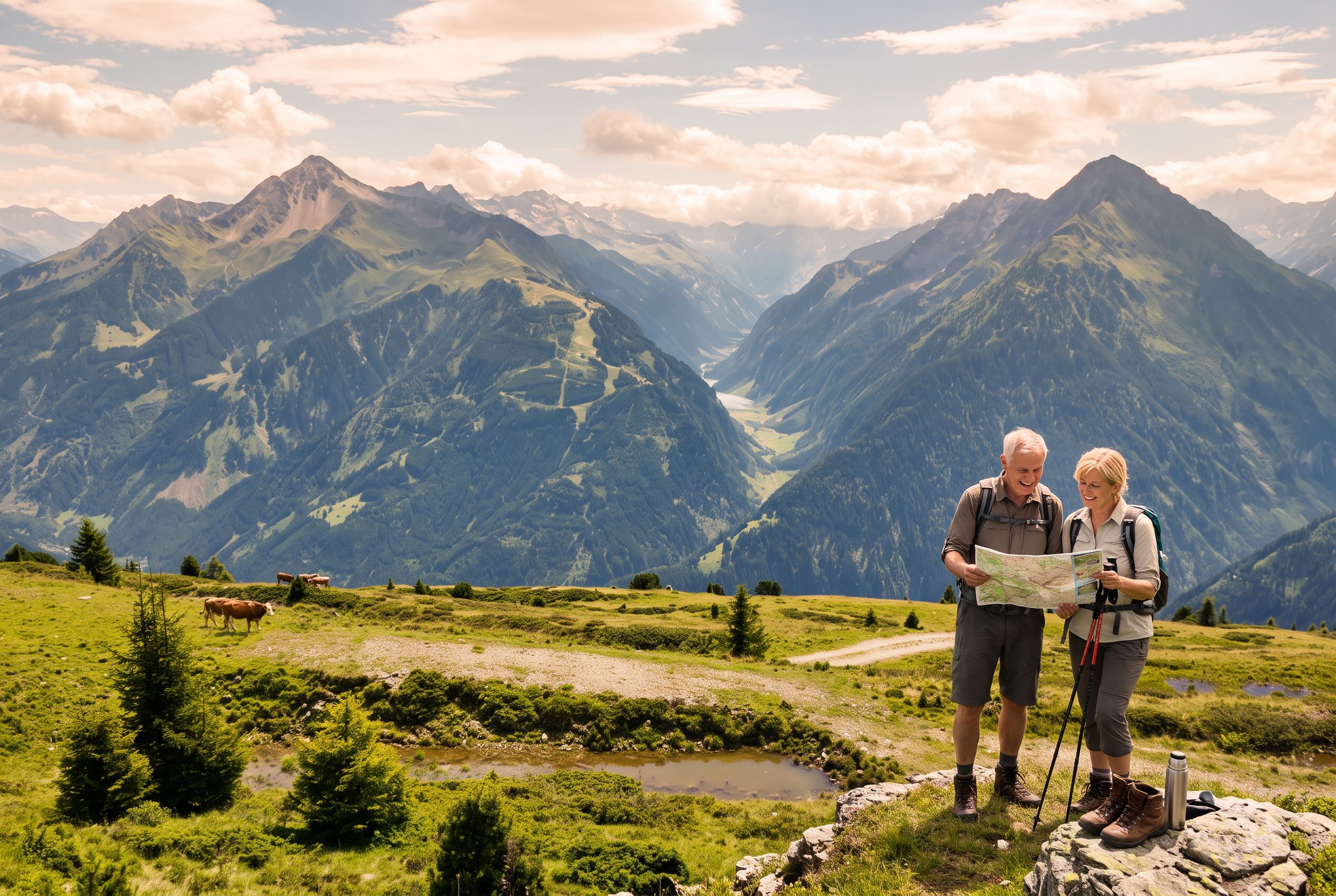 AI-edited
Where should I base myself for five days?
For a five-day stay, choose Zell am Ziller or Mayrhofen as your base. Zell am Ziller offers a flatter, more compact centre ideal for easy walking, while Mayrhofen provides the widest choice of lifts, restaurants, and services, albeit with more bustle and some hills. Both towns are well-served by the Zillertalbahn and valley buses. This itinerary is written from Zell am Ziller, but works equally well from Mayrhofen if you prefer more options on your doorstep. The key is to stay in one place and let the valley’s transport network do the work.
Day 1: Arrival, orientation, and the Zillerpromenade
Your first day is for settling in. Arrive via the Zillertalbahn from Jenbach, a scenic journey of about 50 minutes, and then take a gentle afternoon stroll along the Zillerpromenade, the riverside path that starts at the Ziller bridge in Zell am Ziller. The signed loop measures 3.5 kilometres and takes about an hour; walked in full, the valley path reaches Hippach after 4 kilometres and Mayrhofen after 8. The Zillertal Arena calls it suitable for families with prams, but makes no wheelchair claim. It is the perfect introduction: easy, scenic, and immediately grounding. After your walk, find a café in Zell’s compact centre and enjoy a slice of Apfelstrudel while you watch the village settle into evening.
For those arriving by car, be aware of the ongoing Brettfall Tunnel refurbishment. Zillertal Tourismus scheduled single-lane traffic through the tunnel from 13 April to mid-July 2026, with the whole refurbishment due for completion in summer 2026; traffic may still be regulated at times until then, so allow extra time. The official Zillertal tourism site provides up-to-date travel information.
| Route | Distance | Time | Difficulty |
|---|---|---|---|
| Zillertalbahn (Jenbach to Mayrhofen) | 32 km | ~50 min | All trains wheelchair-equipped |
| Zillerpromenade (signed loop from Zell) | 3.5 km | ~1 hour | Level, prams welcome |
Day 2: A gentle mountain day on the Penkenbahn
Take the Penkenbahn in Mayrhofen, a three-cable gondola that climbs 1,135 metres to the Penken plateau, for a smooth, panoramic ride. At the top, you will find level walking paths, several restaurants with sun terraces, and stunning views of the Zillertal Alps—all without breaking a sweat. The cabins are large and modern, and the ride takes about eight minutes. As of August 2026, the Penkenbahn holds a Google rating of 4.7/5 from 6,283 reviews, a testament to its efficiency and appeal.
Spend a couple of hours walking the easy trails near the top station. You can stop for a coffee at one of the mountain huts—the Bergrast is the one the Austrian cable-car association lists as barrier-free from the Penkenbahn. The lift runs from 23 May to 4 October 2026, 08.30 to 17.00, with the last ascent at 16.30. If you feel energetic, a graded hike down to the middle station is possible, but the lift down is always an option. Return to Zell am Ziller in the early afternoon for a rest or a visit to the local bakery. This day is deliberately light, leaving room for the more dramatic outing tomorrow.
Day 3: The Hintertux Glacier and Nature’s Ice Palace
This is your signature high-alpine day. Take bus line 4104 from Mayrhofen to Hintertux, about 40 minutes, then ride the three glacier gondolas to the top at 3,250 metres, an ascent of about 45 minutes. The lift ride and the panorama terrace are the easy part of the day; Nature’s Ice Palace, the glacier cave below the top station, is a guided tour with real physical requirements. The Austrian cable-car association records step-free boarding on the glacier gondolas and a barrier-free ascent as far as the panorama terrace. The barrier-free restaurants and toilets lie lower down, at the Sommerbergalm (2,100 m) and the Tuxer Fernerhaus (2,660 m); there is no toilet and no restaurant at 3,250 metres itself.
The Ice Palace can be visited only on a guided tour, and the operator is precise about what it asks. The approach from the top station runs about 200 metres over snow, half of it downhill on the way there and uphill again afterwards; firm ankle-high boots are recommended, and there are short iron ladders of up to 1.5 metres inside. Visitors are asked to be physically fit and mobile, sure-footed, free of cardiovascular and respiratory conditions, and untroubled by confined spaces. If any of that gives you pause, the panorama terrace at the top station is the better plan, and it is reached without leaving the lift network. Inside the cave you will see ice formations, tunnels, and an ice chapel. The Extended Tour runs daily at 10.30, 11.30, 12.30, 13.30 and 14.30 and lasts about 70 minutes. As of August 2026 the glacier lifts run all year from 08.15 to 16.30, with the last ascent at 15.00, and the climb alone takes about 45 minutes each way, so allow at least four hours from the valley station. The altitude is noticeable, so take it slowly, drink water, and wear warm layers—even in summer, the glacier is cold. Return to the valley by mid-afternoon for a well-earned spa visit or a quiet read.
“The Ice Palace is beautiful! Truly worth visiting, you can ski to site or ride the gondola and walk over, it’s warmer than you’d think inside too. This is incredible work of nature and a bucket list to-do.” — a guest wrote about the Natureispalast on Google in November 2025
Day 4: The Zillertalbahn scenic railway and a spa afternoon
Let the train do the work today. Ride the Zillertalbahn from Zell am Ziller south to Mayrhofen, then continue to Jenbach in the opposite direction, watching the valley unfold from your window. In the afternoon, return to your base for a spa session at your hotel or a local wellness centre. The railway is one of the most senior-friendly ways to experience the region. The VVT timetable shows for each connection whether the train is low-floor and whether a wheelchair space and accessible toilet are on board; the space can be reserved on +43 5 17 17 5. The journey from Zell am Ziller to Jenbach takes about 40 minutes and passes through charming villages, farms, and forests.
For a cultural stop, consider getting off at Zell am Ziller to visit its Baroque parish church, known locally as the Zillertal Dom. Building began in 1772 to plans by the Salzburg court architect Wolfgang Hagenauer; the shell was finished in 1779 and the interior in 1782, and the tower survives from the earlier church on the site. It is a quiet, beautiful space that speaks to the valley’s history. After your train ride, indulge in a spa afternoon. Many hotels in Zell and Mayrhofen offer thermal pools, saunas, and treatment rooms. This is the day to truly relax, letting your muscles recover from the glacier outing. For more on the valley’s seasonal rhythms, see our guide to the Zillertal through the year.
Day 5: A flexible final day—choose your adventure
Your last day is a buffer. Choose one low-effort option: a repeat visit to a favourite lift, a flat lakeside walk at Schlegeis Stausee, or a heritage stop at a local distillery or brewery. The key is to leave the day unscheduled, allowing for weather, energy levels, and spontaneous discoveries. The Schlegeis Stausee reservoir is about 50 minutes from Mayrhofen station on bus line 4102, which runs daily from 30 May to 4 October 2026. The Austrian Alpine Club lists the 6.5-kilometre lakeside loop as barrier-free: asphalt from the car park as far as the Zamser Eck, then a level gravel track along the water, with 16 metres of ascent in the whole circuit. It warns, though, that the ramp up to the Fischerhütte is very steep and hard to manage in a wheelchair, and VERBUND, which operates the dam, says the tour inside the dam wall cannot be done barrier-free. Alternatively, take the Gerlossteinbahn in Hainzenberg, fourteen minutes by bus from Zell am Ziller, and follow the Almpromenade to the Almtribüne viewing platform: two kilometres and about 45 minutes each way. The lift runs from 4 June to 18 October 2026, with a midday break from 12.15 to 13.00.
For those who want a final cultural touch, consider a guided tasting at a local distillery, where you can sample schnapps made from Zillertal fruits. The valley’s traditions of hospitality and craftsmanship are on full display in these small, family-run operations. Before you leave, ensure you have checked the health and pharmacy guide for any last-minute needs. Pack your bags, enjoy a final dinner at your favourite local restaurant, and reflect on a week well spent in the Alps.
What if I want more active options?
For fitter travellers, each day offers a more challenging alternative. On Day 2, you could hike from the Penken top station down to the middle station. On Day 3, consider a guided walk on the glacier’s edge (with proper equipment). On Day 4, swap the spa for a valley-floor cycle on the Zillertal cycle path. The Zillertal also has a summer toboggan run, the Arena Coaster at Rohr in Zell am Ziller; the PistenBock sledging track at the Ahorn, by contrast, is a winter offer on a marked piste. These options are noted for those who want them, but the core itinerary is designed for a relaxed, comfortable pace.
For a more ambitious day, the Schlegeis Stausee area offers a hike to the Olpererhütte and its famous suspension bridge. VERBUND puts the hut at 2,389 metres and the ascent from the reservoir at about 1.5 hours and 600 metres of climb; as one review left on Google in June 2025 describes it, the path is “rocky and not the easiest, but manageable”. Treat it as an optional high-energy day rather than a default plan. Always check lift operating dates and weather conditions before heading out. Zillertal Tourismus publishes the summer bus and rail timetables for the whole valley, which makes it easy to adjust your plans on the fly.
Practical tips for a smooth trip
Book barrier-free accommodation early, as level-access rooms are limited. Pack layers and good walking shoes, as weather in the Alps can change quickly. Use the Zillertalbahn and valley buses to avoid parking hassles, and always check lift operating dates before travelling. The valley’s accessibility infrastructure is strong but not universal. For regional buses the VVT publishes no low-floor information online and asks passengers with reduced mobility to contact the operating bus company in advance. And while the Mayrhofner Bergbahnen document step-free boarding on their four feeder lifts, and Hintertux is barrier-free as far as the panorama terrace, some smaller lifts are not.
For health and peace of mind, our dedicated guide covers pharmacies and medical facilities in the Zillertal. The nearest hospital is the Bezirkskrankenhaus Schwaz, about 35 kilometres and roughly 35 minutes by car from Zell am Ziller; its emergency department is staffed around the clock, and the Austrian ambulance number is 144. For those concerned about mobility, the valley’s official accessibility PDF, available from the Zillertal tourism office, details step-free routes and accessible facilities. Finally, late May to early October is the window in which the summer lift network runs, and it brings the mildest weather and the easiest walking conditions with it.


