
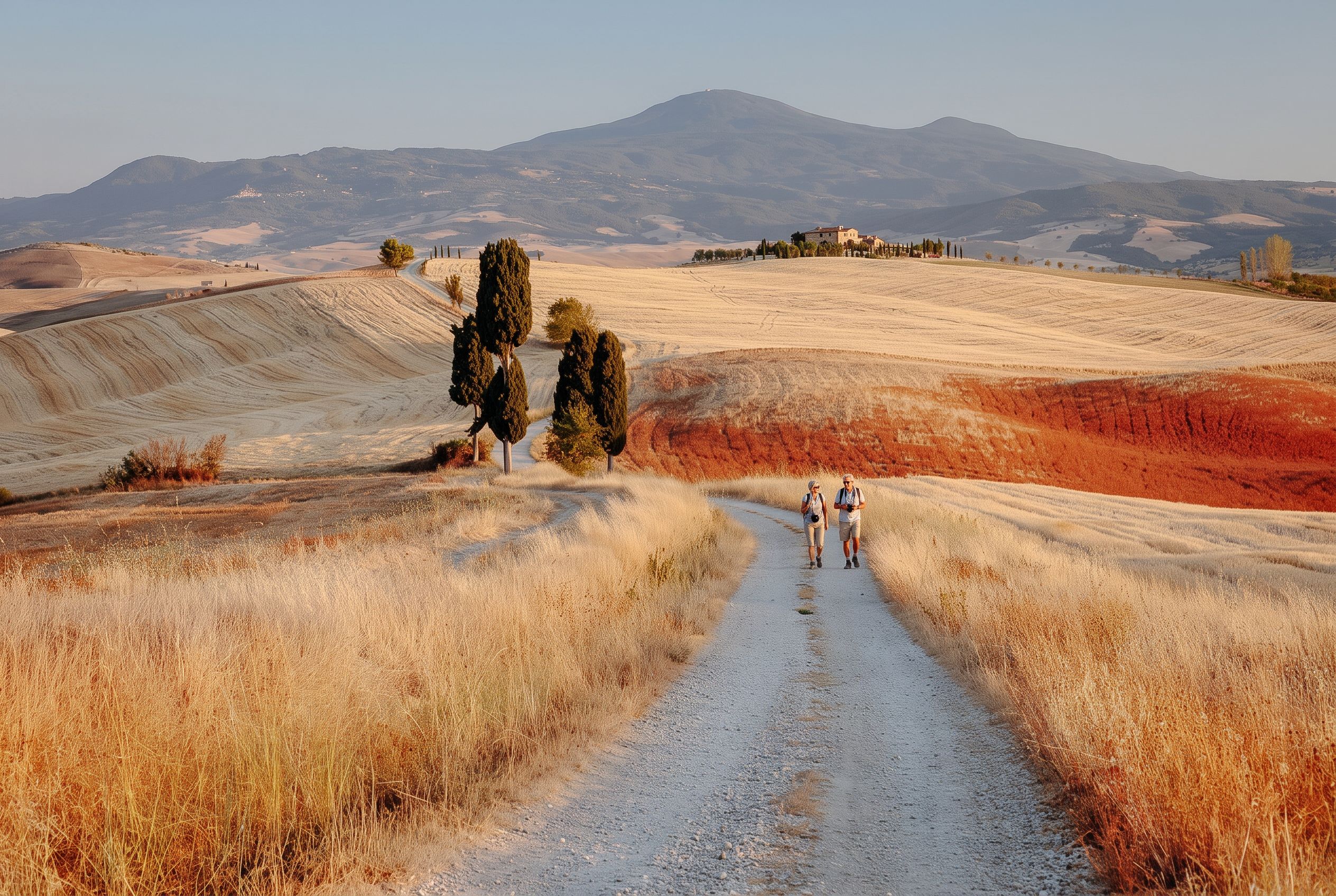
Tuscany rewards the traveller who resists the urge to climb. For those aged 50 to 70 who prefer less walking, the region's genius lies in its roads, its terraces and its tables. The Val d'Orcia unfurls from a car window in a way no hilltop ascent can match, and the finest wineries pour their best work at a seated table. This guide keeps your feet rested and your eyes wide open.
The countryside is best explored by car or private driver, with scenic areas like the Crete Senesi and Val d'Orcia enjoyed from the car window. A 2026 senior-travel guide describes this as the ultimate senior-friendly Tuscany experience, noting that a private driver lets travellers stop for photos, lunch and wine without worrying about parking or luggage. SITA buses connect Florence with many hill towns for those who prefer not to drive.
 AI-edited
Which hill towns should you admire from below rather than climb?
Choose towns where the reward sits at the car park or the valley floor: Monticchiello, Castiglione d'Orcia and Monteriggioni all reveal their character without a steep ascent. Save your energy for level ground and let the hills provide the scenery.
Forum discussions about towns for elderly travellers specifically ask about places with parking at the top, funiculars and escalators. A Fodors thread warns that even short distances can become a really steep hike into the hill towns, despite the countryside approach being fairly easy walking. The practical question is not whether a town is beautiful, but how much uphill walking it demands.
Monticchiello, a fortified hamlet within Pienza rather than a separate municipality, sits on scenic routes rather than requiring a long town climb. Castiglione d'Orcia is a stone borgo in the UNESCO Val d'Orcia at 540 metres, with fortresses overlooking the road from Amiata to the Via Francigena. Monteriggioni's walls can be seen from the highway passing below it, a perfect model of admiring from below, though it lies outside the Val d'Orcia proper.
What are the best Val d'Orcia drives for minimal walking?
The Val d'Orcia is car recommended, with limited public transport. A circular drive through medieval villages, cypress groves and isolated farmhouses delivers the region's essence without demanding a single steep climb.
The official Val d'Orcia tourism site gives driving approaches from the south via the A1 Chiusi-Chianciano or Valdichiana exits, and from the north via the Florence-Siena freeway and Cassia toward Rome. A published route guide describes a circular drive linking San Quirico d'Orcia, Rocca d'Orcia, Castiglione d'Orcia, Vivo d'Orcia and Campiglia d'Orcia, passing Romanesque churches, castles and isolated farmhouses.
A route page gives a 39-kilometre Val d'Orcia scenic drive from Montepulciano to Montalcino, estimated at one to two days, with stops including La Foce cypress avenues, Pienza and the Vitaleta Chapel area. A Tuscan scenic-drive guide identifies a top route beginning in San Quirico and following the SR2 south toward Poggio Covili before continuing toward Monticchiello and Pienza. An agriturismo route page gives a circa 70-kilometre drive through the countryside with a stop near Villa to admire the cypress road, naming Pienza, Monticchiello, Orcia DOC cheese farms and wineries, and Montepulciano.
A Val d'Orcia guide published in 2026 says the SR2 between San Quirico and Gallina is a classic scenic stretch with fast traffic, while the SP146 between Pienza and San Quirico has open views and variable traffic. It also notes the Castiglione to Radicofani road as wilder and slower. A separate 2026 scenic-drives article advises choosing fewer roads, driving them slowly, and using Tuscany's small pleasures, vineyard lunches and village squares, rather than packing in many walking stops.
| Route | Distance | Driving time (clear roads) |
|---|---|---|
| Montepulciano to Pienza | 14 km | About 15 minutes |
| Pienza to San Quirico d'Orcia | 10 km | About 10 minutes |
| San Quirico d'Orcia to Castiglione d'Orcia | 9.2 km | About 10 minutes |
Where can you stop along the drives without a long walk?
Plan stops around car parks, viewpoints and village edges. The Val d'Orcia's beauty is best absorbed from a parked car, a terrace or a bench, not from the middle of a cobbled climb.
The official Val d'Orcia portal lists local tourist offices in Castiglione d'Orcia, Montalcino, Pienza, Radicofani and San Quirico d'Orcia, each offering tourist information, a reservation centre, guided tours and museum tickets. These offices can help plan a route that minimises walking.
A Rick Steves forum post says to plan enough time to stop and dawdle in the towns along the Chiantigiana, the SR222 from Florence to Siena repeatedly cited as one of Tuscany's best scenic roads. The same advice applies to the Val d'Orcia: the dawdling happens at the car park, the viewpoint and the café table.
Which wineries offer tastings at the table?
Seated tastings at a private table are the normal format across Tuscany, usually lasting one to one and a half hours. Many Chianti wineries are equipped for visitors with mobility issues, and some Val d'Orcia estates work by reservation only.
A Tuscany wine-tour FAQ says tastings are seated, at a private table, and usually last between one and one and a half hours. The same FAQ says tastings are usually private or small-scale rather than walk-in counter tastings. A Tuscany wine-tasting guide says there is no obligation and no minimum purchase after a tasting.
Castiglion del Bosco in Montalcino states that visits and tastings are made only upon reservation. Visit Tuscany says many Chianti wineries are equipped to be accessed by people with mobility issues for tours and tastings. The same source documents three accessible looped routes in Chianti starting from Castellina in Chianti, Barberino Tavarnelle and Castelnuovo Berardenga, with two more being completed in San Casciano in Val di Pesa and Tavarnelle.
The Association Via Romea Sanese provides nine Joëlettes and two electric Trirides free of charge upon reservation for use on these routes. Some routes can be used independently by people with mobility issues using off-road wheelchairs. For a closer look at one notable estate, see our dossier on Rosewood Castiglion del Bosco.
Why is Lucca the easiest historic city to enjoy on foot?
Lucca's Renaissance city walls form a flat, tree-lined promenade of about 4 kilometres around the historic centre, with benches and shade. This is the clearest low-effort sightseeing option documented in Tuscany.
A Fodors forum post describes Lucca as the flat hill town, adding that it has a nice wall turned park, which makes it attractive for people who want a historic Tuscan place without steep climbs. The wall circuit is flat and even, offering easy walking with benches and shade along the way.
The walls have been repurposed as a walkable promenade, a defining historic feature of the city. The wall walk is described as easy and calm, positioned as a relaxed day activity. For those who prefer not to walk the full circuit, the walls offer numerous access points where you can enter, enjoy the view, and return the same way.
Lucca sits 75 kilometres from Florence by road, about 45 minutes with clear roads, making it a practical base or day trip. For broader transport planning, see our guide to getting around Tuscany by train, bus or car.
How can you enjoy Florence without excessive walking?
Florence's historic centre is relatively flat and manageable, with accessible museums, elevators in many museums and a step-free tram system. Stay central, book museum tickets in advance and use taxis for longer distances.
The city is described as compact and easily walkable, though the Duomo and Santa Croce area gets extremely crowded in high season. Some visitors prefer the quieter Oltrarno side and an easy stroll across the bridge back to the centre. The historic centre has uneven paving and crowds can be intense, so plan rest breaks and long lunches.
Florence's main art museums, including the Uffizi and Accademia, are highlighted as major attractions for senior travellers. Skip-the-line advance booking is advised for these major sites. The tram system is step-free, and tram line T2 is accessible with four anchored wheelchair spaces per tram. Many museums have lifts and accessible routes.
A Rick Steves forum post describes Florence as compact and easily walkable, but notes the crowds. Taxis are recommended for longer distances, and rest breaks are advised. Confirm hotel lifts and step-free access before booking, as historic buildings often lack elevators and have stairs.
What does Pisa offer at square level?
The Piazza dei Miracoli's monuments and museums are fully accessible, with the single exception of the Leaning Tower, which has 251 steps and is not accessible to people with mobility disabilities. Enjoy the square and cathedral without climbing.
Visit Tuscany documents that the square's monuments and museums are fully accessible except the Leaning Tower. The Cathedral and square-level attractions are the low-walking part of a Pisa visit. The square itself is level and open, allowing visitors to appreciate the ensemble of buildings without exertion.
The Leaning Tower's 251 steps make it inaccessible to people with mobility disabilities, a fact clearly documented. For those who cannot climb, the square offers abundant views of the tower from every angle, and the Cathedral interior rewards a visit without any stair climbing.
Can Siena work with minimal walking?
Siena is walkable but hillier than Florence or Lucca, with uneven streets and more vertical change. Use taxis for the last mile, keep visits to three or four hours, and consider Piazza del Campo at dusk.
Forum discussions group Siena with other easy-access Tuscan places, implying the practical question is how much uphill walking is involved and whether transport or parking reduces it. The city is described as hillier than Florence or Lucca, with uneven streets and more vertical change.
A published guide recommends using taxis for the last mile and keeping visits short, limited to three to four hours. Piazza del Campo at dusk is recommended in one source as a particularly atmospheric time to visit. The famous square itself is level once you arrive, and the surrounding cafés offer seated views of the city's life.
Siena sits 69 kilometres from Florence by road, about 65 minutes with clear roads. Montalcino is 43 kilometres from Siena, about 50 minutes with clear roads, making a Siena base practical for Val d'Orcia exploration.
What accessible routes exist in Chianti?
Chianti offers three accessible looped routes starting from Castellina in Chianti, Barberino Tavarnelle and Castelnuovo Berardenga, with off-road wheelchairs available free of charge upon reservation.
Visit Tuscany documents these routes as usable independently by people with mobility issues. The Association Via Romea Sanese provides nine Joëlettes and two electric Trirides free of charge upon reservation. Some venues along the routes have accessible facilities and elevator access in specific museums.
The routes support mobility issues on rough terrain, and some wineries are accessible for tours and tastings. Chianti is best handled by car or private driver, with the sources emphasising scenic drives and seated visits rather than walking. The SR222, or Chiantigiana, from Florence to Siena passes through the heart of the region.
What practical details should you confirm before you go?
Confirm hotel lifts, step-free access and bathroom layout before booking, as historic buildings often lack elevators. Driving into historic centres can trigger fines in restricted traffic zones, so arrange permits through your hotel.
The Val d'Orcia official portal states that people with disabilities who have supporting documentation can freely access the LTZs, the restricted traffic zones common in Tuscany's historic centres. Hotels may be able to register cars or arrange permits for these zones.
Taxis in the Val d'Orcia must always be white and cannot be stopped on the street, according to the official portal. Plan taxi use by phone or through your accommodation. Public transport can involve stairs, and not all trains are step-free, so first- and last-mile taxis may be needed for mobility reasons.
For those over 65, Autolinee Toscane states that special fares are available depending on personal income, with some income positions receiving a 40 per cent fare reduction. These special fares require Tuscany residency and an ISEE certificate below a stated threshold. Trenitalia's Senior Offer gives up to 50 per cent off for CartaFreccia and X-GO members over 60 on certain services, while FrecciaSENIOR offers tickets at €29 or €39 on high-speed routes. For seasonal planning, see our guide to Tuscany through the year.
How do you structure a low-walking Tuscany visit?
Base yourself in Florence or Lucca, use a private driver or taxis for Chianti and the Val d'Orcia, and favour seated experiences: wine tastings, farmhouse lunches and guided transfers over self-guided hill climbing.
The calmest, easiest way to do Tuscany, according to the sources, involves exactly this structure. A week based in Florence or Lucca allows day trips by car or driver into the countryside, returning to flat, manageable evenings. The Val d'Orcia works as a two or three day circuit, staying in one of the valley towns and driving the scenic roads each day.
For a fuller itinerary built around these principles, see our week in Tuscany for the over-50s. The essential rhythm is simple: drive in the morning, lunch slowly, taste wine seated, and return before the crowds build. Tuscany's appeal for older travellers is repeatedly tied to long lunches, farmhouse tables and unhurried tastings rather than strenuous sightseeing.
The Accessible Tuscany section of the official tourism site offers barrier-free itineraries and travel suggestions, developed following specific guidelines to ensure everyone has access to content and features. The Val d'Orcia official portal provides practical information on LTZ access, taxi arrangements and local tourist offices.
The property does not publish step counts for every winery or viewpoint. Ask when booking. Rates across Tuscany are indicative and vary by season and booking channel. What remains constant is the region's capacity to reward the traveller who stays seated, stays low and lets the landscape come to them.


