
Hallstatt is a compact, UNESCO World Heritage lakeside village in Austria’s Salzkammergut region that rewards those who arrive without a car. The system is reliable, scenic, and surprisingly simple once you understand the ferry, the buses, and the walking routes. This guide covers exactly how to move around the village and the surrounding lakes without driving, focusing on the practical details that matter most to active travellers aged 50–70.
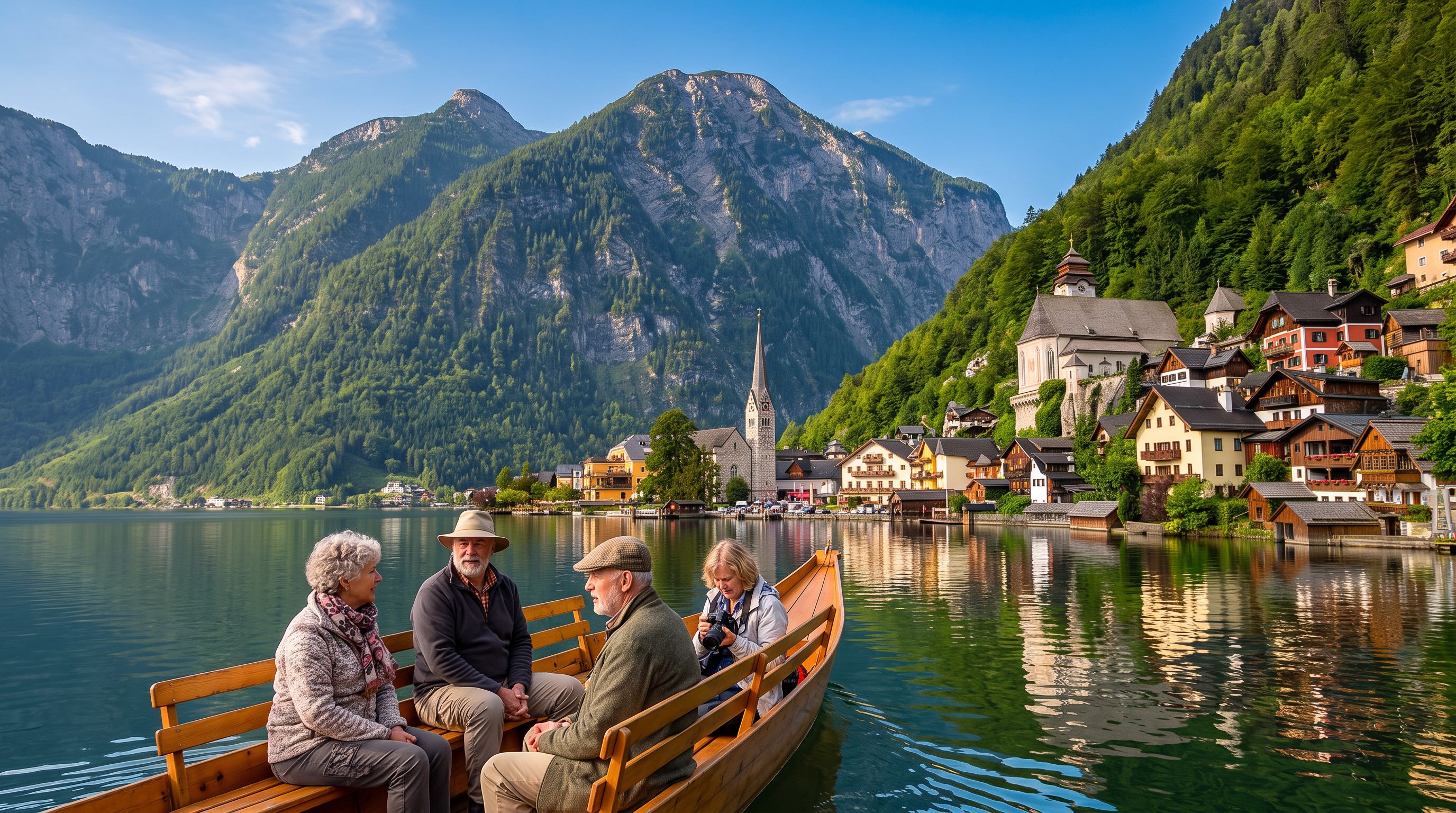 AI-edited
How do I get from the train station to the village?
The Hallstatt train station sits on the opposite side of the lake from the village. A mandatory seven-minute ferry ride connects the two, running year-round on a single timetable: the first boat leaves the station at 8.35 am, or 7.32 am on school weekdays, and the last at 6.30 pm. This is the single most important step to plan for.
The ferry, operated by the Stefanie and sister ships, is timed to the trains: leaving the village it casts off 14 to 22 minutes before the connecting service to Bad Ischl, and the operator warns that departure times can shift when a train runs late. This means you step off the train, walk the short platform to the dock, and board the boat. The crossing itself is a scenic bonus: you glide across Lake Hallstatt with postcard views of the village and the Dachstein mountains rising behind it. The fare is approximately €4 one-way as of 2026, and it is cash only—bring small notes and coins. Credit cards are not accepted on board. The Stefanie is listed by its operator as wheelchair accessible, and ÖBB rates Hallstatt station as step-free to the platform, with assistance recommended for blind and partially sighted travellers. The dock in town is next to the Evangelische Pfarrkirche (Lutheran church), placing you right at the edge of the historic core.
What are the bus options around the Salzkammergut?
Regional buses connect Hallstatt to Bad Ischl, Obertraun, and other lakeside towns. From Bad Ischl you take line 541, which runs on as line 543 from the Gosaumühle stop; the ride to Hallstatt Lahn takes about 40 minutes, followed by a 10-minute flat walk along the lake promenade to the market square. Single fares start at €3.00.
If you are coming from Salzburg, the most scenic route is Bus 150 to Bad Ischl, which the ÖBB timetable shows at 1 hour 12 minutes to 1 hour 30, then line 541 onward — it becomes line 543 at Gosaumühle. This avoids the train change at Attnang-Puchheim and allows a stop in Bad Ischl for a pastry at the famous Zauner bakery. Boarding arrangements vary from bus to bus, so if you have mobility concerns the train-and-ferry combination is the safer bet — the Stefanie is wheelchair accessible. Plan the last leg with care: there is no evening bus service from Bad Ischl towards Hallstatt, Gosau, Obertraun and Bad Goisern, and the last departure in that direction leaves Bad Ischl station at 6.16 pm. For those who prefer not to use standard buses, the Salzkammergut Shuttle runs daily from 7 am to 10 pm and is booked on +43 50 422 422 at least an hour ahead, at €6 per route for adults. One catch: around Bad Ischl and the Dachstein-Salzkammergut it will not serve stops that double as official OÖVV bus stops between 7 am and 6 pm.
For a deeper look at guided options that combine these routes, see our guide to Small-Group and Guided Tours of Hallstatt and the Salzkammergut: A Practical Guide for Travellers 50–70.
Is the Hallstatt-Dachstein funicular accessible?
The new funicular reopens on Saturday 29 August 2026 at 9 am, together with the salt mine. Its cabins carry 60 people, more than double the old capacity, and the ride itself is barrier-free. The mine tour is not: the operator states plainly that the salt mine is not wheelchair accessible.
The operator's own announcement records the last ride of the old funicular on 31 August 2025 and the closure of both railway and mine from 1 September 2025. From 29 August to 24 October 2026 the funicular runs 9 am to 6 pm and the mine admits its last tour party at 4.30 pm. From the panoramic lift you reach the Skywalk, and a walk of roughly 15 minutes then leads to the Knappenhaus, where the guided tour begins. The ferry keeps its own timetable and is unaffected by work on the mountain.
Where are luggage and steps an issue?
Dragging wheeled bags over cobblestones and narrow sidewalks is the most common complaint among visitors. The historic core has stone stairs, steep short climbs, and sidewalks that narrow sharply in places. Pack light—a small rolling suitcase or a backpack is ideal.
Guest reviews frequently mention that the pavement through the historic core is too narrow for two people to walk side by side once crowds, prams and wheeled luggage are added. The lakeside promenade from Hallstatt Lahn to the market square is flat and step-free, but once you enter the historic core, cobblestones and stairs are unavoidable. If you are staying at a hotel in the centre, ask ahead about elevator access. The Heritage Hotel Hallstatt, for example, spreads across three protected buildings that are not equally easy to reach: the main Kainz house has a lift and so does the Seethaler house, but the Stocker house has none, and the hotel asks guests with walking difficulties to say so when booking.
For a full breakdown of what to pack and how to prepare, read our guide on Packing for Hallstatt: Shoes, Steps and Mountain Weather.
How walkable is Hallstatt for seniors?
The village is highly walkable for those with moderate mobility. The lakeside promenade is flat, step-free and asphalted, with benches and photo spots. The historic core is moderate difficulty due to cobblestones and stairs, but most visitors cover the main sights in 3–5 hours.
On Google, as of August 2026, Hallstatt station is rated 4.6 out of 5 from 237 reviews and the market square 4.7 out of 5 from 1,311, with consistent praise for the compact layout and scenic walking routes. The Hallstatt Museum (Welterbemuseum) charges €12 for adults and €11 from age 60; neither the museum nor the regional tourist board publishes anything about step-free access, so ring ahead if that matters to you. The Bone House (Beinhaus) is the opposite of an easy stroll: the ascent runs up numerous steps or the slightly steeper Kirchenweg. The summer round-trip boat sails Hallstatt Markt to Obertraun in 25 minutes, May to September only. For a low-impact itinerary, start at the Lahn bus stop, walk the promenade north to the market square, visit the museum, then take the ferry back to the train station.
What are the best car-free routes to nearby lakes?
From Hallstatt, you can reach Obertraun (south end of the lake) by Bus 543 in nine minutes, or take the ferry to the train station and continue by rail to Bad Ischl. The Salzkammergut region is well connected by public transport, with buses and trains running hourly in peak season.
For a longer day trip, the Salzburg bus route described above is more scenic than the direct train and allows a stop in Bad Ischl for the famous Zaunerstollen. If you prefer to avoid the ferry entirely, you can stay on the train past Hallstatt station to Obertraun and take the bus from there — or, in season, the round-trip boat, which first calls at Obertraun at 11.25 am; its 4.30 pm sailing runs in July and August only. Senior fares are worth arranging before you travel: the ÖBB VORTEILSCARD Senior costs €31 a year and halves ÖBB standard singles, and inside the Upper Austrian network it earns you the reduced fare of €1.70 instead of €3.00 for one zone.
“Ferry service is well coordinated with train time table. So you can rely on them. The ferry fee is €4 pp for one way. It accepts only cash.” — from a Google review of Hallstatt station, April 2025
What should I know about the 2026 railway closures?
The summer closure between Attnang-Puchheim and Bad Ischl ran from 11 July to 2 August 2026 and is over. ÖBB has flagged one further round of work on the Salzkammergut line, provisionally 10 October to 2 November 2026 between Gmunden and Bad Ischl. The Hallstatt ferry is unaffected either way.
During a closure the train-to-ferry route still works, but you transfer to a replacement bus at Attnang-Puchheim or Bad Ischl and should allow extra time. The ferry keeps to its own timetable, so once you reach the Hallstatt station dock the crossing is unchanged. Before an autumn trip, check the ÖBB construction notices and the operator's own ferry timetable, published as a PDF for the whole year. If you are booking accommodation, consider staying overnight to avoid the day-trip crowds and give yourself flexibility with transport connections.
For a complete itinerary that accounts for these changes, see our Four-Day Hallstatt and Salzkammergut Itinerary for the Over-50s: Beating the Crowds, Savoring the Serenity.
What are the costs for public transport?
| Mode | Route | Duration | Cost (2026) |
|---|---|---|---|
| Ferry | Hallstatt Bahnhof ↔ Markt | 7 min | €4 one-way, €8 return (cash only) |
| Bus 541 → 543 | Bad Ischl → Hallstatt Lahn | about 40 min | from €3.00 single |
| Bus 150 | Salzburg → Bad Ischl | 1 h 12 – 1 h 30 | Salzburg network tariff |
| Shuttle | Salzkammergut region | On demand | Varies (book by phone) |
Bus tickets are sold on board, but the ferry is strictly cash-only. The Upper Austrian tariff valid from 1 January 2026 sets a single at €3.00 for one zone and €3.50 for two, and travellers aged 65 and over pay €1.70 or €1.90 on production of an ÖBB VORTEILSCARD Senior. For a longer stay, the pass that actually covers Hallstatt is the KlimaTicket OÖ Regional at €467 a year, or €350 from age 65 — the KlimaTicket Salzburg SENIOR at €299 stops at the provincial border. For a detailed look at accommodation that works well with car-free travel, read our A Closer Look: Seehotel Grüner Baum, Hallstatt.
As of August 2026, the Hallstatt ferry operates year-round on one timetable, valid from 14 December 2025 to 13 December 2026 — there is no separate winter service. The lake does not freeze, so winter access is reliable. For the most comfortable experience, arrive before 10 am or after 5 pm to avoid the day-trip crowds that dominate the village between those hours.
Frequently Asked Questions
Can I use a credit card on the Hallstatt ferry?
No. The ferry from Hallstatt Bahnhof to the village accepts cash only—Euros in small notes and coins. Credit cards are not accepted on board. The fare is €4 one-way and €8 for a return, which also gives you priority boarding. Bring enough cash for both legs before you set off.
Is the Hallstatt Museum free for seniors?
No. The Welterbemuseum (Hallstatt Museum) charges €12 for adults and €11 from age 60 on production of ID. It is indoor and shows 7,000 years of history with prehistoric artefacts and mining tools. Opening hours move with the season: 10 am to 6 pm from May to September, 10 am to 4 pm in April and October, and 11 am to 4 pm from November to March, with last admission 60 minutes before closing. Neither the museum nor the regional tourist board publishes anything about step-free access.
What is the best time of year to visit Hallstatt without a car?
May to September gives you the fullest offer: the summer round-trip boat only sails in those months, and bus frequencies are at their best. July and August are peak season with large crowds; May and September bring fewer visitors and mild weather. Winter works too — the ferry to the station keeps the same timetable all year, with the last boat back at 6.30 pm. Check the ÖBB works calendar before booking: after the summer closure that ended on 2 August 2026, another spell of work on the Salzkammergut line is pencilled in for 10 October to 2 November 2026.
How do I get from Hallstatt to Obertraun without a car?
Take Bus 543 from Hallstatt Lahn to Obertraun (nine minutes to the Dachstein cable-car valley station, single from €3.00). Alternatively, take the ferry to Hallstatt Bahnhof and continue by train to Obertraun station. The bus is more direct and runs hourly. Obertraun offers access to the Dachstein Ice Caves and the Five Fingers viewing platform.
For a complete overview of what to wear and carry, including advice on sturdy shoes and layered clothing, see our dedicated guide on Packing for Hallstatt: Shoes, Steps and Mountain Weather.


