
Located on a narrow strip between a deep green lake and a sheer mountain wall, Hallstatt looks like a toy village from a storybook. For grandparents traveling with grandchildren, the question is not whether it is beautiful—it is—but whether it works for both generations at once. The answer is yes, provided you stick to the flat lakeshore, the museum, and the boat rides, and treat the steep upper village as a separate outing for another day. This guide focuses entirely on the easy, low-strain side of Hallstatt: the salt mine slides that delight children, gentle lake cruises, the funicular, easy promenade strolls, ice-cream stops, and the rest points that make a multigenerational day feel calm rather than chaotic.
 AI-edited
Is Hallstatt easy for grandparents with grandchildren?
Yes, if you stay on the lakeside road (Seestraße) and in the Market Square area, which are asphalted and the easiest going in the village. The historic upper village involves steep climbs and stairs, so plan your day around the easy zones and use the ferry or boat for scenic views without the uphill effort.
The village is less compact than it looks: the tourist board gives twenty minutes on foot from the P1 car park at the edge of the village to the centre, and that walk is not all flat. The lakeside road (Seestraße) is the best all-ages route in Hallstatt: smooth, wide enough for a stroller or a walking cane, and lined with benches where you can sit and watch the swans glide past. The Market Square (Marktplatz) is a natural pause point, with cafés and a fountain that grandchildren love to investigate. Beyond these two areas, the lanes quickly become cobbled, uneven, and steep. The church hill, the Bone House, and the upper village are not suitable for anyone with limited mobility or for pushing a stroller uphill. Plan your route before you arrive, and you will avoid the frustration of discovering a steep climb halfway through your morning.
What are the best activities for mixed ages?
The salt mine tour with its two wooden slides, the lake boat cruise, the Hallstatt Museum, and the lakeshore playground at Hallstatt Lahn are the four activities that work best for grandparents and grandchildren together. Each is gentle, engaging, and paced for both generations.
The salt mine (Salzwelten Hallstatt) is the anchor of most family days here. The guided tour lasts around ninety minutes, and Salzwelten asks visitors to be at the funicular valley station forty-five minutes before it starts. Inside the mountain you walk about two kilometres, ride two long miners' slides and leave on the mine train, all at a constant 8°C. The funicular that takes you up to the mine entrance was rebuilt over 362 days; Salzwelten gives Saturday, 29 August 2026 as the reopening date for the funicular, the mine and the Skywalk together. Until 31 August 2026 a daily replacement shuttle leaves the Hallstatt bus terminal at 1.30 p.m. for the Altaussee salt mine. Once the funicular is running again, a walk of about fifteen minutes still leads uphill from the Skywalk to the Knappenhaus, where the tour begins—manageable for most active grandparents but worth knowing in advance. Google rates the Salzwelten Hallstatt 4.6 out of 5 from 6,051 reviews as of August 2026, with consistent praise for the slides and the underground salt lake.
The lake boat cruise is the opposite of strenuous. The line ferry crosses from the railway station to the village 365 days a year—its operator calls it Austria's only year-round shipping line—while the longer Round-trip South to Obertraun runs from May to September. You sit, you watch the mountains reflect on the water, and grandchildren can count the swans. Children under four travel free if they do not need their own seat, and up to the age of fourteen they get a discount on the round trip. The Hallstatt Museum (World Heritage Museum) is indoors and full of archaeological finds from the Iron Age—perfect for a midday break when the village gets crowded, and two minutes on foot from the boat landing. The playground at Hallstatt Lahn is free, open around the clock and has public toilets, making it an ideal spot for grandchildren to burn off energy while grandparents rest.
How do we handle the salt mine with grandchildren?
Book tickets in advance online, especially in summer. Salzwelten runs its guided tours in German or English and offers further languages through its free audio-guide app. Bring warm clothing and sturdy shoes as the operator asks, and be prepared for the uphill walk from the top station to the mine entrance.
The hard rule to plan around is the age limit: Salzwelten admits children to the mine from the age of four, and under-fours may ride the funicular and visit the Skywalk but not join the tour. If your grandchildren are just over that line, consider whether the ninety-minute tour and the two kilometres underground will hold their attention. The slides are the payoff—as you race down, a camera takes a souvenir photo with your speed on it, and you can collect the print after the tour. Salzwelten asks you to allow at least three hours for the whole visit, including the funicular ride and the walk. Between 29 August and 24 October 2026 the last guided tour starts at 4.30 p.m., with the last ascent half an hour before that, and the last ride down on the funicular is at 6 p.m. Plan to arrive early in the day so you are not rushing.
| Detail | What to know |
|---|---|
| Tour duration | ~90 minutes (plus funicular and walking, total ~3 hours) |
| Temperature inside | A constant 8°C; sturdy shoes and warm clothing advised |
| Slides | Two long miners' slides; souvenir photo with your speed |
| Funicular status | Reopens 29 August 2026; Altaussee shuttle only until 31 August 2026 |
| Minimum age | 4 for the mine; under-4s may ride the funicular and visit the Skywalk |
| Rating | Google 4.6/5 (6,051 reviews, August 2026) |
Where are the best rest points and ice-cream stops?
The lakeside road has benches facing the water, many with a direct view over the lake. The Market Square has several cafés with outdoor seating—Café Derbl at Marktplatz 61 counts twenty seats in its garden. The playground at Hallstatt Lahn is free, open around the clock and has public toilets. Both the café and the museum take cards, so you do not need to hold cash back for them.
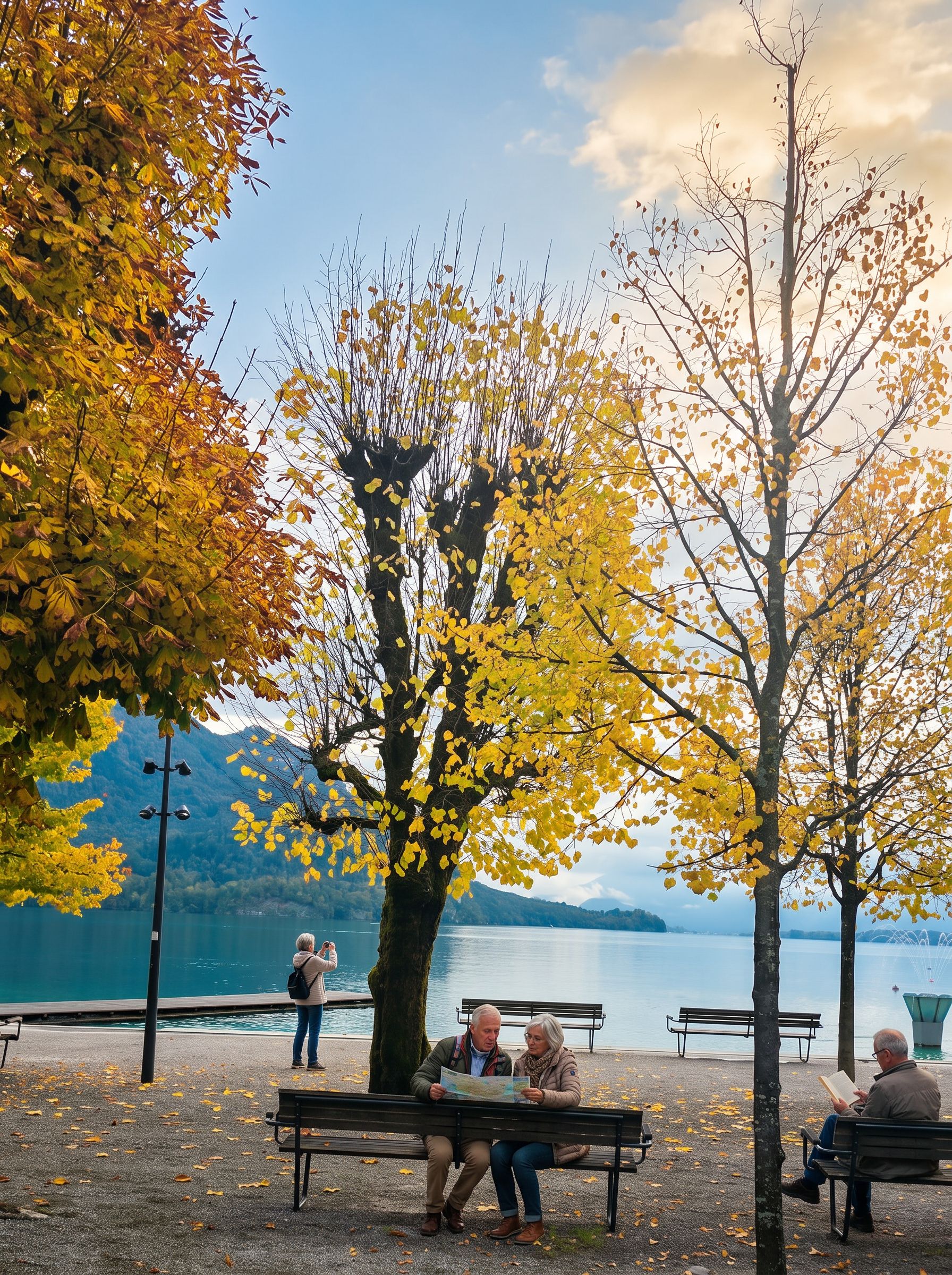
Hallstatt is small enough that you can always find a place to sit, and the best stretch runs along the lakeshore between the Market Square and Hallstatt Lahn, shaded in parts by old trees. Grandchildren can throw pebbles into the lake while you sit and catch your breath. The Market Square itself has a handful of cafés; the outdoor tables at Café Derbl and the nearby ice-cream shop are popular with families. A Google reviewer wrote of Café Derbl in November 2024: "Delicious warm chocolate cake! Quite possible the best I've ever had! The hostess was accommodating of our limited time, which we really appreciated." If the weather turns—and mountain weather can change fast—the Hallstatt Museum is open daily from 10 a.m. to 6 p.m. between May and September, and a family ticket costs €25. For a longer rest, consider booking a room at Pension Sarstein, which sits directly on the lakeshore just outside the centre and advertises a private lawn with sun loungers and its own bathing area. That bathing area has a diving board, so it is open water rather than a paddling pool—keep young children within reach.
What about the funicular and the Skywalk?
The Salzbergbahn funicular and the Skywalk viewing platform reopen on Saturday, 29 August 2026 after a 362-day rebuild; until 28 August 2026 both stay closed. From that date the funicular is a short, level-floored ride up the mountain, and a panorama lift and bridge lead to the Skywalk with very little walking.
The funicular is the easiest way to reach the upper slopes without a strenuous hike. Salzwelten describes it as carrying you up in just a few minutes, 360 metres above the rooftops of Hallstatt, and the new cabins keep the passenger floor level throughout the ride. From the top you take a panorama lift and then the panorama bridge to the Skywalk, a twelve-metre steel platform that juts out over the drop; the operator calls the platform comfortably reachable and of interest to families and seniors alike. The Rudolfsturm restaurant beside it reopens on the same day as the funicular, 29 August 2026, and the new Weitblick 7000 bistro with its viewing terrace sits at the mountain station itself. The mine entrance is a further walk of about fifteen minutes uphill. Note that the Serpentinenweg, the footpath up into the high valley, stays closed on safety grounds even after the reopening. For more details on easy mountain walks, see our guide to Easy Lakeshore Walks and the Best Views Around Hallstatt. Out on the point of the platform there is nothing below but air, so families will want to keep small children within arm's reach. If you are interested in the Dachstein Ice Caves and the Giant Ice Caves, those are a full-day outing from Hallstatt and are covered in our separate guide to The Dachstein Caves and Skywalk: What Older Visitors Should Know.
How do we get around without strenuous walking?
Use the lake ferry to cross from the railway station to the village—the station sits on the opposite shore, so the boat is how you arrive. Day visitors park in the P1, P2 or P4 lots outside the centre and walk in: twenty minutes from P1, fifteen from P2. The shuttle bus is reserved for guests who have booked accommodation in the centre.
Day visitors arriving by car are directed to parking lots outside the village centre, and the historic core itself is sealed off by two barriers—no visitor drives in, and neither do guests of the hotels inside. The free shuttle from P1 runs daily between 9 a.m. and 7 p.m., but only for guests with booked accommodation in the centre. If you arrive by train, you land on the far side of the lake and must take the ferry across, which costs €4 one way and €8 for the return or open ticket. The operator states it plainly on its own site: no card payment is possible, cash only. Inside the village, the only practical way to get around is on foot, but the distances are short: the tourist board puts the museum in the centre two minutes from the boat landing and ten minutes from the bus terminal at Lahn, where the playground is. For grandparents who use a walking cane or a wheelchair, the asphalted lakeside road is the easiest going, and the line ferry MS Stefanie is listed by its operator as wheelchair accessible; the interior streets are cobbled and steep. For a broader overview of accessibility, see our guide to Hallstatt Accessibility for Older Travellers.
"I had such a wonderful stay at Pension Sarstein! The location is absolutely perfect — just a few minutes' walk to the center of Hallstatt, yet very quiet and peaceful at night, which made it easy to relax. My room had a lovely, cozy vibe with everything I needed, and the view from the balcony was simply magical." — from a review left on Google in September 2025
What should we know about crowds and timing?
Day visitors to Hallstatt are not counted, but on the busiest August days the regional tourism director reckons with well over 10,000 people. The quietest times are early morning (before 9 AM) and late afternoon (after 4 PM). Staying overnight transforms the experience—the village empties out and becomes peaceful. Avoid midday in July and August if you can.
The biggest surprise for many first-time visitors is how crowded Hallstatt can feel. The region books around a million overnight stays a year, close to 150,000 of them in Hallstatt itself, and on peak days the lakeside road can be shoulder-to-shoulder. Staying overnight is what changes the day, because the town becomes far more pleasant after the day buses leave. One Google reviewer who stayed in the village in June 2025 put it this way: "If you choose to go, it's one of the world's most beautiful places but know that the town is extraordinarily crowded during the day in the summer. When the day ends and the day crowds leave, it's a wonderful thing." If you cannot stay overnight, aim to arrive before 9 AM or after 3 PM. The village is especially enjoyable at dawn, when the light is soft and the only sounds are the church bells and the lapping of lake water. For day trips beyond Hallstatt, see our guide to Day Trips Worth Making from Hallstatt: Five Senior-Friendly Outings Beyond the Village.
What about the weather and what to pack?
Summer is warm but mountain weather can bring sudden showers. Pack layers, a rain jacket, and comfortable walking shoes with good grip. Salzwelten asks visitors for sturdy shoes and warm clothing, because the mine holds a constant 8°C all year.
Hallstatt sits in a valley between mountains, which means the weather can change quickly. A sunny morning can turn into a rainy afternoon within an hour. For grandparents and grandchildren, the key is to be prepared without overpacking. Comfortable walking shoes with non-slip soles are essential—the cobblestones are slippery when wet. A small backpack with water, snacks, and a light rain jacket for each person will cover most situations. If you plan to visit the salt mine, remember that you walk about two kilometres inside the mountain—the shoes matter as much as the fleece. For grandchildren, a small toy or a book for the ferry ride and the museum visit can help fill the quieter moments.
Where should we stay for multigenerational comfort?
Pension Sarstein is the property this guide keeps coming back to for families, and Google rates it 4.8 out of 5 from 85 reviews as of August 2026. It sits directly on the lakeshore with a private lawn and its own bathing area, offers a cot on request, and the regional directory lists it as suitable for both seniors and families. It is closed from November to mid-April, so book well in advance for summer.
Pension Sarstein is a family-run guesthouse 0.2 km from the centre and 0.3 km from the boat landing, with nineteen beds across three double rooms, a triple and three apartments. Every room and apartment has a balcony facing the lake, and the property has its own lawn with sun loungers and a private bathing area with a diving board. Breakfast is offered on request rather than included in the room rate, so agree it when you book. There is a sauna, an infrared cabin, a lounge and a reading room, and free Wi-Fi throughout the house. Parking is at the P1 multi-storey car park about 1.2 km away, on the hotel ticket that costs €20 for the first day and less on each following one—and the house runs a free shuttle between P1 and the front door on arrival and departure, luggage included. It is away from the daytime crowds but still an easy walk from everything.
| Feature | Pension Sarstein |
|---|---|
| Rating | Google 4.8/5 (85 reviews, August 2026) |
| Location | On the lake, 0.2 km from the centre, 0.3 km from the boat landing |
| Family features | Private lawn, own bathing area with diving board, sauna, cot on request |
| Breakfast | On request, not included in the room rate |
| Parking | P1 hotel ticket, €20 first day; free shuttle on arrival and departure |
| Season | Closed November to mid-April |
What are the key practical details?
No entry fee for the village itself. Parking is restricted for day visitors. The salt mine, museum, and Bone House have separate ticket prices. Book the salt mine online in advance. Bring cash for the ferry. The funicular reopens on 29 August 2026.
Hallstatt does not charge a general entry fee—you can walk into the village for free. The costs come from parking, attractions, and transport. Day visitors park in P1, P2 or P4; P3 is the coach and camper lot and has to be booked. The tariff is the same in all of them: fifteen minutes free, €10 for three to four hours, €12 for five to six, and €20 for a day ticket. The historic core is not a matter of peak-hour controls but permanently sealed by two barriers, so nobody drives in. The combined salt mine and funicular ticket is €49 per adult and €23 for children aged 4 to 15. The Hallstatt Museum costs €12 per adult and €25 for a family. The Bone House (Beinhaus) in St. Michael's Chapel charges €2 for adults and €0.50 for children. Schengen visa rules apply for most international visitors. For a full overview of costs and logistics, see our guide to Hallstatt: A Senior-Friendly UNESCO Lakeside Village Guide.
One final note: Hallstatt is a UNESCO World Heritage site (inscribed in 1997 as part of the Hallstatt-Dachstein/Salzkammergut cultural landscape), and the village takes its heritage protection seriously. The old town core is closed to traffic, which is why arrival and departure need planning: even guests of the houses inside are brought in from the P1 car park by shuttle. The village is one of Europe's oldest continuously inhabited settlements, with salt-mining history going back thousands of years. That depth of history is part of what makes it special—and part of why it draws so many visitors. One last practical point that no family should have to look up in a hurry: in Austria the ambulance is 144, the Europe-wide emergency number is 112, and mountain rescue is 140. Hallstatt has no pharmacy of its own—the nearest is the Apotheke im Baumhaus at Bundesstraße 112 in Bad Goisern, about twelve kilometres up the lake, open Monday to Friday from 8 a.m. to 6 p.m. and Saturday from 8 a.m. to noon. With the right planning, a multigenerational trip to Hallstatt can be a memory that both grandparents and grandchildren carry for years.


