
Lake Garda rewards the traveller who lets the water do the work. For those of us who have traded the driver's seat for a deck rail, the ferry network run by Navigazione Laghi becomes a floating boulevard connecting lemon-scented promenades, castle towns and lakeside cafés. This guide covers the practical essentials: which boats to take, where the steps and gangway gaps hide, how to manage luggage, and how to read the seasonal timetables that make or break a car-free day.
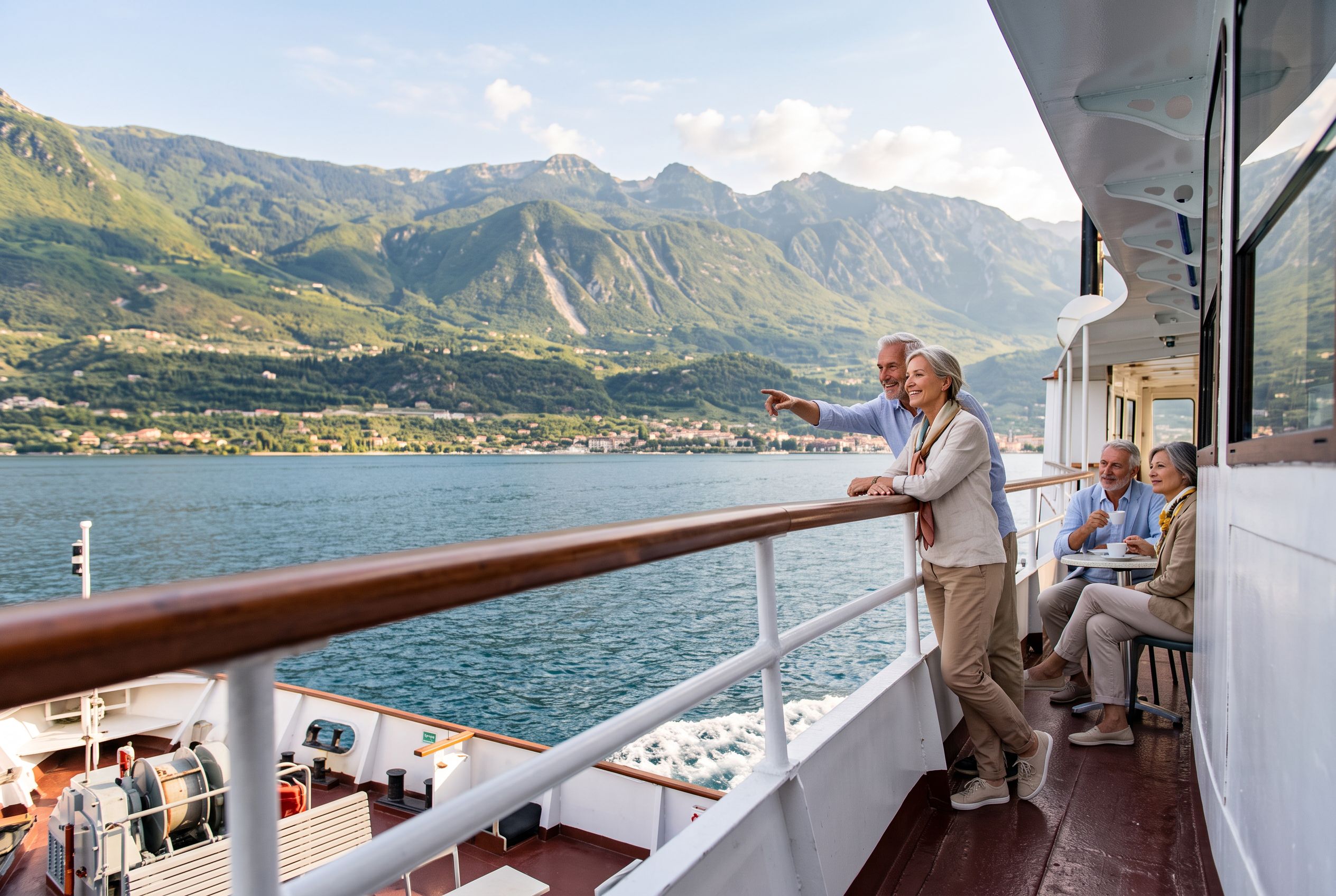 AI-edited
Which ferry should I take: fast, slow, or car ferry?
Choose the slow passenger ferry for sightseeing, the fast hydrofoil for covering distance, and the car ferry only for the few routes where it runs. The slow boats have open decks and better views; the hydrofoils are quicker but keep you inside. As of August 2026, the car ferry operates primarily on the Torri del Benaco–Toscolano Maderno crossing.
The Navigazione Laghi network works like a bus system on water, linking nearly every lakeside town. The slow vaporetti make more stops and let you sit outside, which matters when the scenery is the point. The fast aliscafi (hydrofoils) cut travel time significantly but confine you to an enclosed cabin. Forum contributors note that on the fast ferry you have to remain inside, which limits views—a fair trade when you are heading from Desenzano to Riva for a day trip.
For most journeys between southern and northern towns, the fast ferry is the practical choice. For hopping between neighbouring villages—say, Garda to Bardolino—the slow boat's gentle pace suits a morning out. The car ferry exists mainly for vehicles and foot passengers crossing the narrow waist of the lake; unless you are staying in Torri del Benaco or Toscolano Maderno, you will rarely need it.
| Boat type | Speed | Best for | Drawback |
|---|---|---|---|
| Slow passenger ferry | Leisurely | Sightseeing, open decks | Longer travel times |
| Fast hydrofoil | Quick | Covering distance | Enclosed cabin, fewer views |
| Car ferry | Moderate | Torri–Toscolano crossing | Limited routes |
How do I buy ferry tickets without hassle?
Buy tickets at the dock ticket office or online through the official Navigazione Laghi site. On-board purchase is possible but may carry a surcharge. In peak season, queues at popular ports like Sirmione and Malcesine can exceed an hour by mid-afternoon, so buy morning tickets or book online where available.
Travellers consistently report that ticket offices are the most reliable option, though lines build quickly. Forum contributors advise buying tickets early in the morning, reporting waits of well over an hour by late afternoon. The official operator, Navigazione Laghi, offers online ticketing for many routes, which bypasses the queue entirely. The Gardapass—a combined bus-and-ferry ticket—runs from 3 April to 4 October 2026 and is valid on Arriva buses and Navigazione Laghi scheduled boat services, so fast hydrofoils still need their own supplement.
Keep your ticket until the end of your trip; inspectors do check on board. Under the 2026 transport conditions, a ticket bought on board costs €1.00 more per passenger, item of luggage or vehicle — a surcharge the operator waives when the ticket office ashore is closed.
Where are the steps and gangway gaps a problem?
Navigazione Laghi states that boarding is assisted by staff using gangways at least 80 cm wide with non-slip surfaces, and that main ports have had stepless ramps since 2016. However, not every small landing stage is fully step-free, and the gap between jetty and boat varies with water levels.
According to the official operator, ships and the main ports of call have been fitted with stepless ramps to reduce or remove the step between jetty and walkway. Six Lake Garda piers—Desenzano, Sirmione, Peschiera, Garda, Malcesine and Riva—carry the Bandiera Lilla Approved certificate, issued after an assessment of those landing stages and nine of the ships. Beyond that list the operator is deliberately cautious: it states that not every wharf is easy to reach for disabled or reduced-mobility passengers, and that its lake-wide survey of pier accessibility has not yet been published. The gangway also shifts with the water level.
Staff are on hand to assist boarding, and it is worth asking for help rather than hesitating. Travellers with mobility concerns consistently recommend staying somewhere you can walk to the dock and avoid extra transfers, which is sound advice. If you use a walking stick or have balance concerns, board early and take a seat before the boat fills. The crew will steady the gangway if you ask.
On board, the slow ferries have outdoor seating with steps down to the lower deck. The hydrofoils have a single level with a small step at the entrance. Recent guests note that summer crowds can mean standing or sitting on stairs, so travel outside peak hours—an early departure is quieter than the mid-morning rush.
How do I handle luggage on ferries and buses?
Pack one carry-on each. Ferries have no dedicated luggage storage, so your bag stays with you, and buses have limited space under the floor. The mobility-focused advice from experienced travellers is consistent: if you can lift it onto a coach rack, you can manage Lake Garda.
Forum advice from travellers 50 and older repeatedly stresses keeping luggage light. "One carry-on each" is the recurring survival tip, because you may need to haul bags on and off boats and buses, and stations often involve stairs. On ferries, standard carry-on-sized luggage is usually fine, but there is no dedicated storage area—your bag sits at your feet or on the seat beside you.
On buses, luggage goes in the underfloor compartment, which means lifting it from the pavement to waist height. The ATV and Arriva buses that serve the lake are standard coaches, so if you can manage a suitcase onto a train rack, you will cope. A small backpack or wheeled bag with sturdy wheels is ideal; soft-sided bags are easier to wedge into tight spaces.
Which bus routes complement the ferries?
Bus route 483 runs from Malcesine to Peschiera without changing, making it the most useful overland connection on the eastern shore. Route 204 connects Desenzano to Salò every half hour from 7:00 to 23:00. These buses fill the gaps where ferries are infrequent or stop early.
The ferry network is the backbone, but buses extend your reach. Route 483 is the direct east-shore link, useful if you want to return from Malcesine to Peschiera without waiting for a boat. On the western shore, Arriva's R-link 204 makes Desenzano a rail-to-bus gateway, running every half hour from 7 a.m. to 11 p.m. every day, with stops at Lonato Lido, Lido di Padenghe, Moniga, Manerba and Raffa di Puegnago.
For the northern lake, buses connect Riva, Torbole and Limone to the ferry piers, which is helpful when the evening ferry schedule thins out. One Reddit traveller specifically suggested taking the bus back after a Malcesine–Monte Baldo outing rather than depending on the ferry, noting that bus schedules are sometimes more reliable for returns.
The Gardapass has one practical catch worth knowing before you count on it: Arriva sells it exclusively through its MyPay app, at a flat €33.50, and it activates automatically for the day. If you would rather not buy transport on a phone, plan on separate bus and boat tickets instead.
What about the Malcesine cable car?
The Malcesine–Monte Baldo cable car is a separate ticket from the ferry, bought at the station near the castle. The lower station is a short walk from the ferry pier, but the town centre has slopes and cobbles. The cable car itself is step-free, but the queue area can be crowded in summer.
Malcesine is one of the lake's most scenic stops, with a compact historic centre and the castle-cable-car combination. The cable car rises from the lakeshore to Monte Baldo's summit, offering panoramic views over the lake and the Dolomites beyond. The valley station is at Via Navene Vecchia 12, north of the historic centre rather than beside the castle; the operator puts the walk between station and castle at about five minutes. Its ticket office is on the ground floor, and there is step-free entry from street level via the lift in the underground car park on level -1.
The ride takes about 20 minutes each way and runs in two stages; only the upper cabin, between San Michele and Monte Baldo, rotates to give a 360-degree view. At the top, a restaurant and walking paths await, but the terrain is alpine and uneven. Reviewers recommend waiting for a clear morning before buying tickets, because weather matters and planning far ahead is not practical for this outing. The cable car runs all year apart from March and November, when it closes for maintenance, and it stays shut until shortly before Christmas. Departures are guaranteed at least every 30 minutes from 8:30.
Recent guests at hotels near Malcesine note that the town's hillside location means some properties require a steep walk back from the centre. If mobility is a concern, check whether your hotel offers a shuttle—several do, running two to three times daily.
"The cable car on the upper section slowly rotates so that you get a 360° view of the lake and the mountains." — a review left on Google in October 2025
Which towns are easiest without a car?
Desenzano, Peschiera and Bardolino are the flattest and most senior-friendly bases, with broad waterfronts and easy ferry access. Sirmione's old town is walkable but busy. Malcesine and Riva are scenic but hillier, so plan for slopes and steps.
Desenzano is the natural hub: a major ferry node with a lively waterfront, train station, and flat streets that suit short strolls and café stops. Peschiera offers similar ease, with the added benefit of being close to the southern lake's quieter stretches. Bardolino's promenade atmosphere makes it a relaxed base for slow sightseeing.
Sirmione is the signature day trip—arrive by boat, walk the flat lakeside streets, visit the Scaliger Castle and Roman ruins. It is busy in summer, so early morning or late afternoon visits are more comfortable. If the walk out along the peninsula is too much, Arriva runs a ShuttleBus through the historic centre and along the peninsula every 15 to 20 minutes, daily from 10:00 to 00:40, between 28 March and 27 September 2026; a single ride is €2.00. Gardone Riviera is praised by forum users as a central ferry base with "numerous ferries all round the lake every day."
For the northern lake, Riva del Garda offers striking scenery and a mountain backdrop, but the overall trip is best planned around ferry times because seasonal schedules are limited. Malcesine rewards those comfortable with some uneven walking; the centre has more slopes and steps than the flatter southern towns.
When should I travel for the best ferry service?
The full summer timetable runs roughly mid-May to early October, with reduced shoulder-season service in spring and autumn. Winter schedules are skeletal, with only the car ferry continuing year-round. June to September sees the heaviest crowds and the most frequent boats.
The Veneto regional authority reported occupancy of 75% across the April-to-September season at campsites on the Verona shore of the lake, with August peaks of between 90 and 98%, for the 2023 season. September averaged 60 to 86%, close to June and July. This means more ferries, but also longer queues and fuller boats. The shoulder months of May and October offer a better balance: fewer crowds, still-reliable service, and milder temperatures.
The summer timetable for 2026 runs from 16 May to 4 October. Outside these dates, service reduces significantly, and some routes operate only a few times daily. The operator publishes each timetable with its own validity window—the 2026 spring schedule ran from 1 April to 15 May before the summer one took over—so check the current ferry timetable before committing to a late-season trip.
Weather can also suspend services—strong winds occasionally halt crossings, particularly on the northern lake. The official Navigazione Laghi notices page is the best source for same-day disruptions. For a fuller picture of seasonal events and quieter periods, see our guide to Lake Garda through the year: festivals and quiet seasons.
How do I plan a day trip that avoids stress?
Base yourself in one town, take one or two ferry trips per day, and return by mid-afternoon to avoid queues. Check the return boat times before you commit to a destination. The base-and-day-trip approach is the most comfortable way to see the lake without a car.
Experienced travellers consistently recommend a base-and-day-trip strategy: stay in one well-connected town, use ferries for one or two nearby destinations, and avoid trying to see the entire lake in a single day. One ferry reviewer advised travellers to "check there is a returning boat to where you are staying," which is the single most important planning step.
For a relaxed itinerary, consider our five-day Lake Garda itinerary for the over-50s, which uses two bases and gentle ferry days. If you prefer guided excursions, small-group and guided tours can remove the planning burden entirely.
Returning by mid-afternoon is a common recommendation from forum users, who note that queues build later in the day. The recurring advice is to do the ferry sightseeing mid-morning and head back by 3 pm to avoid the worst crowds. This also leaves time for a relaxed dinner at your base town, which is often the highlight of a car-free day.
| Destination | Journey time from Desenzano | Return options |
|---|---|---|
| Sirmione | About 20 minutes on fast services, around 30–35 on ordinary boats | Frequent, both types |
| Bardolino | About an hour on ordinary boats, less on fast services | Hourly until evening |
| Malcesine | Around two hours on fast services, longer on ordinary boats | Check the last boat |
| Riva del Garda | At least two hours, and considerably more on ordinary boats | Check the return before you go |
Travellers who leave the car behind tend to rate the experience well. The operator's Desenzano terminal on Piazza Matteotti holds 3.7 out of 5 from 202 Google reviews as of August 2026, with recurring praise for the scenery and for not having to drive, alongside notes that queues and crowding in peak season require patience.
What should I pack for a car-free lake trip?
Pack light: one carry-on each, with a small day bag for ferry trips. Comfortable walking shoes are essential, as are layers for changing lake breezes. A refillable water bottle and sun protection round out the essentials.
There is a fare reason to keep the case small as well. The operator's baggage tariff, edition 01-2026, charges €4.80 for a bag whose longest side is over 0.60 m, or which weighs more than 20 kg, and no single piece may exceed 0.80 m or 40 litres. Wheelchairs and tricycles for disabled passengers, powered ones included, travel free. A wheeled bag with sturdy wheels and a comfortable shoulder strap for a day pack will serve you well.
For ferry days, carry a light jacket or shawl—the lake breeze can be cool even in summer, especially on the fast hydrofoils. Comfortable, non-slip shoes matter for gangway boarding and cobbled town streets. Sun protection is non-negotiable: the lake reflects light, and you will spend time on open decks.
A small backpack with water, snacks and a camera is ideal for day trips. Leave larger bags at your hotel; most will store luggage if you arrive early or depart late.
"Great way to get about Lake Garda. Efficient, cost effective & enjoyable. Also stress free not having to drive." — a Google reviewer wrote in May 2026
What senior discounts are available?
Travellers over 65 qualify for reduced fares on ordinary ferry tickets, typically valid on weekdays only. Age verification is required at the ticket office. Multi-day tickets may have broader validity, so ask about options before buying single journeys.
The senior fare reduction is a genuine saving for those who qualify. The operator's own fare conditions set it out precisely: passengers over 65 pay the reduced fare on ordinary tickets and on day tickets from Monday to Friday, but not on Saturdays, Sundays or public holidays. The reduction on three-day tickets applies on any day of the week. Bring your passport or ID to confirm your age. Some multi-day passes include the discount automatically, but this varies by ticket type, so it is worth asking at the ticket office.
The Gardapass, which combines bus and ferry travel, does not include fast ferries and may not offer a senior rate—check before purchasing. For frequent travellers, a multi-day pass often works out cheaper than individual tickets, even without the senior discount.
The saving is modest on short hops but adds up on the longest crossings, such as Desenzano to Riva: the fare table in force from 1 April 2026 puts these at €16.00–17.50 one way at the full fare and €12.80–14.00 with the over-65 reduction, with a supplement on top for fast services.
What if I need mobility assistance?
Navigazione Laghi provides assisted boarding with staff using gangways at least 80 cm wide, and main ports have had stepless ramps since 2016. Not every small landing stage is fully step-free, so check with the operator if you have specific needs.
Two details make planning easier. Since the 2018 season the operator has marked, on the timetable boards and in the pocket timetables, which sailings are best suited to wheelchair passengers, so a route can be chosen in advance. And on the Maderno–Torri car ferry the printed timetable states that every sailing is recommended for wheelchair passengers. Asking for assistance at the ticket office ensures the crew is ready to help you board; the operator also notes that boarding can be restricted at the captain's discretion when conditions are rough.
On board, the slow ferries have accessible seating areas on the main deck, while the hydrofoils require a single step at the entrance. Staff are generally helpful, though recent guests note that summer crowds can make movement on board challenging. Travelling outside peak hours—before 10 am or after 3 pm—makes the experience more comfortable.
Ashore, the Giovanni Rambotti Archaeological Museum in Desenzano documents its own access: an entrance ramp on Via Anelli 42, and a lift on the ground floor beside the ticket desk that takes wheelchair users, and anyone avoiding stairs, up to the second floor. At the northern end, the Garda Trentino tourist board states that public transport in its area is entirely barrier-free — buses, trains, the Bus&Go service and the lift up to the Bastion above Riva del Garda — and lists barrier-free hotels, campsites and attractions separately.
If you are considering a hotel stay, properties near ferry piers reduce the need for transfers. Our detailed look at Villa Cortine Palace Hotel covers accessibility considerations for a Sirmione property with direct lake access.
Lake Garda without a car is not just possible—it is arguably the best way to experience the lake. The ferries become part of the pleasure, the buses fill the gaps, and the towns reveal themselves at a walking pace. With a little planning around timetables and a light suitcase, the lake opens up in ways that driving never allows.


