
The northern shore of Lake Garda has a pulse you can feel before you see the water. It’s the sound of rigging clanking against masts, the hiss of a hull planing across the surface, and the low hum of a steady breeze that seems to have found its forever home between the mountains. For travellers aged 50 to 70 who want to be near the action without being flattened by it, Riva del Garda and Torbole offer something rare: a front-row seat to one of Europe’s most reliable wind-sport arenas, plus the chance to step onto a boat yourself at a pace that suits you.
This guide focuses entirely on the waterborne heart of the north lake—sailing outings, windsurf-watching, boat hire, and lessons designed for older beginners. If you’re also curious about exploring the shoreline on foot or by bike, we have dedicated guides for easy lakeside walks on Lake Garda and cycling Lake Garda by e-bike that cover those topics in depth.
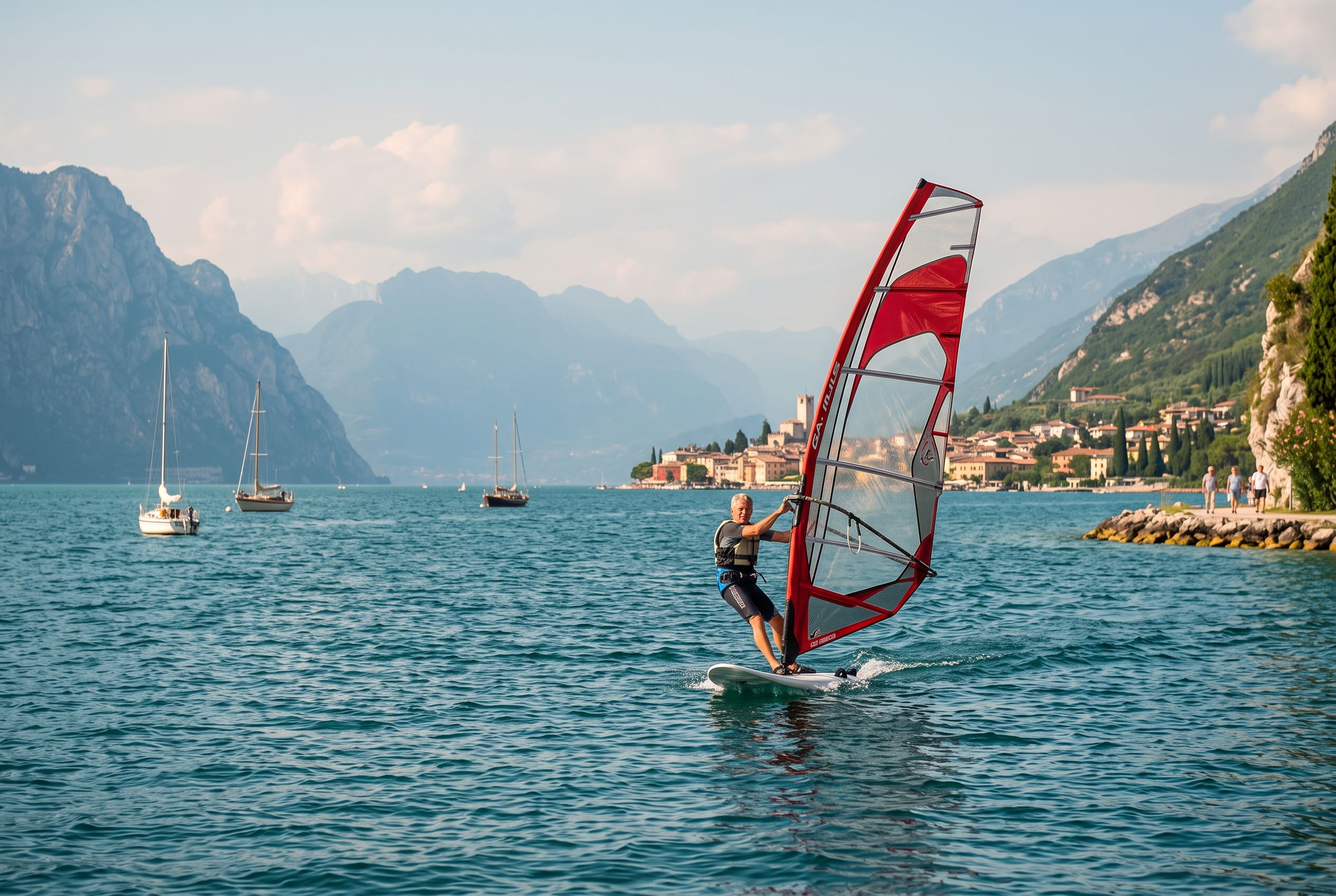 AI-edited
Why is the north lake the best place to experience sailing and windsurfing?
The north lake’s geography creates two reliable daily winds that arrive from opposite ends: the Pelèr, a north wind that comes down the valley in the morning, and the Ora, a south wind that pushes up the lake in the afternoon. Between them they give Riva and Torbole two dependable daily windows for sailors and spectators alike.
This isn’t a marketing claim; it’s physics. The mountains around the northern basin act like a natural funnel, channeling air into predictable patterns that have drawn windsurfers and sailors here for decades. The result is a lake that feels alive with movement from dawn until dusk, but in a way that’s surprisingly manageable for those who prefer to watch from a terrace with a coffee in hand.
What makes this area particularly appealing for the 50-70 traveller is the variety of ways to engage. You can book a gentle morning sail with a patient instructor, hire a small boat for a few hours of puttering along the shoreline, or simply find a bench near the water and watch the colourful sails crisscross the bay. The choice is yours, and the infrastructure supports all three options comfortably.
Where are the best spots to watch windsurfers in Torbole?
For pure spectating, the main Torbole beach, the promenade near the Sarca river mouth and the shore in front of the Circolo Surf Torbole clubhouse offer the closest views of windsurfers launching and returning, all within easy walking distance of cafes and restaurants.
The shoreline at Torbole is surprisingly compact, which works in your favour. You don’t need to hike or scramble to find a good viewpoint; the flat promenade runs alongside the water, and the beaches are sandy enough to walk on with reasonable shoes. The main launch areas are clearly visible from the shore, and you’ll often find locals and visitors alike gathered to watch the morning Peler bring the first boards onto the water.
For a slightly elevated perspective, the area near the Circolo Surf Torbole clubhouse offers a broad view of the bay. The club runs a full regatta calendar there, and the racing is free to watch from the shore. In 2026 the fixtures ran from the Austria Slalom Cup in April through the Coppa Italia iQFoil, the Italian Slalom Championship in late May and the One Hour Foil Days in June, to the national Windsurfer regatta in July; the season closes with a second Austria Slalom Cup and an open iQFoil championship in the second half of September.
- Main Torbole beach: Closest action, sandy underfoot, busy on summer weekends
- Spiaggia delle Lucertole: About 2.5 km south on the Gardesana — a limestone crag over the water, not a strolling beach
- Sarca river mouth: Where the wind funnels strongest, dramatic launches
- Lakeside promenade: Flat, shaded in parts, cafes every few hundred metres
One practical note: the wind can be intense on exposed areas, especially in the afternoon when the Ora picks up. If you’re sensitive to strong breezes or prefer a calmer experience, the morning hours are generally gentler, and the light is softer for photography.
Can I learn to sail at 60? What lessons suit older beginners?
Yes, absolutely—several schools around the north lake take complete beginners, with courses that can be tailored by duration, intensity and wind conditions, and private tuition that is open to any level: at Sailing du Lac the instructor agrees the goals directly with the participant rather than working to a fixed syllabus.
The key is choosing the right school and the right format. Private tuition is often the best option for older beginners because it allows the instructor to adjust the pace entirely to your comfort level. Schools like Sailing Du Lac in Riva del Garda and Campione Univela in Campione del Garda offer private sessions that can be scheduled around the wind windows, meaning you’re not committed to a rigid timetable.
Group courses are also available and can be a lovely way to meet fellow travellers, but they tend to follow a set schedule that may not account for your energy levels on a given day. If you’re unsure, start with a single private lesson to gauge your comfort, then decide whether to continue.
Most schools provide all the equipment, including buoyancy aids, and the boats used for beginners are stable and forgiving. You won’t be expected to have any prior experience, and instructors are accustomed to working with adults who may feel nervous about being on the water. The sensation of gliding silently across the lake with the mountains rising around you is genuinely one of the most peaceful experiences the region offers.
“We went out on the catamarans, group of 7 ages 13 - 72. Great instructors and everyone enjoyed it.” — a guest wrote on Google in August 2025 about Sailing du Lac in Riva del Garda
What are the options for gentle boat hire without a license?
On the Trentino waters off Riva and Torbole you cannot take a motorboat out yourself: provincial law 9/2001 restricts motorised navigation there to professional work and to assistance and rescue. What you can hire without any licence is muscle-powered — a kayak, a stand-up paddleboard or a pedalo — or you can go out under sail or with a skipper at the helm.
A kayak or a stand-up paddleboard suits the 50-70 traveller better than it sounds. Both are silent, both need no licence and no prior experience, and both let you hug the shore, find a quiet cove and simply float for a while, listening to the water lap against the hull. Sailing du Lac on the central beach at Riva rents either one, and as of August 2026 the listed rates are €19 an hour, €29 for two hours or €60 for the day. The centre puts the important part plainly: the buoyancy aid is always included in the rental price.
If you would rather not paddle at all, the alternatives are a pedalo from the stands at Punta Lido and the Lungolago Marinai d’Italia in Riva, a skippered taxi boat from the same waterfront, or a sailing yacht chartered by the half day, the day or the week — with a skipper aboard if you want one. The same centre arranges the last of these together with GardaseeCharter at Porto San Nicolò.
| Boat type | Typical duration | Approximate cost | License required |
|---|---|---|---|
| Kayak or stand-up paddleboard | 2 hours | €29 | No |
| Kayak or paddleboard, full day | 1 day | €60 | No |
| Trial sailing lesson, instructor aboard | 2 hours | €85 | No |
| Private sailing lesson, one person | 2 hours | €180 | No |
Before you book, check whether the operator includes a safety briefing and a buoyancy aid in the price — Univela, for instance, lists life jackets with the boats used for its lessons. It is worth confirming either way, especially if you have any mobility considerations, and Garda Trentino’s own water-sport advice is blunter still: use only boats and gear appropriate to your abilities, and wear a CE-certified lifejacket.
How do the public ferries work for a scenic north lake outing?
The public boat network operated by Navigazione Laghi links Riva, Torbole, Limone and Malcesine, and it is the least strenuous way to see the north lake from the water. Six Lake Garda piers carry the Bandiera Lilla Approved certificate — Riva and Malcesine among them, Limone not — along with nine of the boats.
This is the option to choose if you want to see the lake but prefer to leave the navigation to someone else. The ferries are comfortable, with both indoor and outdoor seating, and the routes along the northern shore offer some of the most dramatic scenery on the entire lake—sheer cliffs dropping into deep blue water, lemon groves clinging to terraced hillsides, and villages that seem to spill down to the water’s edge.
As of August 2026, Navigazione Laghi states that its ships and main ports of call have been equipped with stepless ramps for wheelchair boarding since 2016, and that onboard staff have been trained by a specialist accessible-tourism association. The company is franker than most about the limits: the most recent ships carry lifts and adapted toilets while studies are still under way for the older ones, and it notes that a captain may still restrict boarding on safety grounds, for instance in a rough lake.
A practical note from seasoned travellers: the boat is slower than it looks on the map. Between the northern towns it is manageable — on the summer 2026 timetable Riva to Limone takes 25 to 45 minutes and Riva to Malcesine 37 to 65 minutes, depending on the sailing. It is the full length of the lake that eats a day: Desenzano to Riva runs from just under three hours on a fast service to more than five on the slow steamer. Plan your day around the timetable rather than trying to improvise, and you’ll have a relaxed, enjoyable outing.
Is the north lake accessible for travellers with limited mobility?
Yes, with some planning—the flat promenades of Riva and Torbole, the Bandiera Lilla certified piers at Riva and Malcesine, and the barrier-free hotels, attractions and transport listed by Garda Trentino make this one of the more accessible stretches of Lake Garda for older travellers.
The key is choosing your base and your activities thoughtfully. Riva del Garda is the most walkable of the northern towns, with a flat old town and easy access to the waterfront. Torbole is similarly good along the promenade, though the wind can be intense on exposed areas. Malcesine also carries the Bandiera Lilla for accessible tourism: the cycle-and-foot path along the shore runs the full length of the municipality without architectural barriers, and the town library, the Palazzo dei Capitani and the church of Santo Stefano are accessible. It is the lanes of the old town behind the harbour that climb and stay cobbled.
Garda Trentino runs an official accessibility programme that lists barrier-free hotels and campsites, barrier-free attractions, barrier-free sports providers and barrier-free transport, and it states plainly that public transport in Garda Trentino is entirely barrier-free. The scenic lift up to the Bastione above Riva is part of that list, which makes it one of the few viewpoints on the lake reachable without a climb.
For the least strenuous experience, combine a boat ride with short waterfront walks. Where step-free boarding matters, plan around the certified piers rather than assuming every landing works: on Lake Garda the Bandiera Lilla Approved certificate covers Desenzano, Sirmione, Peschiera, Garda, Malcesine and Riva. Navigazione Laghi asks passengers with reduced mobility to contact it in advance so it can advise on the individual sailings.
| Town | Walkability | Terrain notes | Senior recommendation |
|---|---|---|---|
| Riva del Garda | Good | Flat in town, hills outside centre | Best easy-walking base |
| Torbole | Good | Flat near water, windy in exposed areas | Great for short strolls and spectating |
| Malcesine | Good along the water | Barrier-free lakeside path end to end; old-town lanes climb | Bandiera Lilla town — stay by the shore path |
| Limone | Moderate | Stepped lanes inland; level lakeside ciclopedonale with benches | Bandiera Lilla town; walk the shore path from Lungolago Marconi, though its pier is not one of the six certified landing stages |
If you’re considering combining your water-based activities with some gentle exploration on land, our guide to easy lakeside walks on Lake Garda covers the flattest, most rewarding routes in detail. And for a change of scenery, day trips from Lake Garda offers ideas that don’t require strenuous effort.
When is the best time to visit for sailing and watching?
The most reliable window for both sailing lessons and windsurf-watching is late spring through early autumn (roughly April to October), with the peak season running from June to September when visitor numbers and hotel occupancy are highest.
The opening periods the schools themselves file with the Garda Trentino tourist board are the more useful guide, and they do not all match. Sailing du Lac in Riva is listed as open from 1 May to 31 October; the Vasco Renna windsurf centre in Torbole runs longer, from 7 April to 7 November; Circolo Surf Torbole, as a club, is listed year-round. So an April booking is possible for windsurfing but not for a sailing lesson at Sailing du Lac. Daily scheduling is adjusted according to wind conditions in every case.
If you want to watch top-level competition, check the Circolo Surf Torbole calendar before you fix your dates. The 2025 season included the Campionato Italiano Assoluto Windsurfer in early June and the IFCA Slalom European Championships in mid-October; the 2026 fixtures were spread from April to late September, with the Italian Slalom Championship in May and the national Windsurfer regatta in July. These events are free to watch from the shore and offer a spectacular display of skill, though they do bring crowds to the waterfront.
For a quieter experience, consider late September or the very start of October. The water is still warm enough for comfortable sailing, the crowds have thinned, and the autumn light on the mountains is arguably the most beautiful of the year. One date to keep in mind if boat trips are part of the plan: the 2026 timetable ran only to 4 October, so a stay after that leaves you with the buses and the shore. Accommodation prices also drop outside the peak summer months.
Where should I stay for easy access to the water?
Choose a base in Riva del Garda for the easiest walking and best ferry access, or stay in Torbole if you want to be right at the heart of the windsurfing action—just be aware that the waterfront can be noisy at night.
Riva del Garda is the more refined choice, with a compact historic centre, a beautiful lakeside promenade, and a wider range of restaurants and hotels. It’s also the main ferry hub for the northern lake, so you can easily plan day trips to Limone and Malcesine without changing transport.
Torbole is more laid-back and sports-focused, with a younger energy and a stronger watersports culture. The waterfront is lined with bars and rental shops, and you can watch the windsurfers from your breakfast table. However, guest reviews consistently mention night-time noise from the waterfront venues, so if you’re a light sleeper, request a room away from the main promenade or consider staying slightly inland.
For a quieter alternative, the area around Campione del Garda and Brenzone offers sailing schools and calmer waterfront access, though you’ll need to factor in transport to reach the main action in Torbole.
What practical tips should I know before I go?
Book sailing lessons in advance, check the ferry timetable carefully, arrive early for windsurf-watching, and confirm accessibility details with your accommodation before booking.
These four pieces of advice come directly from the experiences of travellers in their 50s and 60s who have navigated the north lake before you. The lessons are weather-dependent, so schools may reschedule at short notice—build flexibility into your itinerary. The boat timetable is not merely seasonal, it stops altogether: for 2026 Navigazione Laghi published two Lake Garda timetables, 1 April to 15 May and 16 May to 4 October, and nothing beyond. Outside that window there is no scheduled service on the lake at all, so check the operating period against your travel dates.
For windsurf-watching, the morning Peler window is the most reliable, so plan to be on the shore by 9:00. The afternoon Ora can be gustier and more crowded, but it’s also when the more experienced sailors come out to play.
Finally, don’t underestimate the value of a travel insurance policy that covers water activities. Even gentle sailing carries some risk, and the right cover is what lets you stop thinking about it and enjoy the day.
Two numbers are worth writing down before you go out. The emergency number across the province of Trento is 112, the single European emergency line: it is free, reaches the control room in Trento, and works even if your phone has no SIM, no credit or a locked screen. The nearest emergency department to both towns is at the Ospedale di Arco, viale dei Capitelli 48, which the provincial health service staffs around the clock — roughly six kilometres from Riva del Garda and seven from Torbole.
The ferry timetable is the detail that most often catches visitors out. Connections between the northern towns are less frequent than many people expect, so plan around the published schedule rather than assuming you can simply turn up and hop on.
Frequently asked questions
Do I need to book sailing lessons in advance?
Yes, especially during peak season from June to September. Schools like Sailing Du Lac and Campione Univela recommend booking ahead, particularly for private tuition, which is limited by instructor availability. During the busy summer months, group courses can fill up weeks in advance. Booking early also gives you more flexibility to schedule lessons around the wind windows—morning Peler or afternoon Ora—that suit your energy levels. If you’re travelling in shoulder season (April-May or September-October), you may have more luck with last-minute bookings, but it’s still wise to confirm at least a few days ahead. Most schools offer online booking with free cancellation up to 24-48 hours before the lesson, which is ideal if your plans are uncertain.
What should I wear for a sailing lesson or boat trip?
Dress in layers and bring a windproof jacket, even in summer. The wind on the north lake can be surprisingly cool, especially during the morning Peler. Quick-drying fabrics are ideal, and non-slip shoes with a good grip are essential for moving around on a boat. Most schools provide buoyancy aids, but you’ll want to bring sunscreen, sunglasses with a strap, and a hat that won’t blow away. In the shoulder seasons, a light fleece under your windproof layer is advisable. If you’re prone to seasickness, consider taking medication before you go out—the lake can be choppy in the afternoon when the Ora strengthens. Waterproof phone pouches are also worth investing in; you’ll want to capture the views without worrying about splashes.
Can I watch the windsurfers without being on the water?
Absolutely—the Torbole shoreline offers excellent free viewing spots. The main beach, the promenade near the Sarca river mouth, and the area around Circolo Surf Torbole all provide close views of the action. Bring a folding chair or find a cafe terrace, and you can comfortably watch for hours. The morning hours are generally quieter and more relaxed, while the afternoon brings more activity and a livelier atmosphere. During championship events, which are free to attend, the shoreline fills with spectators, so arrive early for a good spot. Binoculars are useful for following the sailors as they move across the bay, and a camera with a zoom lens will help you capture the colourful sails against the dramatic mountain backdrop.
Is the north lake suitable for a non-sailor partner?
Yes, the area is wonderfully accommodating for mixed-interest couples. While one partner takes a sailing lesson, the other can enjoy the lakeside promenades, visit the historic centres of Riva or Torbole, or simply relax at a waterfront cafe with a book. The towns are compact and safe, with plenty of people-watching opportunities. For a shared experience, consider a public ferry ride to Limone or Malcesine—both partners can enjoy the scenery without any physical effort. Alternatively, take a kayak or a double paddleboard out for a couple of hours and take turns leading; it’s a gentle way to see the shoreline together. Many sailing schools also offer tandem or double-handed boats, so you can learn together if you’re both interested.


