
Rome rewards the traveller who stays put, but some of the region's finest experiences sit just beyond the city limits, reachable by suburban train, regional rail or a short bus ride. For travellers aged 50 to 70, four outings stand out for the balance of reward against effort: the Roman port city of Ostia Antica, the garden villas at Tivoli, the wine towns of the Castelli Romani, and the cathedral hill town of Orvieto. Each can be done as a comfortable day, and each asks something different of your legs, your patience and your planning.
This guide covers transport, terrain, opening patterns and the practical logistics that matter most when you are managing energy across a long day. In-city sightseeing has its own dedicated guide, so we stay outside the walls here. What follows is built on operator pages, official park information and the accumulated experience of travellers who have made these trips.
 AI-edited
Which day trip from Rome is the easiest to manage?
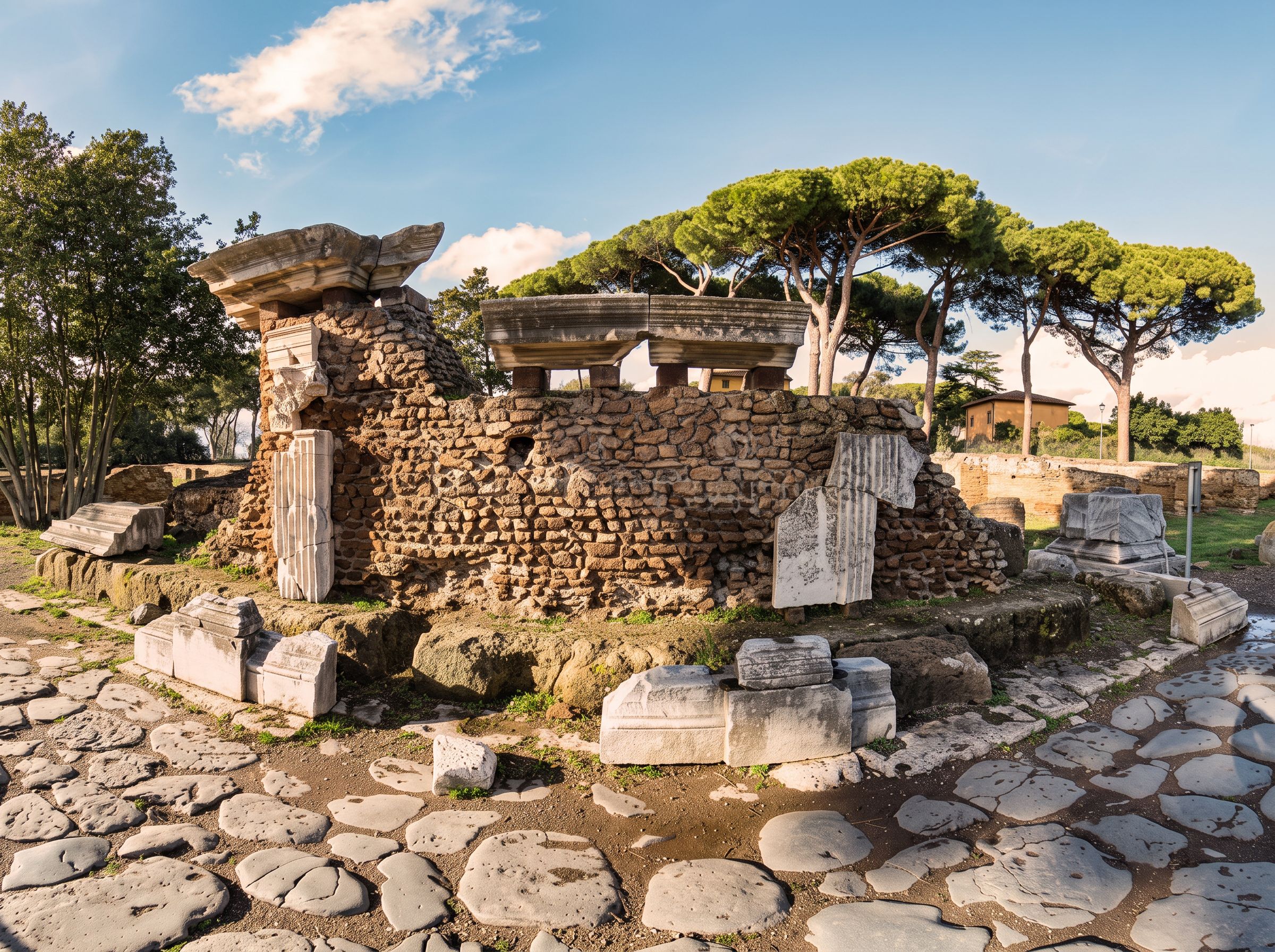
Ostia Antica is the simplest and most economical day trip from central Rome, according to a recorded travel guide. The Roma-Lido suburban train runs from Piramide / Porta San Paolo to Ostia Antica station, and the archaeological park sits about a 10 to 15 minute walk from the platform. The site itself is comparatively flat, which matters for comfort.
The park's official visitor information places it at Viale dei Romagnoli 717 in Rome, and the site is far more than a single ruin field. The Theatre, the Piazzale delle Corporazioni, the Ostiense Museum, the Capitolium and the House of Diana all appear in the park's own visitor material, and one integrated ticket covers all the archaeological and museum sites within the park.
Forum posters on Rome travel threads repeatedly describe Ostia Antica as a good low-stress alternative to Pompeii, offering ruins without the physical intensity. Several estimate roughly two to four hours on site, with about 30 to 45 minutes each way from Rome depending on the route. One recurring tip from those threads is to walk to the far end of the park first and work back toward the entrance, which lets you set your own pace and avoid missing the outer areas.
There is a heat consideration. A Fodors forum post warns specifically that in summer the site can be "real hot," which matters even on relatively level ground. Several posters mention taking breaks or making a relaxed day of it, including lunch on site; a Rick Steves forum post says a cafeteria lunch worked well, and another suggests a picnic and time to sit.
What should I know about Ostia Antica tickets and access?
The park's own fare pages list a full ticket of €18 and a reduced ticket of €2 for EU citizens aged 18 to 25. The full ticket is valid for eight consecutive calendar days across all the park's archaeological and museum sites. Admission is free on the first Sunday of the month, subject to each site's opening hours.
The park states that tickets can be bought at the ticket office with cash or electronic payment methods, and also through the Musei Italiani App. The ticket desk closes one hour before park closing. For visitor information, the park publishes the phone number +39 06 39967950.
On accessibility, the park's own information is specific and worth reading carefully. The route from the ticket office to the Ostiense Museum is fully wheelchair accessible, and the museum has an access ramp. The Piazzale delle Corporazioni can be visited along that accessible route before reaching the museum. Visitors with reduced mobility may enter with their own vehicle, with the proper permit, up to the internal parking area, and the route from there leads to the Capitolium and the House of Diana. Accessible restroom facilities are available.
The park describes its accessibility as partial rather than universal, and it has created routes for visitors with mobility difficulties or wheelchair users. The official park page does not document a full step count, slope gradient or total walking distance for the site. A visitor guide notes that the main Decumanus Maximus is paved with original Roman cobblestones and can be uneven, though that description comes from a travel guide rather than the park itself. The park's own advice is to wear suitable clothing and footwear for paths and gradients.
When is Ostia Antica open, and when is it closed?
The archaeological park is open Tuesday to Sunday and on public holidays, opening at 8:30 a.m., with closing varying by season from 4:30 p.m. in late autumn and winter to 7:00 p.m. in late spring and summer. Last entry is one hour before closing. The park is closed on Mondays, 25 December and 1 January.
That Monday closure matters for planning, and it is worth confirming before you set out, because the official park page did not itself carry the Monday detail; it appears in secondary guide material. The park's own pages do confirm the seasonal opening pattern and the last-entry rule.
One further note on the ticket: a March 2026 platform travel guide reports the integrated ticket at €18, valid for eight days from first use, and says the first Sunday of every month is free for all visitors. The park's own pages confirm the €18 full fare and the free first Sunday. The park also runs a summer theatre season called the Ostia Antica Festival, and a festival ticket can be exchanged for reduced park admission.
On arrival logistics, the park states that the unattended car park is open from 7:30 a.m. to 7:30 p.m. and warns visitors not to leave valuables in vehicles. Reporting in 2026 said the Ostia Antica station on the Metromare line is being turned into an "archeostazione," with a renovated passenger area, improved platforms and new exhibition space, and that work also affects the old pedestrian bridge and the access road to the park. The same report noted planned night closures and diversions on Via Ostiense from 3 to 23 August to allow the works to advance. Expect the arrival experience to be less straightforward than usual while this is under way.
Is Tivoli worth the extra effort for Villa d'Este and Hadrian's Villa?
Tivoli rewards a focused day, but it asks more of you than Ostia Antica. Forum posters consistently describe it as more complicated to reach, usually involving Metro B to Ponte Mammolo and then a Cotral bus, or other local connections. A published day-trip guide gives Tivoli as typically reachable in about 40 to 60 minutes from Rome by regional train.
The official Villa d'Este page gives a regional train from Roma Tiburtina to Tivoli taking 35 to 60 minutes for about €2.60, followed by a 10-minute walk from the station. The Ministry of Culture's Villae site publishes Villa d'Este at Piazza Trento 5, Tivoli, and Hadrian's Villa at Largo Marguerite Yourcenar 1, Villa Adriana-Tivoli. The road distance between Tivoli railway station and Hadrian's Villa is 5.1 km, about 10 minutes by car with clear roads and no stops.
Villa d'Este is the central Tivoli garden villa, described by its own operator as Cardinal Ippolito II d'Este's Renaissance masterpiece, with four hectares of terraced gardens, around fifty monumental fountains and a frescoed palace. Hadrian's Villa lies 6 km further downhill and requires additional travel between the two sites. A published guide for Tivoli day trips describes the pair as practical for a same-day visit, though the transport between them adds time.
One important caution for older travellers comes from guest feedback rather than the operator. A Rick Steves forum post notes that the time spent at Villa d'Este can feel "rather short," because the gardens are not large. That suggests Tivoli is better chosen when the goal is a slower garden-and-villa day rather than a long archaeological hike.
How demanding is the terrain at Tivoli's villas?
Villa d'Este is built on a steep hillside with many steps up and down, and its own operator states that the garden descends across steep terraces and you climb back up on foot. Guest reviewers note that those who cannot manage stairs will miss parts of the gardens. Hadrian's Villa is the flatter of the two and more manageable, though gravel paths and uneven surfaces still limit full wheelchair access.
The operator's own advice is direct: expect real changes in elevation at Villa d'Este. A 2026 guide describes the site as partly accessible, with signposted accessible routes in the palace and some terraces, but the historic gardens remain steep and stair-filled. That same guide reports that Villa d'Este has a lift, but it serves only some levels, and that wheelchair users usually see the upper gardens rather than the full descent.
At Hadrian's Villa, the same 2026 guide says there is a step-free route to several major areas, and golf-cart assistance may be available for reduced-mobility visitors. The Villae institute's own guidance for the archaeological area notes that the nature of the route, with paths and gradients, requires suitable clothing and footwear.
Guest feedback on Villa d'Este, where the Google rating stands at 4.7 out of 5 from 35,353 reviews as of September 2026, consistently singles out the terraced hillside gardens, the gravity-fed fountains and the water features as the highlight, with the Avenue of the Hundred Fountains, the Fountain of Neptune and the Organ Fountain named repeatedly. The atmosphere is described as quiet, peaceful and uncrowded, and reviewers note it as a calm contrast to Rome. Monday afternoon and late-afternoon visits, around 3 to 6 p.m., are mentioned as less busy.
"Such incredible place. I'm not sure any word I will say will give it justice. Just go and visit it." (Google, June 2026)
One practical point on the fountains: the operator states that the hydraulic organ of the Organ Fountain is activated daily, starting at 10:30, every two hours. The operator also warns that in the event of rain and the consequent swelling of the Aniene River, the water supply of the villa's fountains could be temporarily suspended. Multiple guest reviewers encountered fountains switched off for maintenance, seasonal shutdowns or after heavy rain, sometimes with a reduced admission price and sometimes without advance notice on the website.
What are the opening hours and ticket prices at Tivoli?
Villa d'Este is open daily, with Mondays opening at 2:00 p.m., according to the Villae institute. On public-holiday Mondays, opening is from 8:45 a.m. and the following Tuesday from 2:00 p.m. Hadrian's Villa is open every day. The official Villa d'Este page lists a full ticket of €15, a reduced €2 ticket for EU citizens aged 18 to 25, and free admission under 18.
The operator's page gives opening hours as Tuesday to Sunday from 8:45 a.m. and Monday from 2:00 p.m., closing at sunset, which it puts at 5:15 p.m. in winter and up to about 7:45 p.m. in summer. The page suggests allowing two to three hours for the garden and palace together. There is also an official Villae combined ticket at about €25, valid three days, which includes the Sanctuary of Hercules.
Closing days for the villa complex are 1 January and 25 December, except for special project openings reported on the operator's website. Free admission applies on the first Sunday of the month, 25 April, 2 June, 4 November, and 8 March for women for International Women's Day. The Villae institute says the usual half-day maintenance closure was suspended for Easter week, 6 to 12 April 2026.
On capacity, the operator states that with a high number of visitors, for safety reasons, entrance to the villa may be limited, the route may be subject to changes and some exhibition rooms may be closed. Access is permitted only with a ticket, which can be purchased online, via QR code on site, or at the institute's ticket offices. For Tivoli administration enquiries, the official Villae page gives the phone number +39 077419804 and the email va-ve@cultura.gov.it.
Are the Castelli Romani wine towns a good day out?
The Castelli Romani are the volcanic hill towns south of Rome, and published day-trip guides name Frascati, Castel Gandolfo, Grottaferrata and Nemi as the usual cluster for wine, lakes and easy half-day outings. One guide places the Castelli Romani generally at about 40 minutes from Rome and calls them a good choice for wine and an easy day out.
For Frascati specifically, the same guide gives about 35 to 40 minutes from Roma Termini on the FL4 regional line and says no reservation is needed. The road distance from Roma Termini to Frascati railway station is 21 km, about 25 minutes by car with clear roads and no stops. From the published weekday timetable for 25 September 2026, the connection from Roma Termini to Frascati station runs about 30 minutes by train with no change.
That combination makes the Castelli Romani the most flexible of the four outings in this guide. The towns sit close together, the rail link is direct, and the appeal is food and wine rather than monuments, which suits a slower day.
Exact Rome-area frequency and fares for every Castelli Romani town beyond Frascati are not documented at the same level. If you are considering a specific town, confirm the connection before you commit to it.
Is Orvieto doable as a day trip by train?
A published day-trip guide places Orvieto at under 90 minutes from Rome by train and describes it as a direct rail day trip. The same guide lists it at about 1 hour 30 minutes, with the caveat that ticket cost varies by service. No reservation is needed on regional trains, while reservation is recommended for intercity services.
The guide frames Orvieto as suitable for a day focused on a hill town, cathedral and wine, which makes it a good fit for travellers who want scenery without strenuous walking. The town sits on a volcanic plateau above the surrounding countryside, and the day is built around the cathedral and the streets around it rather than a long trail.
There is a documentation gap worth naming. Exact fast-train operators and published ticket prices for Orvieto are not documented in the gathered official material, and no source documented Orvieto-specific fast-train journey times from Rome, reduced fares for seniors, or a local accessibility package for the town-level day-trip topic. No source documented an Orvieto municipality rule set for senior tickets, step-free station access or local visitor passes. Confirm your service and fare with the operator before booking.
For anyone weighing Orvieto against the other three, the trade is straightforward: it is the longest journey of the four, but the day itself is the least physically demanding once you arrive, because the focus is a compact town centre rather than a sprawling archaeological site or a terraced garden.
How should I plan transport and timing across these trips?
Each of the four trips uses a different transport pattern, and the effort varies accordingly. Ostia Antica uses the Roma-Lido suburban train from Piramide. Tivoli uses regional rail or Metro plus bus. The Castelli Romani use the FL4 regional line. Orvieto uses a direct rail service. Timetables change, so check the operator before travelling.
The standard BIT/ROMA ticket is published at €1.50 for 100 minutes on the guidance source for the Ostia Antica route. Prices for the other services come named above and vary by service and season. Rates are indicative and vary by season and booking channel.
Rome's transport network has been subject to recurring disruption. The city's tourism site said 2024 work included track replacement on the Ottaviano-Battistini section, new lifts at San Giovanni for step-free access, and station restyling, and it also said evening service was curtailed Sunday to Thursday, with Vittorio Emanuele, Spagna and Ottaviano temporarily closed at different points in 2024. Local and international reporting described closures and bus substitutions across tram lines, Metro A and other links ahead of the Jubilee, with Piazza Venezia also heavily affected by construction for the future Metro C station. Step-free access may improve at San Giovanni, but other station works can add walking, detours and late-service limits, as the Rome tourism office notes on station works set out.
Tivoli day trips are vulnerable to rail interruptions. The Local reported that the FL2 Rome to Tivoli regional line was completely suspended from 10 to 28 June 2024, which directly affects trips to Tivoli from Rome. Checking FL2 status before departure is essential. For a broader picture of how the city's transport fits together, see our guide to getting around Rome by metro, bus, taxi and on foot.
What should travellers with mobility considerations plan for?
Accessibility varies sharply across these four trips. Ostia Antica has documented accessible routes from the ticket office to the Ostiense Museum and an access ramp at the museum. Villa d'Este is steep and stair-filled. Hadrian's Villa is flatter but has gravel and uneven surfaces. Orvieto and the Castelli Romani have no documented accessibility package.
At Ostia Antica, the park states that visitors with reduced mobility may enter with their own vehicle, with the proper permit, up to the internal parking area. The park does not publish a full step count, slope gradient or total walking distance, so ask at the ticket office if you need specifics. A third-party tour product for Ostia Antica states on its listing that it is not wheelchair accessible and not recommended for wheelchair users and those with mobility impairments, which is a different proposition from visiting the park independently.
At Tivoli, the operator's own advice is to expect real changes in elevation at Villa d'Este. The 2026 guide's assessment is that Hadrian's Villa is the more manageable of the two for reduced mobility, with a step-free route to several major areas and possible golf-cart assistance. Neither site publishes a full step count or gradient, so confirm with the site before booking if access is decisive for your day.
For a wider look at reducing walking across a Rome stay, our guide to seeing Rome with little walking covers the city-side logistics. On health provisions, the material documents accessible restrooms at Ostia Antica but does not document a nearest pharmacy or medical point for any of the four day-trip destinations. Ask locally on arrival.
When is the best time to make these trips?
Spring and autumn suit all four outings best, because summer heat is the most repeated caution in the traveller feedback for Ostia Antica, and the Tivoli fountains can be affected by heavy rain. The first Sunday of the month brings free admission at Ostia Antica, Villa d'Este and Hadrian's Villa, which also tends to mean more visitors.
One secondary guide says the site has "almost no crowds," but that is a general travel claim rather than an official park statement. For Villa d'Este, guest reviewers mention Monday afternoon and late-afternoon visits, around 3 to 6 p.m., as less busy.
On seasonal closures, the pattern is consistent across the sites covered here. Ostia Antica closes on 25 December and 1 January, and its opening hours shorten in late autumn and winter. The Tivoli villa complex closes on 1 January and 25 December, except for special project openings. Free admission days at the Tivoli sites are the first Sunday of the month, 25 April, 2 June, 4 November, and 8 March for women.
For a fuller picture of how the city's calendar shapes a visit, including quiet seasons and festival periods, see our guide to Rome through the year. If you prefer the structure of an organised outing, our piece on small-group and guided tours of Rome for older travellers covers what to look for.
What else is worth knowing before you go?
Plan each trip as its own day rather than pairing two major sites, because the transport time and terrain add up. Buy tickets in advance where the operator offers it, carry water, and wear shoes suited to cobblestones, gravel and terraced gardens. Check the operator's timetable the day before you travel.
On booking, the park states that Ostia Antica tickets can be bought at the ticket office or via the Musei Italiani App. The Villae institute states that access to its sites is permitted only with a ticket, purchasable online, via QR code on site, or at the institute's ticket offices. For the Castelli Romani, one guide says no reservation is needed on the FL4 to Frascati. For Orvieto, no reservation is needed on regional trains, while reservation is recommended for intercity services.
On safety, the park states that the unattended car park at Ostia Antica is open from 7:30 a.m. to 7:30 p.m. and warns not to leave valuables in vehicles. A third-party Ostia Antica tour listing states that all visitors and belongings undergo screening. No emergency-number listing specific to the Archaeological Park of Ostia Antica was documented; the park's visitor information number is +39 06 39967950.
On accommodation, guest reviews of Rome hotels consistently identify street or bar noise at night, breakfast quality and staff service as the make-or-break issues. For day-tripping, the best-reviewed bases are those with strong breakfast and early service, since guests repeatedly value a solid start to the day. If accessibility matters, verify lift size, shower type and steps before booking, because at least one Tripadvisor review warns directly about mobility difficulties at a central property. For quieter stays, ask for a room away from roads, bars, breakfast areas and lifts, because the most consistent complaint across Rome hotels is noise transfer at night or early morning.
Finally, a note on what the material does not cover. Rome-wide questions about what to bring into Italy, clothing conventions or unspoken rules were not documented for these specific day-trip places, so this guide does not address them. What it does cover is the practical shape of four outings that reward the effort without exhausting the traveller.


