
Rome rewards the traveller who plans around energy rather than ambition. The city's historic core is paved largely with sampietrini, the small uneven cobblestones that sources repeatedly describe as tiring underfoot, and the same sources note narrow sidewalks, crowding, hills and summer heat as compounding factors. None of that makes Rome off-limits. It makes it a city to be taken in clusters, with wheels doing the connecting and a cafe chair doing the recovering. The strategies below are drawn from operator pages, city authorities and the accumulated experience of older visitors who have worked out how to see the major sights without treating the day as a forced march.
Can you see Rome without walking far?
Yes, provided the itinerary is built around vehicles and short bursts on foot rather than continuous walking. The best-supported low-walking structure combines a hop-on-hop-off bus or golf-cart tour for orientation, taxis for point-to-point transfers, and one or two selective site visits per day, with cafe stops treated as part of the plan rather than an interruption.
One guide aimed at visitors with moderate mobility limitations suggests planning only about 4 to 6 km per day on foot. That figure is worth holding onto, because it reframes the trip. Rome's major sights are not evenly spread, and the temptation to string the Colosseum, the Pantheon and the Vatican into a single day is what turns a pleasant morning into an exhausting one.
Forum contributors who travel with limited mobility converge on the same advice: choose one or two places, use taxis between them, and relax somewhere near the hotel afterwards. A contributor describing travel with severe knee and sciatica problems reported taking a cab, walking five minutes at most, visiting one venue, then stopping for coffee. That rhythm, repeated across a week, covers a great deal of Rome.
What are the best low-walking ways to get around?
Hop-on-hop-off buses and golf-cart tours are the two best-documented low-exertion options. A hop-on-hop-off bus covers the major downtown stops in a loop of roughly one hour forty minutes, while golf-cart tours reach squares, viewpoints and hills that would otherwise require long walks between them.
Roma City Tour sells a 24-hour adult ticket at €36 and a 48-hour adult ticket at €41, and states that the 48-hour ticket allows unlimited hopping on and off to visit points of interest (romehoponhopoff.com/price/). The same operator publishes a half-day five-hour ticket, which from 1 April starts its five-hour validity at 1 pm.
A separate guide to Rome's hop-on-hop-off services reports one operator's single-loop ticket at €22 adult, 24 hours at €25.50, 48 hours at €28.90 and 72 hours at €32.30, with a standard route running from Termini between 9:00 am and 6:00 pm and buses every 15 minutes. A newer 2026 guide states that City Sightseeing Rome operates daily from 9:00 am to 6:20 pm with buses every 30 minutes and tickets from €18.27.
The common downtown stop list covers Termini, Santa Maria Maggiore, the Colosseum, Circus Maximus, Piazza Venezia, Castel Sant'Angelo, Via Ludovisi, Barberini, Trevi, Piazza di Spagna and the Vatican. For a traveller who wants the overview without the mileage, a single-loop ticket is explicitly marketed as the orientation ride.
 AI-edited
Golf carts go where the buses cannot. A Rome golf-cart operator lists a three-hour "All in" mini tour at €53, a four-hour "History and Fun" tour at €65 and a two-hour "Rome by Night" tour at €50. The four-hour version adds the Aventine and Celio hills, which suits travellers who want elevated views without the climb. A separate listing shows a shared golf-cart tour with artisanal gelato tasting at about US$45 per person, with 1,858 verified reviews and a 4.8 rating.
Wheelchair access on hop-on-hop-off vehicles is not universal, and the guidance is to confirm it when booking. For the wider picture on public transport, taxis and metro access, our guide to getting around Rome by metro, bus and taxi covers the ground in more detail.
Which major sights can be seen with short walks?
The Pantheon, the Capitoline Museums, Castel Sant'Angelo and the Borghese Gallery are the most consistently supported low-walking major sites. The Colosseum, the Vatican Museums and St Peter's Basilica are all workable but involve longer approaches, queues and some internal steps, so each needs a booked slot and a realistic time allowance.
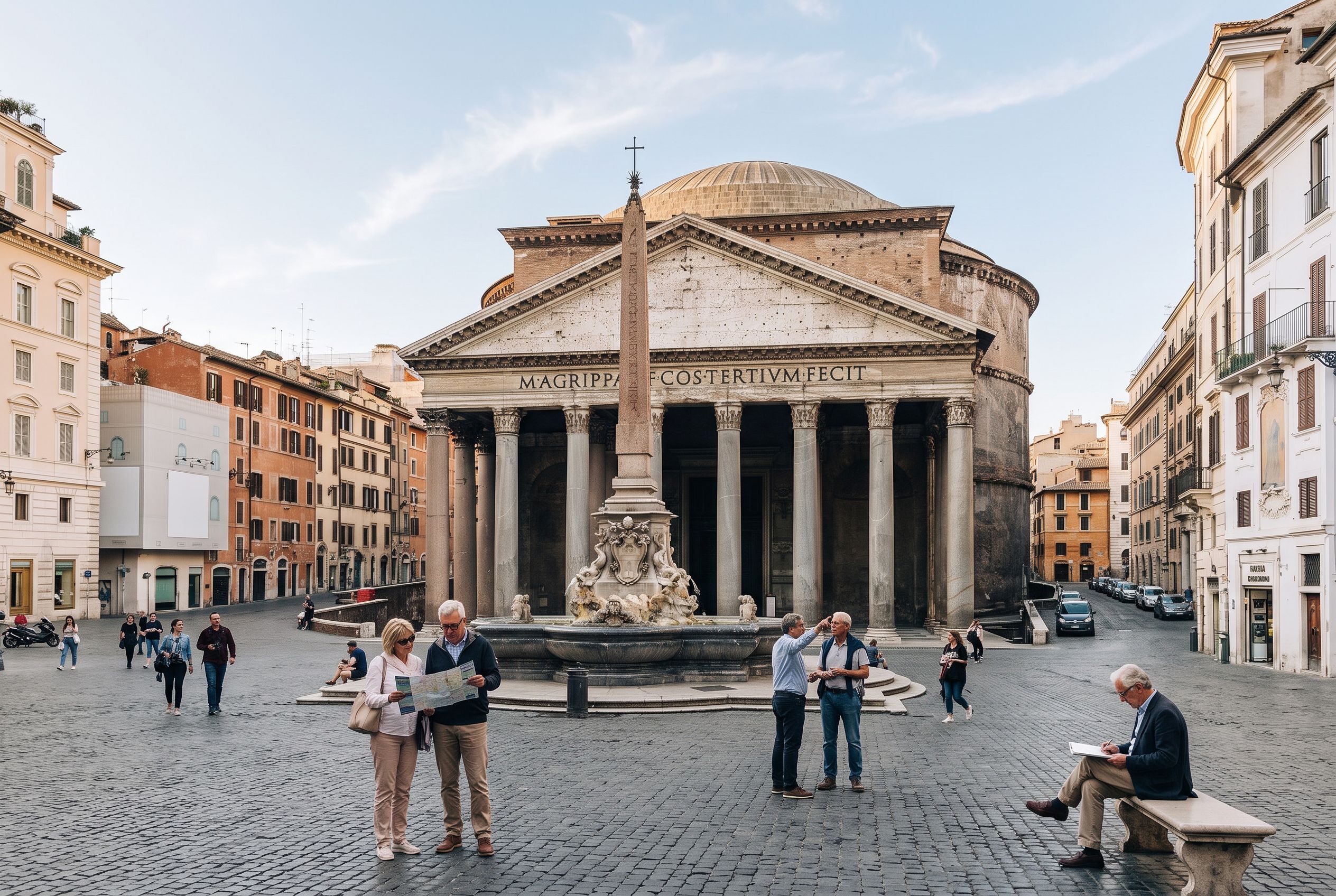
The Pantheon is described as one of the easiest major sites, with a small step or a mostly flat ground-level approach. Crowding in the surrounding piazza is noted, but the building itself presents no documented mobility complication beyond that step.
The Capitoline Museums are reported as fully accessible, with lifts to all levels, and free entry for disabled visitors plus one companion. Castel Sant'Angelo has documented lift access and upper-level viewing areas, with free entry for disabled visitors noted by one source. The Borghese Gallery has elevators and is listed among the better-adapted major sites, though tickets should be booked well ahead.
The Colosseum has ramps, lifts, step-free entrances and accessible toilets documented. The upper tiers and some underground areas remain inaccessible. Timed booking matters, and accessibility needs should be stated when booking.
The Vatican Museums publish a barrier-free route through most galleries, an alternative route to the Sistine Chapel, and wheelchair loans. One source notes a stair-lift constraint on the Sistine Chapel route and that some museum tours exclude wheelchair users. St Peter's Basilica has a step-free main floor reached by a side entrance that bypasses the main stairs, but the dome involves many steps even after a partial lift route.
Which sprawling sites should you admire selectively?
The Roman Forum and Palatine Hill are the clearest candidates for viewing from above rather than descending into. Sources describe uneven terrain, gravel, slopes and only partial accessibility, and some guides recommend taking in the view from the surrounding overlooks instead of walking the site itself.
One source estimates only 10 to 20 per cent is accessible, while another says a wheelchair-accessible route covers about 60 per cent of the site. Sources differ on this figure; confirm the current route with the site or a specialist operator before committing to a visit.
For travellers who want the Forum's atmosphere without the gravel, the practical answer is the elevated view. The same logic applies to the Colosseum's upper tiers and underground areas, which are documented as not fully accessible. Seeing them from the permitted levels, or from outside, is a legitimate way to experience them.
Metro Line C now reaches the Colosseum area at the Colosseo/Fori Imperiali station, which can reduce walking between major sights, according to Turismo Roma. As of 2026, ATAC has said works are starting to extend the lifts to that station's intermediate museum level, with early closures on 7 to 11 September and again from the evening of 18 September through 20 September, when trains terminate at Porta Metronia. Check the current station status close to your travel date.
Where are the best cafe-terrace vantage points?
sitting often, using plaza benches and planned cafe breaks, is repeatedly described by older travellers as essential to making Rome workable with little walking.
Forum contributors recommend going early to piazzas to avoid the crowds that make standing tiring, and suggest that a satisfying non-walking day can be built around Piazza Navona, a table near the Spanish Steps, or a short museum visit rather than a full monument circuit.
The Passeggiata del Gelsomino, a one-kilometre pedestrian path near the Vatican, opened in May 2025. It offers a flatter walking option close to San Pietro and the Vatican area for visitors who want a shorter, easier stroll.
Spring and autumn are identified by one source as the best times for seniors because of lower heat and easier sightseeing conditions. Our seasonal guide, Rome through the year: festivals, holy days and quiet seasons, sets out how the calendar affects crowding and comfort.
What does a low-walking day in Rome actually look like?
A realistic low-walking day pairs one booked site visit with one vehicle-based overview, separated by a long lunch. Forum contributors who travel with mobility limitations consistently describe grouping sights into taxi-based clusters: the Colosseum and Forum area, Piazza Navona and the Pantheon, and the Vatican with Castel Sant'Angelo.
The clusters matter because they keep walking in short bursts rather than continuous stretches. A morning at the Pantheon, a taxi to a long lunch, and an afternoon at the Capitoline Museums covers three major sights with perhaps twenty minutes of walking in total.
Several experienced travellers note that Rome is more walkable than it looks on a map, but only if the route is chosen carefully and the day is not overloaded. Others report being surprised by how quickly fatigue builds when sight-hopping through the historic centre, especially with uneven streets and crowding. Google Maps travel times before each outing are a repeatedly recommended check, since some distances are shorter than expected while others are awkwardly spread out.
For travellers who prefer a structured approach, small-group and guided tours of Rome can be arranged with shorter walking segments and pre-booked entry. Booking accessible tours in advance is advised for the Vatican Museums, the Colosseum and the Borghese Gallery.
| Option | Duration | Published price | Source |
|---|---|---|---|
| Roma City Tour hop-on-hop-off | 24 hours | €36 adult | romehoponhopoff.com/price/ |
| Roma City Tour hop-on-hop-off | 48 hours | €41 adult | romehoponhopoff.com/price/ |
| Golf-cart "All in" mini tour | 3 hours | €53 | alltours.rome.it |
| Golf-cart "History and Fun" tour | 4 hours | €65 | alltours.rome.it |
| Golf-cart "Rome by Night" tour | 2 hours | €50 | alltours.rome.it |
Rates are indicative and vary by season and booking channel. The Roma City Tour page does not publish a senior or over-65 fare, and no official visitor-only over-65 reduced tariff was documented for Rome.
What about tickets, discounts and booking?
A universal over-65 discount in Rome is not documented. One source states that non-EU seniors do not have a universal senior discount, and another says Italy no longer offers a general national over-65 discount at state museums. Reductions are more consistently tied to disability status, EU 18 to 25 eligibility, or specific institutional rules.
One source states that EU citizens aged 65 and over receive free entry to state museums on the first Sunday of each month, while noting that these days are crowded. That is a condition worth weighing against the comfort of a quieter weekday.
The Vatican Museums publish free entry for disabled visitors with a certified invalidity of at least 67 per cent, extended to a companion where the visitor is not self-sufficient, with priority skip-the-line entry guaranteed. These free tickets cannot be booked online and are issued at the Special Permits or Welcome Desk in the entrance hall on presentation of certification (museivaticani.va). Standard full entry is €20 without online booking, with a reduced €10 rate, and €10 plus €5 with skip-the-line booking on the official site. Tickets are valid only on the day of issue and cannot be refunded.
The Roma Capitale civic museums publish free entry on the first Sunday of each month, free admission for visitors with disabilities and a family member or carer, and a 50 per cent reduced rate for non-residents in the last two hours of opening every Wednesday (museodiroma.it). From February 2026, admission is free for residents of Rome and the Metropolitan City on presentation of valid identification at the ticket office.
Turismo Roma states that its Rome accessible content is designed so that people with disabilities or special needs, seniors and families can choose cultural spaces independently. For rail arrivals, Trenitalia's Sala Blu assistance service supports passengers with disabilities or reduced mobility.
When should you go, and what should you watch for?
Spring and autumn are identified by one source as the best times for seniors, because of lower heat and easier sightseeing conditions. The main practical cautions are uneven surfaces, crowding, queues and heat, plus temporary transport works that can complicate short journeys.
Rome's historic centre is repeatedly described as difficult for limited mobility because of sampietrini cobblestones, narrow sidewalks, crowding and uneven surfaces. Better-surfaced areas specifically mentioned are Prati, EUR, Lungotevere, and some main approach roads including Via del Corso, Via Nazionale and Viale di Trastevere.
On public transport, ATAC states that all metro stations in Rome are accessible to passengers with reduced mobility except four Line A stations: Spagna, Barberini, Repubblica and Vittorio Emanuele, which lack lifts or stair lifts to the platforms. ATAC also offers a stair-lift reservation service for metro lines A and B and wheelchair loans at stations on those lines.
Works can affect short itineraries. ATAC's planned works page shows continued service updates for September 2026, including Line C station changes and tram-network works. A 2026 guide noted the redesigned Termini and Piazza dei Cinquecento forecourt with a longer phase of works through 2026, which can affect arrivals and taxi pickup patterns near the main rail station. The emergency number 112 is explicitly stated by one source.
For travellers who want a comfortable base between outings, our closer look at Hotel Eden, Rome examines what a Dorchester Collection flagship offers guests who value quiet rooms and attentive service.
What does a sensible low-walking itinerary look like?
Base the trip around the Colosseum area, Vatican City and Prati, and the Pantheon area, using taxi transfers between them. Treat the Forum and Palatine Hill as optional rather than essential, and build each day around one booked visit plus one vehicle-based overview.
This structure is the best-supported strategy for the easiest Rome with the least walking. It also matches what older travellers report in practice: stay central, cluster sights, pre-book accessible tours, and keep each outing short enough that coffee stops and rests are part of the plan.
Two habits make the difference. First, allow double the time you expect for each activity, a recommendation that appears in forum discussions and is echoed by older travellers describing their own visits. Second, tell any guide or driver in advance if assistance is needed, so that entrances, drop-off points and pacing can be adjusted.
Rome is manageable for many older travellers, but only if the itinerary is built around pre-booked accessible visits, vehicles for the distances, and honest accounting of how much walking a day can hold. The city does not need to be conquered. It needs to be visited at a pace that leaves something in reserve for tomorrow.

