
Located in the heart of Tyrol, the Zillertal valley offers one of Austria's most accessible cycling experiences for active travellers aged 50 to 70. The signature route—the Zillertal Cycle Path—runs 31 kilometres along the valley floor, following the Ziller River on mostly paved and well-graded gravel surfaces. With only about 140 metres of elevation gain over its entire length, this is a ride designed for comfort, not conquest. For those who prefer a little assistance, the valley's dense network of hire shops and charging points, together with bike-friendly public transport, makes it possible to explore without overexertion. This guide focuses exclusively on gentle cycling and e-biking routes, leaving the mountain-biking singletrack and hiking trails for their own dedicated guides.
 AI-edited
What is the best route for a relaxed cycle?
The Zillertal Cycle Path (Zillerradweg) is the valley's premier route for relaxed cycling, running 31 kilometres from Strass im Zillertal to Mayrhofen. It follows the Ziller River on mostly flat, well-surfaced paths, making it ideal for e-bikes and standard bikes alike. The entire route is rated easy, with a gentle overall elevation gain of about 140 metres.
The path is well-marked and passes through charming villages like Fügen, Zell am Ziller, and Mayrhofen. You can ride the entire route in one leisurely morning, stopping at riverside benches and village squares along the way. Tirol's tourism board rates the whole ride as easy, gives it about two hours in the saddle and puts the highest point at 630 metres; the surface is largely asphalt, with only short gravel stretches. For a shorter outing, the section between Zell am Ziller and Mayrhofen is particularly flat and offers the most consistent river views.
Where can I hire an e-bike?
E-bike hire is available across the valley, with rental points in Fügen, Zell am Ziller, Gerlos and Mayrhofen. At Zillerbike in Fügen a day costs €35 for an e-trekking bike, €45 for a hardtail and €60 for a full-suspension model as of August 2026, and three- or six-day hire is cheaper. The Zillertal Arena alone counts 17 e-bike charging stations.
One of the most recommended rental shops is Zillerbike Unterlercher on Hauptstrasse in Fügen, which holds a Google rating of 4.3/5 from 129 reviews as of August 2026. Its workshop covers road, mountain, city and e-bikes. Note the midday break: the hire desk opens Monday to Friday from 8:30 to 12:00 and again from 14:00 to 18:00, on Saturday only from 8:30 to 12:30, and not at all on Sunday. Battery swapping is not part of the offer here: no shop or tourist board in the valley advertises an exchange service, so plan around charging points instead. For those staying in Mayrhofen, several hotels partner with local sports shops to offer on-site e-bike hire. Always book in advance during peak season (July and August), as popular models can sell out quickly.
How does the guest-card bike bus work?
The card you want is the Zillertal Activcard, a paid pass that covers the Zillertalbahn between Jenbach and Mayrhofen and most valley buses, so you can cycle one way and ride back. Buses take bicycles when there is room, at the driver's discretion. The Activcard also includes one return cable car trip a day and runs from 23 May to 26 October 2026.
The Zillertalbahn covers the 32 kilometres from Jenbach to Mayrhofen every half hour. It hires out city bikes at its staffed stations and carries those free of charge when there is room on board; every other bicycle needs a €5 ticket per bike. For a practical day trip, you could ride the cycle path from Mayrhofen to Strass (31 km), then take the train back to your starting point. The journey takes about 45 minutes by rail, giving you time to rest your legs while enjoying the valley views. Buses within the valley are also bike-friendly, though space is limited, so travel outside peak hours if possible.
Which mountain roads should I avoid?
For a gentle cycling experience, stay off the mountain roads leading to Gerlos, Finkenberg and Hintertux. These routes involve steep climbs and narrow, winding roads that are better suited to experienced cyclists or those with powerful e-bikes. Stick to the valley floor for a stress-free ride.
The roads to Gerlos and up the Tuxertal to Hintertux climb steadily and for a long time. Gerlos lies high above the valley — the Isskogelbahn's base station there stands at 1,300 metres, against 575 metres in Zell am Ziller — and Hintertux sits at 1,500 metres, some 860 metres above Mayrhofen. While an e-bike makes these climbs achievable, the traffic and narrow shoulders can be intimidating. If you do want to explore higher elevations, consider taking a cable car with your bike. The Zillertal Arena counts three summer cable cars with bike transport, allowing you to ascend without pedalling; in 2026 its lifts run between 23 May and 18 October, depending on the cable car. For a scenic day out beyond the valley, the Achensee has its own waymarked cycle path that runs flat along the lake to Maurach — though the full circuit of the lake adds a few hundred metres of climbing, mostly on the western shore.
The pattern most riders settle into here is a simple one: stay on the valley floor, ride in one direction at whatever pace suits you, and let the Zillertalbahn handle the return leg. On a profile this gentle an e-bike is less about speed than about arriving without stiffness, which is what turns the route into a relaxed day out rather than a training ride.
What climbs does an e-bike make achievable?
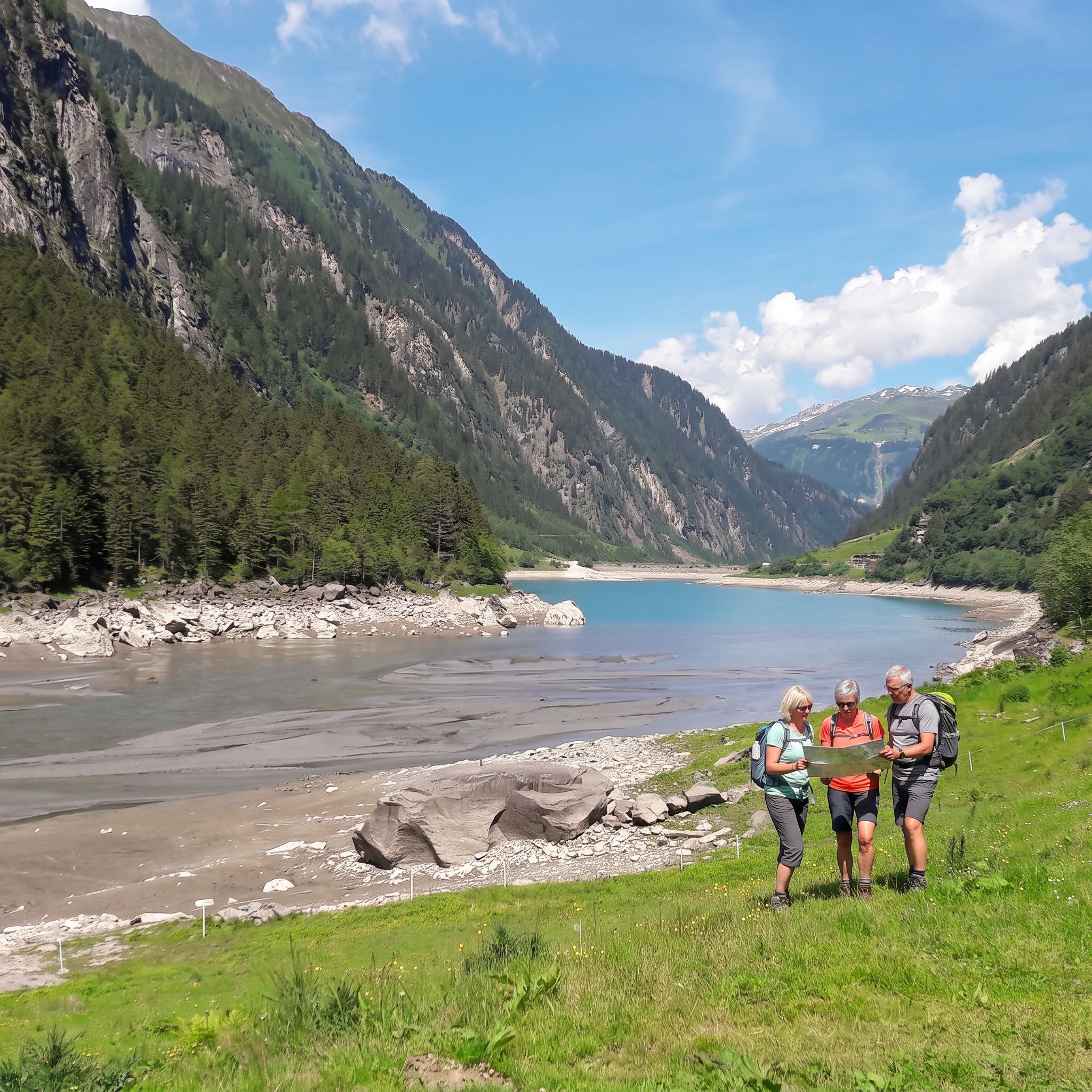
An e-bike turns the Zillertal's side-valley roads from daunting challenges into manageable excursions. With pedal assistance you can ride up the Zemmgrund towards the Schlegeis reservoir, or take the hairpins to the terrace village of Brandberg above Mayrhofen — both strenuous on a standard bike. The key is to start early and plan for battery range.
The Schlegeis Alpine Road is about 13 kilometres long, but it does not begin in Mayrhofen: the toll station stands at Breitlahner above Ginzling, and the whole ride from Mayrhofen to the reservoir comes to roughly 25 kilometres. The lake itself lies at about 1,800 metres, well over a thousand metres above the valley floor, so this is a full day even with pedal assistance. A shorter but still demanding alternative is the hairpin road up to Brandberg, the sun-facing terrace village at 1,080 metres — around nine kilometres from Mayrhofen and some 440 metres of climbing. Range depends far more on gradient and assistance level than on the battery label: the hire fleet at Zillerbike runs 500 Wh on trekking bikes and 625 to 750 Wh on the mountain models. Climbing drains any of them faster, so conserve power on the ascent and use higher assistance only when needed.
“The artificial reservoir is stunning, especially on a sunny day. The area is well-maintained with clean facilities, including toilets, and offers a great viewing point. You can even walk across the dam, which is an awesome experience!” — a Google review of the Schlegeis reservoir, September 2024
What should I know about path etiquette?
On shared-use paths, always ride at walking pace when passing pedestrians, especially elderly walkers, children, and dogs. Ring your bell well in advance—at least 20 metres before you approach—and give far more space than you think you need. On narrow sections, dismount and walk your bike rather than forcing a pass.
The Zillertal Cycle Path is popular with walkers, joggers, and families, so courtesy is essential. The most common mistake is treating a shared path like a fast cycle route. Slow down early, signal clearly, and assume pedestrians may be unaware of your presence. A bell carries better than a shouted "on your left", which tends to startle a walker rather than warn them. If you're riding in a group, ride single file on busy sections and avoid blocking the path. These small courtesies make the experience pleasant for everyone and ensure the path remains welcoming for all users.
What are the best bases for cyclists?
Fügen and Zell am Ziller are the best bases for cyclists aged 50-70, offering flat, compact centres directly on the cycle path. Mayrhofen is also workable but less uniformly flat, so choose a central, lift-equipped hotel. Avoid Gerlos, Finkenberg, and Hintertux for a base, as they involve steeper terrain.
Fügen is one of the flattest towns in the valley, with paved paths and easy access to the cycle corridor. It also hosts Zillerbike, the highly-rated rental shop. Zell am Ziller sits directly on the valley route and has a particularly walkable centre with restaurants, cafes, and a supermarket. Mayrhofen is a practical southern hub with good train connections, but its centre is hillier, so choose accommodation near the station or the cycle path. For a quiet night's sleep, ask for a room away from the B169 valley road, which carries the through traffic of the whole valley. Many hotels also offer secure bike storage and e-bike charging, so ask when booking.
What cultural stops should I make?
The valley offers several low-strain cultural stops perfect for cyclists. The Schaukäserei of the Zillertaler Heumilch Sennerei in Fügen is a highlight, with a show room and cheese museum that are free to enter. Village squares in Fügen, Zell am Ziller, and Mayrhofen offer baroque churches and traditional Tyrolean architecture, all within easy walking distance of the cycle path.
The Schaukäserei in Fügen is particularly suited to older visitors because it requires no strenuous walking. The show room and cheese museum at Sennereistrasse 22 can be visited without booking during business hours, and entry is free. Two things are worth knowing before you plan a lunch stop around it: the dairy shuts at midday on Wednesdays and Saturdays, and the guided tour and the €3 tasting are both only available for groups of ten or more, with a reservation. In Zell am Ziller, the parish church and the old town square offer a pleasant break from riding. For a longer stop, the Zillertaler Regionalmuseum at Talstrasse 50b in Zell am Ziller provides insight into valley history and culture; it opens Monday to Friday from 10:00 to 16:00, June to early October. These stops are designed for comfort and enjoyment, not endurance, making them ideal for a relaxed cycling holiday. For those interested in winter activities, see our guide on Tobogganing and Winter Walks in the Zillertal: A Gentle Snow Adventure for Active Over-50s.
When is the best time to visit?
The best time for cycling in the Zillertal is June to September, with June and September offering quieter paths and pleasant temperatures. July and August are busier and can reach 30°C, so plan rides for early morning or late afternoon. The valley path itself needs no season, but most mountain huts open only from June to October, so check before planning a hut lunch.
GeoSphere Austria's 1991-2020 records for the Mayrhofen station put the average July daily high at 24.8°C, with the warmest day of the month averaging 32.6°C; June and July each see about 15 days with at least a millimetre of rain. September brings cooler temperatures and fewer crowds, making it a favourite among experienced travellers. If you visit in late spring, check which mountain huts are open — the Tux-Finkenberg hut list shows most of them running from June to October. The Zillertal Arena's own 2026 calendar has its summer cable cars operating between 23 May and 18 October, depending on the lift, and the Zillertal Activcard is valid from 23 May to 26 October. For a balance of good weather and fewer people, aim for the first two weeks of September.
How accessible is the valley for less mobile travellers?
The valley floor is gentle rather than certified accessible. Tirol's tourism board rates the cycle path as easy and without notable climbs, mostly asphalted with short gravel sections, but no official source describes it as wheelchair-suitable. Zell am Ziller and Fügen have the flattest, most walkable centres. Always confirm specific accessibility features with a hotel before booking.
Tirol's official tour description calls the Zillertal Cycle Path an easy, family-friendly route without notable climbs, largely asphalted with only short gravel stretches and a highest point of 630 metres. What it does not say is that the path is wheelchair-suitable, and no other official source makes that claim either — so treat it as an easy ride rather than a certified accessible route. Some hotels advertise bike depots and secure storage, and a few list accessible rooms with walk-in showers. For those who want to explore without cycling, the Zillertalbahn provides easy access to villages along the route. Zillertal Tourismus keeps a Barrierefreier Urlaub section with a downloadable list of accessible excursion destinations, and the Austrian cable car association publishes a data sheet for each Zillertal mountain railway giving the highest point reachable without steps. For more active pursuits, see our guide on Half-Day Hikes in the Zillertal Alps for Active Over-50s.
What should I pack for a cycling trip?
Pack a helmet (rental shops charge separately for one — €2 at Zillertalbahn stations, €5 at Zillerbike in Fügen), gloves, weatherproof clothing, good cycling shoes, a phone, and a first-aid kit. Bring a water bottle and snacks, as the villages are strung out along 31 kilometres. For e-bikes, carry a charging cable and check your battery level before setting out.
The Zillertal tourism board calls exactly that kit mandatory for any bike-and-hike day. While the valley path is well-serviced, some stretches between villages have limited facilities. Pack a small backpack with layers, as mountain weather can change quickly. Sunscreen and sunglasses are essential in summer, as the valley is exposed. For e-bike riders, a spare battery is not usually necessary for the valley route, but if you plan to tackle climbs, consider renting a bike with a larger battery (500 Wh or more). Most rental shops provide a charger, and many hotels offer secure charging overnight.
What are the costs for a cycling holiday?
E-bike hire runs from about €35 to €60 a day, depending on the model and shop. Mid-range hotels cost roughly €80 to €200 a night in summer, breakfast often included. The Zillertal Activcard costs €95.50 for three consecutive days in 2026, plus a €2 card deposit, and covers trains, most buses and one return cable car trip a day. Lunch is €15 to €25 a head.
| Item | Cost (€) | Notes |
|---|---|---|
| E-bike rental (per day) | 35-60 | Zillerbike Fügen, August 2026; cheaper from three days |
| Standard bike rental (per day) | 14-19 | €14 city bike at Zillertalbahn stations; €15-19 at Zillerbike Fügen |
| Mid-range hotel (per night) | 80-200 | Often includes breakfast and bike storage |
| Zillertal Activcard (3 days) | 95.50 | Plus €2 card deposit; trains, most buses, one return cable car trip per day |
| Lunch at a mountain hut | 15-25 | Hearty Tyrolean dishes and drinks |
| Helmet rental (per day) | 2-5 | €2 flat at Zillertalbahn stations; €5 at Zillerbike Fügen |
What are the safety considerations?
Ride defensively, especially on shared paths. Wear bright clothing, use lights in low visibility, and always signal your intentions. Check your e-bike's brakes and tyres before each ride, and carry a basic repair kit. In an emergency dial 144 for an ambulance and 140 for mountain rescue; 112 is the general European emergency number.
Visibility and defensive riding matter more here than pace. Wear a helmet at all times, and use front and rear lights even during the day. On the valley path, be aware of pedestrians, children, and dogs—slow down well in advance and pass with plenty of space. For e-bikes, check that your battery is fully charged and that the brakes are responsive before setting out. If you're riding on roads, follow Austrian traffic laws: cyclists must use cycle paths where available, and riding on the pavement is prohibited unless marked. For longer rides, save the numbers that matter before you set off: 144 for the ambulance, 140 for mountain rescue if you come off in a side valley, and 1450 for Austria's round-the-clock health advice line. Knowing roughly where you are — the nearest village or path marker — matters more than the number you dial.
How do I get to the Zillertal?
The Zillertal is easily accessible by train from Innsbruck or Munich. The Zillertalbahn runs from Jenbach (on the main Innsbruck-Salzburg line) to Mayrhofen every half hour. By car, take the A12 Inntal motorway — a motorway vignette is required — to the Zillertal exit, then follow the B169 valley road. Parking is available at most hotels and at park-and-ride facilities in Zell am Ziller and Mayrhofen.
For non-driving travellers, the train is the most convenient option. From Innsbruck Hauptbahnhof, trains to Jenbach take 18 to 25 minutes and run several times an hour; from there the Zillertalbahn covers the 32 scenic kilometres to Mayrhofen in about 50 minutes. The railway hires out city bikes at its staffed stations in Fügen-Hart and Mayrhofen — €14 for a full day, €2 for a helmet — and carries its own hire bikes free, which makes the combination easy. If you're driving, the valley road (B169) runs the length of the Zillertal, but traffic can be heavy in summer. Park at your hotel and use the train or bike for local travel. For those interested in winter sports, see our guide on Skiing the Zillertal in Your 50s and 60s: A Guide to Gentle Slopes, Smart Pacing, and Alpine Comfort.
What makes the Zillertal suit riders over 50 is the combination rather than any single feature: a paved valley path with barely any gradient, a railway running alongside it that carries bikes, and the freedom to turn back at any station once you have had enough. It rewards a relaxed day far more than a hard one.
What are the top 5 locations for cyclists?
The top five locations for cyclists in the Zillertal are: 1) Zillertal Cycle Path (the main route), 2) Mayrhofen (southern hub), 3) Zell am Ziller (mid-valley base), 4) Fügen (flattest town), and 5) the Schaukäserei in Fügen (cultural stop). Each offers easy access to the cycle path and amenities for older travellers.
These locations are chosen for their accessibility, flat terrain, and proximity to the cycle path. Mayrhofen is the busiest base and the southern terminus of the railway. Zell am Ziller sits at the midpoint, where the Rosenalmbahn climbs from 580 to 1,744 metres between 23 May and 11 October 2026 if you want height without pedalling for it. Fügen has both the rental shop and the show dairy. The Schaukäserei provides a cultural break without strenuous walking, free of charge and without booking. For a more adventurous day, consider a ride towards the Schlegeis reservoir, but only with an e-bike and a full battery — and check the toll road's season first, which in 2026 runs from mid-May to 26 October. For those interested in via ferrata, see our guide on Via Ferrata and Klettersteig in the Zillertal for Confident Over-50s.


