
Hallstatt is one of Austria's most photographed villages, but its charm comes with a practical challenge for travellers who prefer not to walk far: the historic core is built on a steep mountainside, with cobblestones, stairs, and short climbs. The good news is that you can enjoy the classic lake views, the market square, a boat trip, and the funicular-served viewpoints with minimal effort—if you know exactly where to focus and which lanes to skip.
 AI-edited
What is the easiest way to arrive with minimal walking?
The most senior-friendly arrival is by train to Hallstatt station (across the lake), followed by a short ferry ride into the village. This route avoids the parking lots and shuttle buses, and delivers you directly to the flat lakeside promenade with your luggage already at your accommodation.
The train station is not in the village itself—it sits on the opposite, eastern shore of Lake Hallstatt. From the station, a short path leads down to the dock where the ferry Stefanie departs; Hallstatt's official tourism site puts it at a two-minute walk below the platform and says the route is easily managed with luggage. The crossing takes seven minutes and costs €4.00 one way or €8.00 for an open return ticket. Bring notes and coins: the boat takes no cards at all. The operator lists the Stefanie as taking wheelchairs on board, and the line runs 365 days a year.
If you are driving, note that the historic core is closed to visitor traffic altogether: two barriers seal it off, and there is no way in by car, not even to the hotels and apartments inside it. Cars go to the peripheral lots P1 to P4. The shuttle bus runs from P1 only, daily between 9:00 a.m. and 7:00 p.m., and it carries guests who have booked accommodation in the centre; day visitors walk, and Hallstatt's own parking pages put that walk at 20 minutes from P1 and 15 minutes from P2. For a low-walking visit, we recommend the train-and-ferry combination, which we cover in detail in our dedicated guide: Getting Around Hallstatt and the Lakes Without a Car: A Practical Primer for Travellers 50–70.
Where should I walk in Hallstatt to avoid hills and steps?
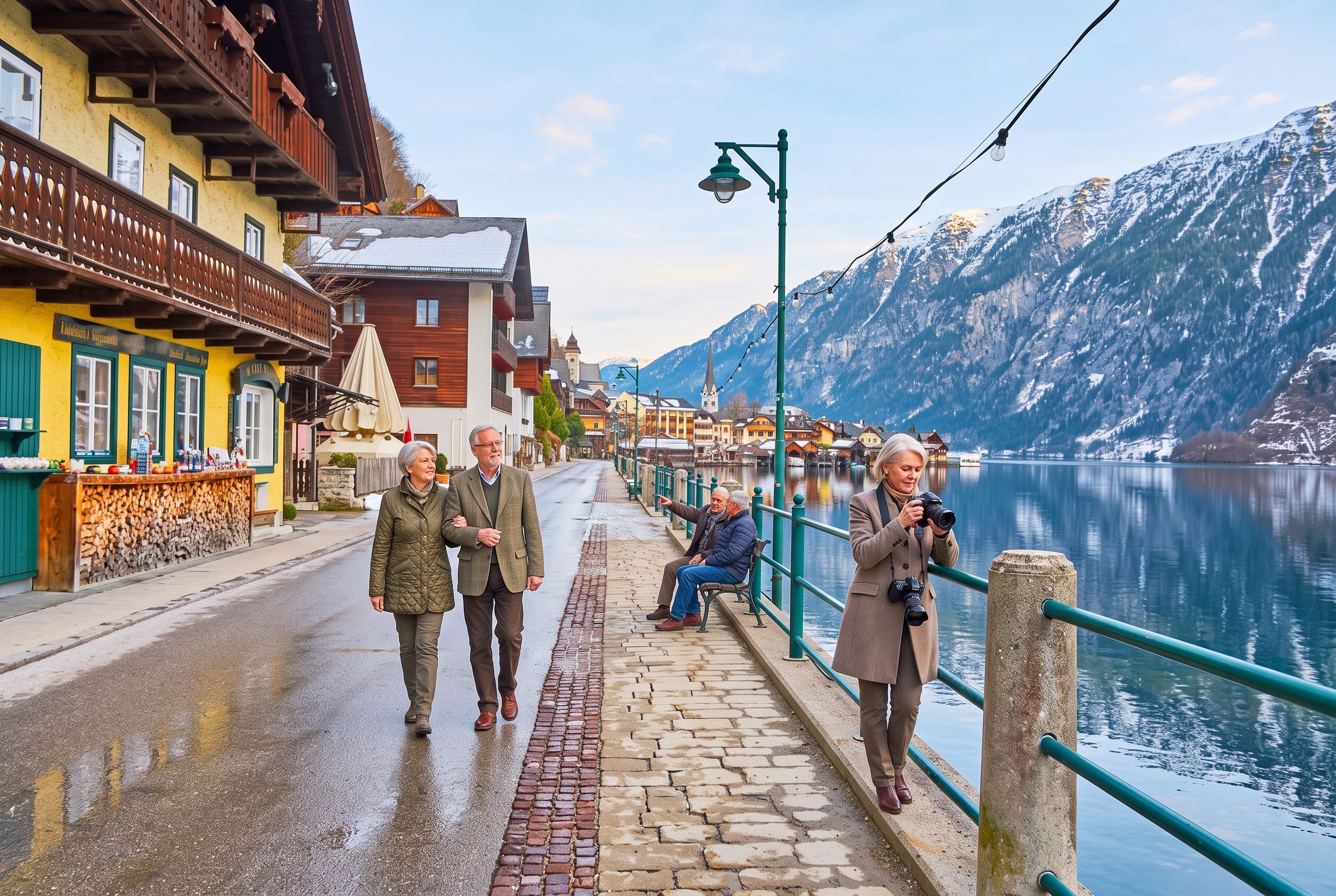
The lakeside promenade is the flattest, most step-free area in the village, making it the ideal zone for an easy stroll, photos, and café breaks. This is where you will find the iconic postcard views of the church spire reflected in the lake, all on level ground.
The promenade runs along the western shore of the lake, connecting the ferry dock to the southern end of the village. It is paved, wide enough for two people to walk side by side, and lined with benches where you can sit and watch the boats. Most of the village's best restaurants and cafés are located here, with outdoor terraces that let you enjoy the view without moving far.
Recent guests at the Seehotel Grüner Baum on the Marktplatz (4.0 out of 5 on Google from 1,919 reviews as of 25 August 2026) consistently praise the lakeside location for its easy access to the promenade and the ferry. The hotel's restaurant terrace is a popular spot for a midday rest.
Can I enjoy the market square without climbing?
Yes—the Marktplatz is located just a few steps inland from the promenade on mostly level ground. It is a compact, pedestrian-friendly square with a central fountain, pastel-coloured houses, and several benches where you can sit and soak in the atmosphere.
The market square is Hallstatt's social heart, but unlike the steep lanes that climb the hillside, it sits at the same elevation as the lakefront. You can walk from the promenade to the square in under two minutes on flat pavement. The square is small enough that you can see everything from a single bench. Local shops and a few cafés line the perimeter, making it a natural place to pause for a coffee or a light lunch.
A Google reviewer who stayed on the square wrote in September 2024: "The location is right in the middle of Market Square. It is very beautiful. … Chill at the restaurant outdoors from 1130 onwards. No regrets staying here, highly recommend if you love to just sit in the balcony and watch the clouds go by. I love it here."
Is a boat trip the best low-walking way to see Hallstatt?
Absolutely. A boat trip on Lake Hallstatt is the most senior-friendly sightseeing option: you remain seated, enjoy panoramic views of the village and surrounding mountains, and cover more scenery than you could on foot—all with zero walking.
Two operators run scenic trips, and both of them board in the village itself, so there is no transfer to organise. NAVIA sails hand-built replicas of the historic salt barges known here as Fuhren from its Seestraße pier: the Hallstatt circuit takes about half an hour and costs €16 for adults, by reservation, from April to October. Hallstättersee Schifffahrt runs the Round-trip South on the MS Hallstatt from the Markt pier to Lahn, Obertraun and back between May and September, departing at 11:00, 13:00, 14:00 and 15:00, with a 16:00 sailing added in July and August; the return fare is €18. The MS Hallstatt takes wheelchairs on board.
For a more practical option, the ferry that connects the train station to the village is itself a mini boat trip. Many travellers find that the seven-minute crossing, combined with a short walk on the promenade and a coffee in the Marktplatz, gives them the full Hallstatt experience without any strenuous walking.
Can I reach the viewpoints without walking uphill?
Yes—the funicular (Salzbergbahn) takes you up to the Skywalk viewing platform and the salt mine entrance, eliminating the steep climb. After the rebuild it reopens on 29 August 2026, and Salzwelten describes the ride itself, and the bistro at the top, as fully accessible. The mine below is a separate matter.
The funicular is the easiest way to reach Hallstatt's famous elevated viewpoints. Salzwelten describes the ride into the Hallstatt High Valley as comfortable and barrier-free, carrying you 360 metres above the village rooftops in a few minutes. From there a panoramic lift and a panoramic bridge lead on to the Skywalk, and the regional tourism board credits exactly that chain—funicular, lift, bridge—for making the platform easy to reach, naming senior citizens among the visitors it suits. The salt mine is a separate ticket and a different proposition: roughly a 15-minute walk from the Skywalk to the Knappenhaus, about two kilometres on foot underground, and the operator states plainly that the mine itself is not wheelchair accessible.
In the 2026 season the funicular runs from 29 August to 24 October, 9:00 a.m. to 6:00 p.m., and the mine from 9:30 a.m. to 4:30 p.m.; outside those dates the boat trip is the best low-walking alternative, and a different but equally beautiful perspective. A funicular return ticket costs €29 for adults and the combined ticket with the salt mine €49; both go on sale from 1 September 2026.
"Our boat trip on the lake in Hallstatt was one of the most magical experiences of our journey. The views are absolutely breathtaking… Sailing across the calm water gave us a completely different perspective of Hallstatt's beauty and it was both relaxing and inspiring. I especially loved how peaceful the atmosphere was — just the sound of the water and the stunning scenery all around." — from a review left on Google in September 2025
Which indoor attractions are easiest to visit with limited walking?
Both of Hallstatt's cultural landmarks ask something of you. The Welterbemuseum is indoors and compact, but states on its own website that it is not barrier-free; the parish church and its Bone House are reached over numerous steps or the somewhat steeper Kirchenweg. Plan them as deliberate outings, not casual detours.
The Hallstatt Museum carries a plain notice on its own website: the Welterbemuseum Hallstatt is unfortunately not barrier-free. That does not rule it out—it is indoors, compact and warm in any weather—but it does mean asking the museum what the route through the building involves before you build a day around it. It houses the village's famous archaeological finds from the Hallstatt culture (an early Iron Age civilisation that gave the village its name). Admission is €12 for adults and €11 from the age of 60, with last entry 60 minutes before closing. The museum opens 10:00 to 18:00 from May to September, 10:00 to 16:00 in April and October, and 11:00 to 16:00 from November to March.
The Pfarrkirche Maria am Berg and its adjacent Bone House (Beinhaus) sit on the hillside above the village. Hallstatt's tourism office is blunt about the way up: the ascent runs over numerous steps, or over the somewhat steeper Kirchenweg. Neither is a stroll, and there is nowhere to sit along the way, so treat it as the one climb of the day rather than an afterthought. The chapel dates from the 12th century and holds over 600 artistically painted skulls, most of them decorated at the end of the 18th century. The church itself is free to enter; the Bone House charges €2.00 for adults and €0.50 for children.
For a more comprehensive cultural itinerary, see our guide: Hallstatt and the Salzkammergut for Travellers Over 50: A Realistic Guide.
Which lanes should I skip to avoid unnecessary walking?
Avoid the steep side lanes that climb the hillside away from the lake—specifically the streets leading up to the upper parking areas and the path toward the waterfall. These involve cobblestones, stairs, and significant inclines that add effort without proportional reward for a low-walking visit.
The historic core has several narrow lanes that look inviting from the promenade but quickly become steep and uneven. The most common mistake is setting off for the waterfall on a whim: the Waldbachstrub falls lie back in the Echerntal, the walk starts at car park P2 by the funicular, and Hallstatt's own tourism site puts the family-friendly hike there at about two and a half hours. Another lane to skip is the one leading to the Kirchenweg (church path) if you are not visiting the church—it is a steep, cobbled climb with no benches for resting.
Instead, stay on the lakeside promenade and the Marktplatz. These two areas contain the village's most photogenic views, best cafés, and essential services. If you want a slightly longer walk, continue south along the promenade toward the Lahn area, which remains flat and offers a quieter perspective of the lake. And if you would like woodland without a climb, the front section of the Echerntal is a level promenade of about an hour and a half, lined with information boards and, in the tourism office's own words, suitable for strollers.
Where are the best places to sit and rest in Hallstatt?
The lakeside promenade has numerous benches with direct lake views. The Marktplatz has shaded seating around the fountain. Several cafés and restaurants on the promenade offer outdoor terraces where you can sit for an hour with a drink and watch the world go by.
Here are the top rest stops, ranked by comfort and view:
| Location | Type | Good to know | View |
|---|---|---|---|
| Promenade benches (south end) | Public bench | Free, no shade | Lake and mountains |
| Marktplatz fountain | Public bench | Free, some shade | Village square |
| Derbl, Marktplatz | Café terrace | Cards accepted | Village square |
| Seehotel Grüner Baum terrace | Restaurant terrace | Step-free entrance, accessible WC | Lake and mountains |
| Ferry dock waiting area | Covered bench | Sheltered from rain | Lake and arriving boats |
For a longer rest, consider NAVIA's half-hour Hallstatt circuit from the Seestraße pier (€16 for adults, April to October, by reservation) or the Round-trip South to Obertraun and back (€18, May to September). Sitting is the whole point of both, and the gentle motion of the lake makes them an easy place to rest while still sightseeing.
One more thing worth knowing before you set out: the public toilet at the Lahn bus terminal is listed in the regional tourism register as completely suitable for wheelchairs and compliant with the legally stipulated ÖNORM. It is down in Lahn, at the southern end of the village.
What practical tips ensure a smooth low-walking visit?
Visit early morning (8:00–11:00 a.m.) or late afternoon (after 4:00 p.m.) to avoid crowds. Book your ferry and any boat trips in advance during peak season. Wear sturdy, comfortable shoes even for short walks, as the promenade can be uneven in places.
Hallstatt is most pleasant for low-walking travellers during shoulder seasons (April–May and September–October) when temperatures are mild and crowds are thinner. Weekdays are significantly quieter than weekends. If you are arriving by train, check the ferry schedule in advance—one timetable runs all year, and the first sailing from Hallstatt station is at 08:35, with an extra 07:32 boat Monday to Friday on school days and the last crossing at 18:30.
For a full itinerary that balances sightseeing with rest, see our four-day plan: A Four-Day Hallstatt and Salzkammergut Itinerary for the Over-50s: Beating the Crowds, Savoring the Serenity.
Finally, one correction worth carrying with you, because it cuts both ways. The Welterbemuseum, the obvious indoor stop and the one a low-walking plan tends to lean on, states on its own website that it is not barrier-free. The lake, meanwhile, is more open than the village looks: the operator lists the Stefanie on the station route and the MS Hallstatt on the Round-trip South as taking wheelchairs on board. From 29 August 2026 the rebuilt funicular carries you up barrier-free, a panoramic lift and bridge lead on to the Skywalk, and the Salzwelten bistro at the top is accessible too, though the mine below it is not. If you use a walking aid, ring your accommodation ahead—and ask the museum specifically what its stairs involve.
"Fantastic museum showing all periods of Hallstatt history. You can get a great understanding of the town and region in about an hour. Well worth the visit!" — one Google reviewer noted in June 2025
Frequently Asked Questions
Is the Hallstatt Museum wheelchair accessible?
No. The museum states it plainly on its own website: the Welterbemuseum Hallstatt is unfortunately not barrier-free. The regional tourism register does not contradict that; it simply asks visitors to get in touch for details. So treat the museum as an open question rather than a safe bet, and ring ahead to ask what the route through the building involves. Adults pay €12 and visitors from the age of 60 pay €11, with last entry 60 minutes before closing. If the answer rules the museum out, the ferry and, from 29 August 2026, the funicular to the Skywalk are two Hallstatt sights whose operators do document step-free access.
How long does the ferry from the train station take?
The crossing from Hallstatt station to the village dock takes seven minutes. One timetable covers the whole year, valid from 14 December 2025 to 13 December 2026: the first sailing from the station is at 08:35 and the last at 18:30, with roughly one boat an hour in between and an extra 07:32 departure Monday to Friday on school days. Hallstatt's tourism office describes the pier as a two-minute walk below the platform, easily managed with luggage. The fare is €4.00 one way and €8.00 for an open return ticket, and the boat takes cash only—no card payment is possible on board.
Can I see Hallstatt in just two hours with minimal walking?
Yes. A two-hour visit focused on the lakeside promenade and Marktplatz is entirely feasible. Arrive by ferry (€4.00 one way, cash only), walk the promenade for 20 minutes, sit at a café for half an hour, and take the return ferry. This gives you the classic lake views, the village atmosphere, and the iconic photo opportunities without any walking beyond the flat promenade.
What should I do if the funicular is closed during my visit?
The funicular reopens on 29 August 2026 and then runs until 24 October, 9:00 a.m. to 6:00 p.m. Outside those dates the best alternative for elevated views is a boat trip on Lake Hallstatt, which gives you the village and the mountains from the water without leaving your seat. For a different perspective, ride the Dachstein Krippenstein cable car above Obertraun to the Welterbeblick, the World Heritage view: five minutes on foot from the mountain station of section 2, an easy walk, and a route the operator states outright is wheelchair accessible and suitable for guests who are not so good on their feet. The Welterbespirale higher up is a 15-minute hike from the same station, and the operator's own wheelchair page warns of stony and steeper sections on the way to it. Both are open with section 2 of the cable car, from 1 May to 1 November 2026.


