
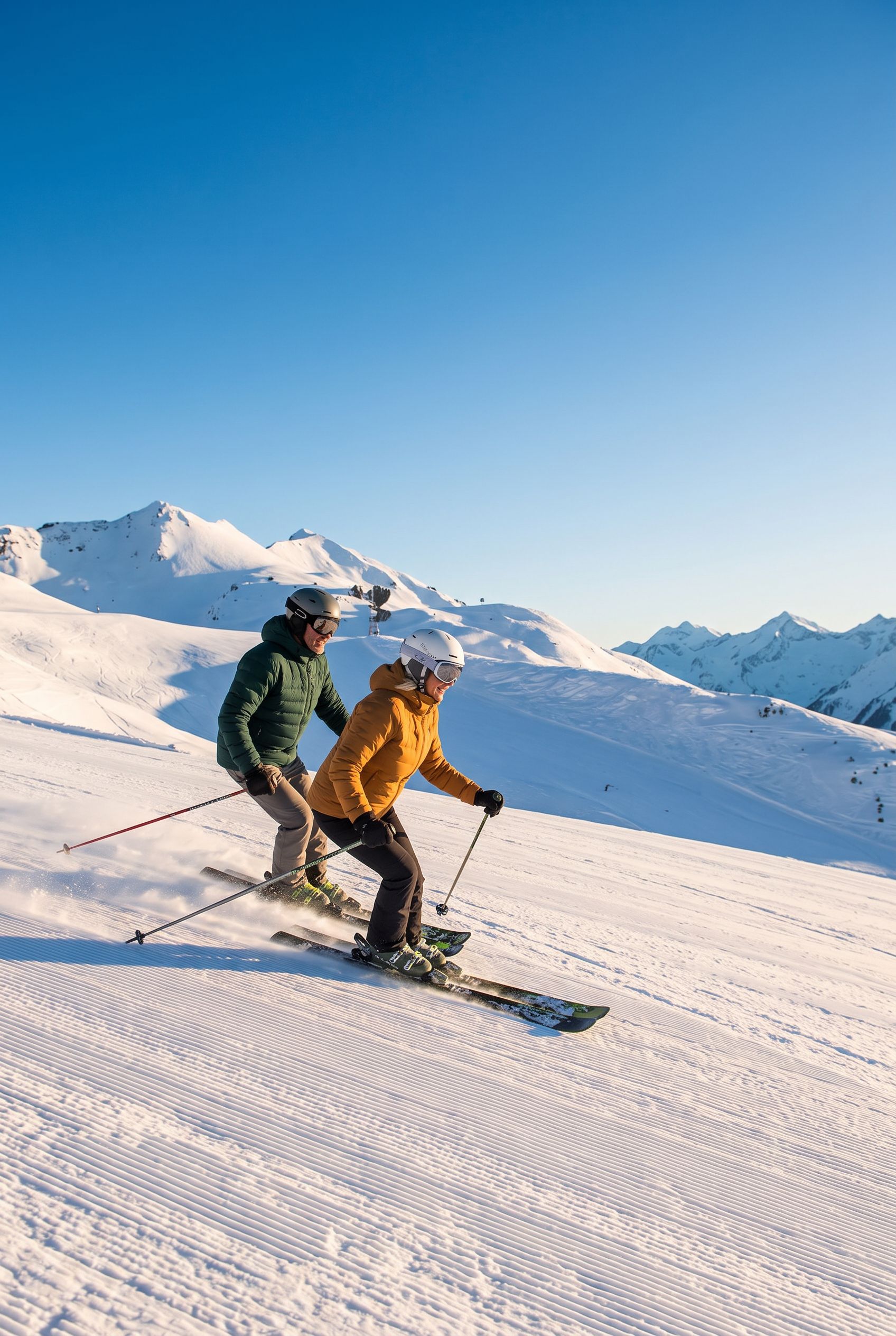
Located in the heart of Tyrol, the Zillertal is a long, sun-drenched valley that runs south from the Inn River toward the Hintertux Glacier. For skiers in their 50s and 60s, it offers something increasingly rare: a place where you can still find wide, forgiving blue runs, modern lifts that spare your knees, and a culture that values a proper afternoon rest as much as vertical meters. This guide focuses on where to ski gently, how to pace yourself, and which bases make the logistics easy.
Which bases are best for older skiers?
Zell am Ziller, Fügen, and Mayrhofen are the three most practical bases for skiers aged 50-70. Zell am Ziller offers the flattest, most walkable village centre with compact access to the Zillertal Arena. Fügen is quieter and spa-oriented, with a step-free gondola. Mayrhofen provides the widest range of services and ski areas, though it has more traffic and some hilly sections.
Zell am Ziller is the easiest base for those who want to park the car and walk everywhere. The village centre is nearly flat, with paved paths connecting hotels, cafés, and the Rosenalmbahn lift. The Zillertal Arena, accessed from here, has a large beginners' area with tow lifts and moving carpets at Rosenalm, making it ideal for refresher days. Fügen, further north, is calmer still. Its Spieljochbahn gondola has ground-level boarding, and the village is compact enough that you can stroll to the spa in your bathrobe after skiing. Mayrhofen is the valley's largest town, and while it is walkable, some streets slope. It gives you direct access to the Ahorn and Penken mountains, plus a 30-minute drive to the glacier.
"I chose Zell am Ziller because I could walk from my hotel to the lift in five minutes on flat pavement. No stress, no shuttles. That mattered more than the size of the ski area." — David K., traveller from Canada
Recent guests at hotels in these bases consistently praise quiet rooms and good breakfasts as essential for a successful ski holiday. The most common complaint is night-time noise from nearby bars or corridors, so when booking, request a room facing away from the main street or on an upper floor. For a deeper look at the valley's walkability and village layouts, see our guide to Easy Valley Walks and the Best Views in the Zillertal.
Where are the gentlest slopes for cautious skiers?
The gentlest skiing in the Zillertal is found on the blue runs of the Rosenalm area in Zell am Ziller, the Ahorn mountain above Mayrhofen, and the lower sections of the Hintertux Glacier. These areas offer wide, well-groomed pistes that are perfect for building confidence or simply enjoying a relaxed day on the snow.
The Rosenalm area in the Zillertal Arena is the valley's most dedicated beginner and easy-intermediate zone. Its blue runs are broad and rarely steep, and the lift system is modern with heated seats on some chairs. Ahorn, above Mayrhofen, is described by local skiers as "possibly the best valley run in the area" and stays sunny all day, which makes a difference for comfort and visibility. The lower runs of the Hintertux Glacier, accessed via the Tuxer Fernhaus lift, are also gentle and reliable, though the upper glacier terrain from Gletscherbus 3 is steeper red runs that are better suited to confident intermediates.
For those who want to explore the valley's peaks without committing to a full ski day, our guide to Riding the Cable Cars: The Zillertal's Peaks Without the Climb covers the best scenic lift rides for non-skiing companions or rest days.
How accessible are the lifts and transport?
Major lifts in the Zillertal, including the Ahornbahn, Rosenalmbahn, Spieljochbahn, and Hintertux Glacier gondola, offer step-free or ground-level boarding. The Zillertalbahn railway, which runs from Jenbach to Mayrhofen, is low-floor and wheelchair-accessible with a lifting platform, though staff assistance should be booked in advance.
This matters more than you might think. After a morning of skiing, the last thing you want is a long climb up stairs to a lift station. The valley's investment in barrier-free infrastructure is one of its strongest assets for older visitors. According to Zillertal Tourism's accessible-holidays page, the valley is the widest side valley on the south side of the Inntal, which helps explain why valley-floor travel is so easy. The Zillertalbahn, in particular, is a practical link between bases, and as of July 2026, it runs regularly with low-floor carriages. If you are staying in Mayrhofen but want to ski the Arena, you can take the train to Zell am Ziller in about 15 minutes.
For those with reduced mobility, requesting assistance in advance is recommended for the Zillertalbahn, where staff help is needed for the lifting platform. The same applies to some older lifts in the valley, though most major gondolas now have level boarding. The Spieljochbahn in Fügen is a standout for its step-free access from the village centre directly to the mountain.
What about the Hintertux Glacier for older skiers?
The Hintertux Glacier is the valley's most reliable snow insurance, offering skiing from late September to late July. However, its upper runs are steeper than many expect, and the weather can change rapidly. For older skiers, it is best approached as a half-day destination, starting lower and assessing conditions before committing to the top.
As of July 2026, the glacier's continuous 365-day skiing has ended, with a summer break introduced due to deteriorating snow conditions. Skiing was planned to run until late July 2026, then restart in September. This change, reported by Snowsports News, means that summer skiing on the glacier is now weather-sensitive rather than guaranteed. For winter visits, the glacier remains excellent, but forum reports consistently warn that the runs from the very top of the Gletscherbus 3 lift are "quite steep red runs" and "definitely the hardest on the glacier."
The glacier also offers a non-skiing attraction: the ice palace, a 1.5-hour tour through the glacier's interior for about €40. One traveller described the icicles as "truly enchanting," making it a good option if one partner wants a break from skiing. The spring ski bus from Mayrhofen to Hintertux runs from 13 April to 15 May 2026, which helps older skiers avoid driving in shoulder season.
Are there ski schools for mature guests?
Yes, several ski schools in the Zillertal offer private lessons and small-group refresher courses specifically for adults. The Ski School Zillertal Arena in Zell am Ziller and the Ski & Snowboard School Mayrhofen both cater to older skiers who want to rebuild confidence or refine technique without the pressure of mixed-age classes.
Private lessons are the most efficient option for skiers in their 50s and 60s. A two-hour private session costs around €120-€150 and allows you to focus on exactly what you need: carving technique, speed control, or simply navigating a new ski area. Group lessons for adults are also available, but they tend to be smaller and more relaxed than the bustling children's groups. The Ski School Zillertal Arena specifically advertises "refresher courses for returning skiers," which is exactly the language that suits this audience.
When booking, ask for an instructor who speaks your language and has experience with adult learners. Most schools can accommodate this request. It is also worth noting that the valley's ski schools are used to guests who ski for a few hours, take a long lunch, and then call it a day. There is no pressure to ski from first lift to last.
How to pace yourself for a full week?
The recommended rhythm for older skiers in the Zillertal is one mountain activity in the morning, a proper lunch in a mountain hut, and then spa or village time in the afternoon. Skiing from 9:00 to 12:30, followed by a two-hour lunch and an afternoon of rest, allows you to ski five or six days without exhaustion.
This pacing is not just a suggestion; it is the pattern that experienced senior travellers in the valley consistently report as the key to a successful week. Forum posts from skiers in their 50s and 60s emphasise starting early to avoid the 9:00 to 10:00 crowd at lift bases, then moving to quieter parts of the mountain before ski school groups arrive. One poster recommended using the Horbergbahn instead of the Penkenbahn, and Hochfügen over Kaltenbach, to avoid morning bottlenecks.
Another critical piece of advice: avoid unnecessary valley descents. The congestion builds up at the bottom, and the energy drain of skiing down to the village and then taking a lift back up is significant. Instead, stay on the mountain for lunch and use lift returns where possible. The mountain huts in the Zillertal are legendary for their food and atmosphere, and they are the perfect place for a long, restorative break. For a list of the best huts for a quiet lunch, see our guide to Half-Day Hikes in the Zillertal Alps for Active Over-50s, which covers several huts accessible from the slopes.
Where to rest and recover?
The best mountain huts for a quiet, restorative lunch are the Tuxer Fernhaus on the Hintertux Glacier, the Rosenalmhütte in the Zillertal Arena, and the Ahornhütte on the Ahorn mountain. All three serve hearty Tyrolean food, have sunny terraces, and are located on gentle terrain that is easy to reach on skis.
The Tuxer Fernhaus is a classic stone hut at 2,660 metres, serving goulash soup, käsespätzle, and strudel. It is located on the lower glacier, so you can reach it without tackling the steep upper runs. The Rosenalmhütte is at the top of the Rosenalmbahn, with a wide sun terrace and a menu that includes vegetarian options. The Ahornhütte is a modern, family-run hut with excellent apple strudel and a view across the entire valley. All three huts are popular, so aim to arrive by 11:30 to secure a table on the terrace.
Back in the valley, the spa towns of Fügen and Zell am Ziller offer excellent wellness facilities. The Erlebnisbad Zell am Ziller has an indoor pool, sauna, and steam room, while the Therme Fügen is a full spa complex with multiple pools and treatment rooms. Recent guest reviews consistently praise the wellness facilities in Mayrhofen hotels, particularly the indoor 25-metre pool and infinity pool at the Alpenbad Hotel Hohenhaus, though some note that the Badehaus wellness area is only open from 14:30 to 19:00, which can feel restrictive after a full ski day.
| Hut Name | Location | Altitude | Speciality |
|---|---|---|---|
| Tuxer Fernhaus | Hintertux Glacier | 2,660 m | Goulash soup, käsespätzle |
| Rosenalmhütte | Zillertal Arena | 1,800 m | Vegetarian options, strudel |
| Ahornhütte | Ahorn mountain | 1,960 m | Apple strudel, valley views |
What about costs and lift passes?
The Zillertal offers a single valley-wide lift pass covering all four major ski areas, including the Hintertux Glacier. As of the 2025-2026 season, a six-day pass costs approximately €350-€400 for adults. Note that the Zillertal Arena does not offer senior citizen discounts, so the standard adult rate applies to all skiers over 18.
The valley-wide pass is the most practical option if you want to sample multiple areas. It covers 180 lifts and about 542 km of slopes, according to Zillertal Tourism. If you plan to stay in one area, single-area passes are available at a lower cost. The Hintertux Glacier pass is separate but can be added to the valley-wide pass for a supplement. For those driving, parking at the main lift stations is generally free, though spaces fill by 9:30 on peak days.
Lift-pass prices are subject to change, so check the official Tyrol tourism website for current rates before booking. The valley's ski season runs from late November to mid-April, with the glacier extending into summer. For the best combination of snow reliability and sunshine, March and April are ideal, with longer days and warmer temperatures.
What to pack for a senior ski trip?
Beyond standard ski gear, pack a good-quality neck gaiter, hand warmers, and a lightweight down jacket for lunch breaks on the terrace. Comfortable walking shoes are essential for the village, and a small backpack for water and snacks will save you from buying overpriced drinks on the mountain.
Hydration is more important than many skiers realise. The altitude and exertion can dehydrate you quickly, leading to fatigue and muscle cramps. Carry a 500ml water bottle and refill it at mountain huts, where tap water is safe and free. Sunscreen is non-negotiable, even on cloudy days, as the reflection off the snow is intense. A lip balm with SPF is also worth packing.
For the village, pack a pair of thermal trousers or a long coat for evening walks. The valley can be cold after sunset, and you will appreciate having something warm to wear to dinner. If you plan to use the spa facilities, bring a swimsuit and a robe; most hotels provide towels and slippers.
Are there non-ski activities for rest days?
Yes, the Zillertal offers excellent non-ski activities, including scenic cable car rides, easy valley walks, and day trips to Innsbruck, the Achensee, or the Krimml Waterfalls. Snowshoeing and tobogganing are also available but have their own dedicated guides.
For a rest day, take the Ahornbahn to the top of the Ahorn mountain for panoramic views of the Zillertal Alps. The cable car ride itself is an experience, and the summit has a restaurant and a short walking trail. The Zillertalbahn steam train runs on select dates and is a charming way to see the valley without effort. For a longer excursion, the city of Innsbruck is about an hour away by train, with its imperial palace, alpine zoo, and Christmas markets in winter. Our guide to Day Trips Worth Making from the Zillertal: Innsbruck, Achensee, Krimml & Wattens covers these options in detail.
For those who want to stay active but give their knees a break, the valley's paved walking paths are perfect for a gentle afternoon stroll. The path from Zell am Ziller to the nearby village of Zellberg is flat and takes about 30 minutes each way, with views of the surrounding mountains. Snowshoeing and tobogganing are popular winter activities in the valley, but they are covered in separate guides and are not detailed here.


