
The Dolomites sit at a crossroads of cultures, and the plate reflects it. South Tyrolean cooking draws on Austrian, German and Italian traditions at once, while the Ladin valleys hold their own older kitchen with its own names for things. For food-minded travellers aged 50-70, the reward is a mountain region where the everyday cooking is often the point of the journey rather than an afterthought. The dishes are hearty, the portions generous, and the best of it is served in places that have been feeding walkers and families for generations.
This guide covers the South Tyrolean and Ladin specialities worth seeking out, the difference between a mountain-hut lunch and a valley inn dinner, and how to eat well without paying tourist-strip prices. High-end restaurant dining and hotel restaurants are separate subjects with their own dedicated guides, so they are mentioned only in passing here.
What are the classic dishes of the Dolomites?
The core repertoire is short and consistent: canederli (bread dumplings), speck, schlutzkrapfen, barley soup, polenta with mountain cheese, Kaiserschmarrn and apple strudel. Ladin valleys add cajincì, tutres, furtaies and poppy-seed pastries. These appear across hut menus, bakeries and gasthaus-style inns throughout the region.
Canederli, known in German as Knödel, are described by the Dolomites tourism authority as the emblem of mountain cuisine, served either in broth or dressed with melted butter. They are the single most reliable dish to order if you want to understand what the region cooks when nobody is performing for visitors.
Speck Alto Adige carries PGI status, a cured ham made with traditional smoking methods. One practical warning surfaces repeatedly in traveller accounts: menus sometimes translate speck simply as "bacon," and it is not the same thing. Read it as smoked local ham, not as a breakfast strip.
Schlutzkrapfen are half-moon ravioli, typically filled with spinach and ricotta. In the Ampezzo valley around Cortina d'Ampezzo, the local variant is casunziei ampezzani, filled with red beetroot and dressed with melted butter, poppy seeds and smoked ricotta. Polenta with melted alpine dairy cheese is described by the regional tourism authority as the ultimate comfort food of the Dolomitic valleys.
 AI-edited
Desserts matter here. Apple strudel is called the iconic dessert of South Tyrol: wafer-thin pastry rolled around apples, raisins, pine nuts and cinnamon. Kaiserschmarrn, the shredded pancake, appears on nearly every hut menu and is frequently named by travellers as a reason to stop walking.
What is different about Ladin cooking?
The Ladin valleys, centred on the six Ladin villages of Alta Badia, keep a distinct kitchen with its own dish names: cajincì, tutres, furtaies, smoked ham dumplings and poppy-seed pastries. Ladin is described as the oldest language of the Alpine region, and the food follows that separate line.
The South Tyrol tourism board documents a denser set of specific traditional dishes at the Alta Badia and Ladin valley level than for the Dolomites as a whole, including Panicia, Bales, Gnoch, Turtres, Grestl, Fortaies and Jufa. If you have eaten canederli and strudel elsewhere in the Alps, this is the layer that will be new to you.
Autumn is when the Ladin and South Tyrolean farm calendar turns most visibly edible. Törggelen season runs from early October to late November in South Tyrol, when farm inns serve Schlutzkrapfen, Knödel, cured meats, sausages with sauerkraut, sweet krapfen, roasted chestnuts, grape must and young wine. Alta Badia also runs an autumn event called Saus dl Altonn, with food at selected alpine pastures and huts.
Mountain-hut lunch or valley inn dinner: which should you choose?
Huts are best at lunch. Several travellers report that rifugios serve sit-down meals of genuinely high quality rather than ski-lodge snack food, and that lunch is the better meal to take there. Valley inns and gasthaus-style restaurants suit dinner, when you are off the mountain and unhurried.
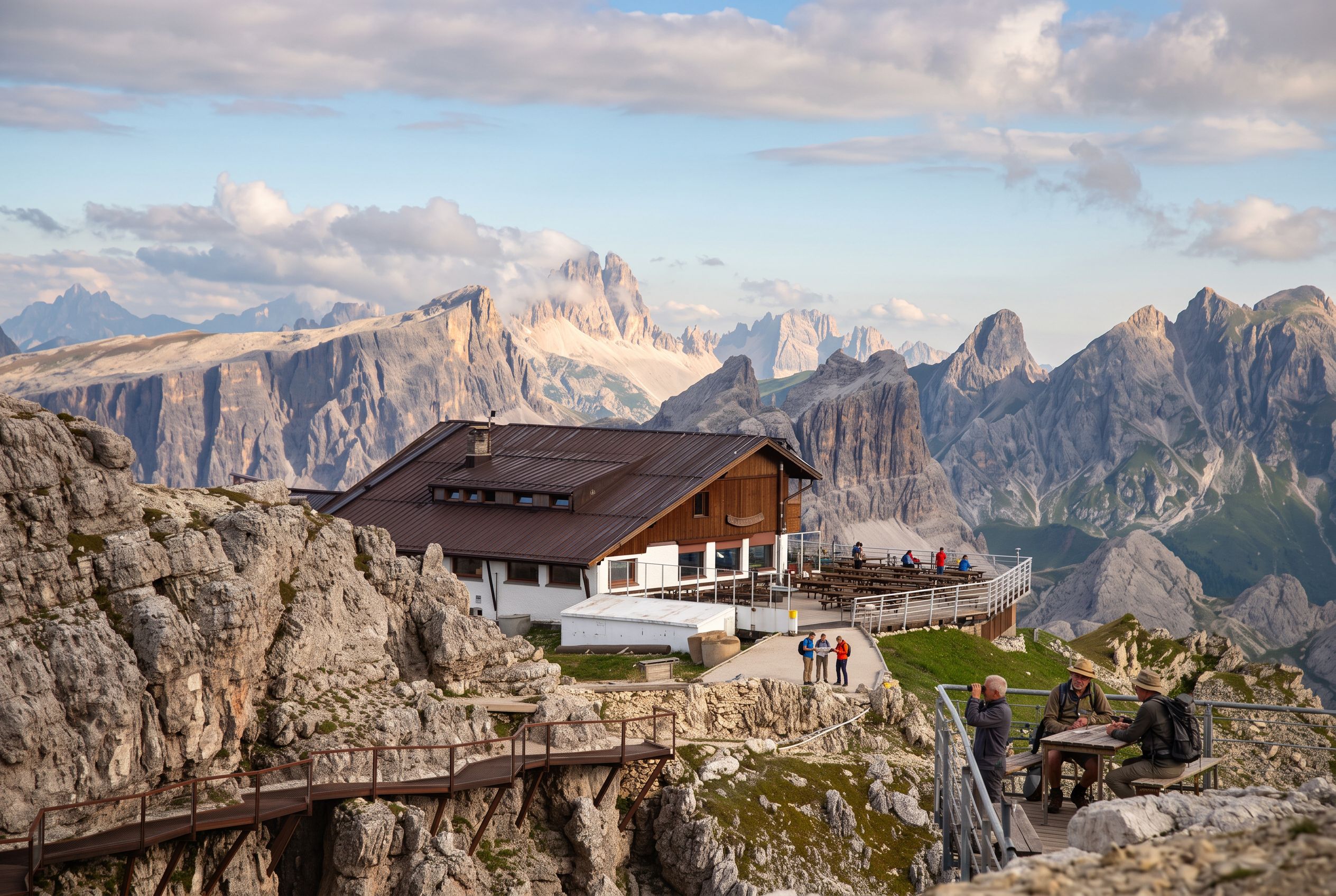
The mountain huts are described by the Dolomites tourism authority as the places offering food and accommodation right in the heart of the World Heritage mountains. That positioning is the whole argument for eating there: you are not choosing a hut for convenience, you are choosing it because it is where the region's food culture actually lives.
What arrives is simple and hearty. Hut cooking is documented as typically including canederli, barley soup, polenta and cheese, goulash, strudel and Kaiserschmarrn. A typical hut dinner may run to three courses: soup, a pasta- or polenta-based main with meat, and dessert. Breakfast is usually simpler than dinner, commonly bread, meats, cheeses, hard-boiled eggs, yogurt, muesli and coffee drinks.
One traveller account captures the surprise well: they had expected mountain huts to resemble simple ski-lodge cafeterias and found instead that rifugios usually offer sit-down meals of high restaurant quality. The same account notes that many refuges post their menus online, which is worth checking before a long walk.
Where can you actually try these dishes?
Val Gardena, Bolzano and the Seceda area carry the strongest documented concentration of traditional cooking. Named places include Speckkeller in Val Gardena for South Tyrolean food, Baita Pra Valentini near Sëlva, Bäckerei Willi Costa for baking, and Cafe Karin for strudel and desserts.
In Val Gardena, Speckkeller is singled out for traditional South Tyrolean food and takes reservations. Baita Pra Valentini is technically a hut but sits within walking distance of Sëlva, and is praised for truffle-and-mushroom pasta. Malga Nëidia Hütte is named for its Kaiserschmarrn. In Santa Cristina, La Tambra drew praise for a pizza with ham, ricotta, walnuts, pears and balsamic, along with steaks and desserts.
Around Seceda, Haite Odle is described as a strong lunch stop with a wide view, and Baita Cuca Seceda serves a regional pancake dish with four sauces.
In Bolzano, Vögele is recommended as a member of the Südtiroler Gasthaus group, with the food stands along Piazza delle Erbe flagged for local specialities. The same account notes Franziskanerstuben, and that Vögele was closed on a Saturday night. That is the pattern to plan around: the most sought-after traditional kitchens have limited days and fill up.
In the Carezza and Nova Levante area, Marions Steakhouse and Franzin Alm were named as favourites in a traveller report that described food quality across the region as consistently high.
What about market days and bakeries?
Market days and historic cafes are not documented for the Dolomites as a whole, so no reliable schedule can be given here. What is documented is bakery culture: Bäckerei Willi Costa in Val Gardena is named as an outstanding bakery, and Bolzano's Piazza delle Erbe food stands are flagged for local specialities.
This is one area where you should plan to ask locally rather than rely on a published calendar. Your accommodation host is the practical source: ask on arrival which morning the market runs in the nearest town, and whether it is a weekly or seasonal event.
Bakeries, by contrast, are a dependable route into the regional larder. Schüttelbrot, the crisp South Tyrolean flatbread, travels well and is worth buying to take home. Speck, mountain cheese and apple strudel are all repeatedly cited as regional specialities that appear in bakery and deli counters as readily as on restaurant menus.
What should you expect to pay?
Published price ranges for individual dishes are not documented, so no per-dish figures are given here. What is documented is the value pattern: half-board and hut dining are described as usually good value and convenient, particularly in smaller villages where restaurant choice is thin.
Several traveller accounts note that the best food in the Dolomites often comes with reservations or timing constraints, especially at popular huts and well-known local restaurants such as Speckkeller and Vögele. That is a booking problem rather than a price problem, and it is the one to solve first.
One documented outlier sits far outside the everyday range: Yera, a subterranean cave restaurant carved into the mountainside in the Plose area above Bressanone, was reported in July 2025 as seating only 18 guests and charging €650 per person for a four-hour experience. It is included here only so that you recognise it as a different category of evening, not as a benchmark for what a Dolomites dinner costs.
Rates and menu prices are indicative and vary by season and by booking channel. Where a specific figure matters to your budget, ask the establishment directly rather than relying on a published menu.
How do you avoid the tourist traps?
Eat where the menu is in the local language first, book the well-known places ahead, and treat July and August as the period when everything is busiest and sells out earliest. Late June is documented as a shoulder window with fewer crowds and easier bookings.
The most crowded periods are July and August, when peak hut booking demand is highest and many places sell out early. One source recommends late June as a shoulder season with lighter crowds and easier bookings, while noting that July is safer if weather and access are your main concern. Off-season closures are also common: some towns and amenities shut from mid-October to December and again from April to June.
Popular routes and areas named as booking hotspots include Alta Via 1, the Tre Cime loop, Seceda and Alpe di Siusi/Seiser Alm. If your eating plans sit near any of these, reserve rather than turn up.
One structural point matters more than any single tip. Many smaller villages have few or no restaurant options, which makes half-board a practical choice, and traveller reports describe half-board as often delivering excellent food at a reasonable price. In a hamlet with one kitchen, the hotel dinner is not a compromise; it is the local cooking.
For the wider question of where to base yourself so that good food is within easy reach, our resort-by-resort guide to choosing a Dolomites base sets out how the valleys differ. If you are still working out how to arrive, getting to the Dolomites by air, rail and transfer covers the practical side.
How do you book, and what should you know before you go?
Many huts take bookings through their own website, by email or sometimes by phone. Some require deposits, and no-shows may be charged the full night's fee. Cancel as early as possible. Baita Checco in Val di Fassa takes mountain-dinner reservations by phone or WhatsApp, on Wednesday, Friday and Saturday from July to mid-September.
Hut booking practice is not uniform, so check the individual hut rather than assuming a regional system. Some huts may offer emergency spots for walk-ins, but these are explicitly described as a last resort only. If you have dietary requirements, one general hut source notes that staff can ask guests to report food allergies in advance; it does not describe a medical service, and no health provision is documented for huts in the Dolomites specifically.
Two practical notes on hut conditions, since they affect how a meal fits into a day. Some huts have lights-out rules from 10 p.m. to 6 a.m., no smoking, and shared facilities, and some lack private bathrooms. If you are visiting for lunch rather than staying overnight, none of this applies, but it is worth knowing before you book a bed on the strength of a good menu.
On mobility, huts are often reached on foot, by cable car or by a short walk, depending on the hut. The detail of which huts are reachable without steps is not documented; ask the individual hut when booking. For a gentler day between meals, our guide to what to expect from an alpine spa day in the Dolomites covers the recovery side of a walking trip.
When is the best time to eat your way through the Dolomites?
Late June offers lighter crowds and easier bookings, and the main hut season runs into late September. Many huts and trails stay closed until roughly mid-to-late June. Autumn brings Törggelen from early October to late November, when farm inns serve the traditional repertoire with new wine and roasted chestnuts.
The season shapes what you can eat as much as where. Alta Badia's official hut listings show multiple huts opening from late May or June and closing between late September and early October, and official listings also mark some days as closed, so day-by-day opening should be checked before setting out. Mountain-hut opening hours in South Tyrol depend heavily on season, weather and lift operations.
Autumn is the exception to the general closing pattern. Törggelen runs from early October to late November, and the farm inns that observe it serve Schlutzkrapfen, Knödel, cured meats, sausages with sauerkraut, sweet krapfen, roasted chestnuts, grape must and young wine. It is a defined season with a defined menu, and it sits after the summer crowds have gone.
Spring has its own moment. White asparagus season was on during a documented spring visit to Bolzano, with a large town market selling spargel. If your trip falls in that window, the valley kitchens shift accordingly.
For a broader look at what the region does well beyond the table, our selection of the finest Dolomites experiences for the over-50s puts the food alongside the rest of the trip.
Can you eat straight from the farm?
Yes, through a documented certification scheme. Gallo Rosso's "Masi con gusto" guide requires more than 80% of produce to come from the farmstead or other South Tyrolean farms, and permits only home-cooked dishes without pre-cooked products. Named farms include Griesserhof in Varna, Burgerhof in Bressanone, Ebnicherhof on the Renon and Huberhof in Fiè allo Sciliar.
This is the most direct route from mountain pasture to plate that the region documents, and it suits travellers who want to understand what they are eating rather than simply order it. Huberhof is noted as renovated in keeping with its historic structure.
For a food-minded traveller in the 50-70 bracket, the appeal is straightforward: a short menu, a defined provenance rule, and a setting that does not require a long walk to reach.
The wider point about eating in the Dolomites is that the regional style, not any single dish, is the attraction. The official sources document a regional food style rather than one signature dish, and travellers consistently report that the classics (speck, Knödel, Schlutzkrapfen, polenta, strudel and Kaiserschmarrn) are what the region does best. Build your days around those, in huts at lunch and valley inns at dinner, and the food will be the part of the trip you remember.


