
Salzburg rewards those who let someone else do the planning. For travellers aged 50 to 70 who prefer organised travel, the city offers a mature ecosystem of small-group walks, private guides, and accessible minivan tours that respect both your pace and your knees. The Old Town is compact, but its cobblestones and hills demand strategy. This guide cuts through the noise, telling you exactly which tour formats suit older travellers, what to ask before you book, and how to avoid the fatigue that turns a beautiful day into an ordeal.
The key is matching the tour to your mobility, not just your interests. A Mozart-themed walk through the Getreidegasse is a different physical proposition than a Sound of Music tour that climbs to the hills above the city. Both are wonderful; neither suits every traveller. We will help you tell the difference before you hand over your credit card.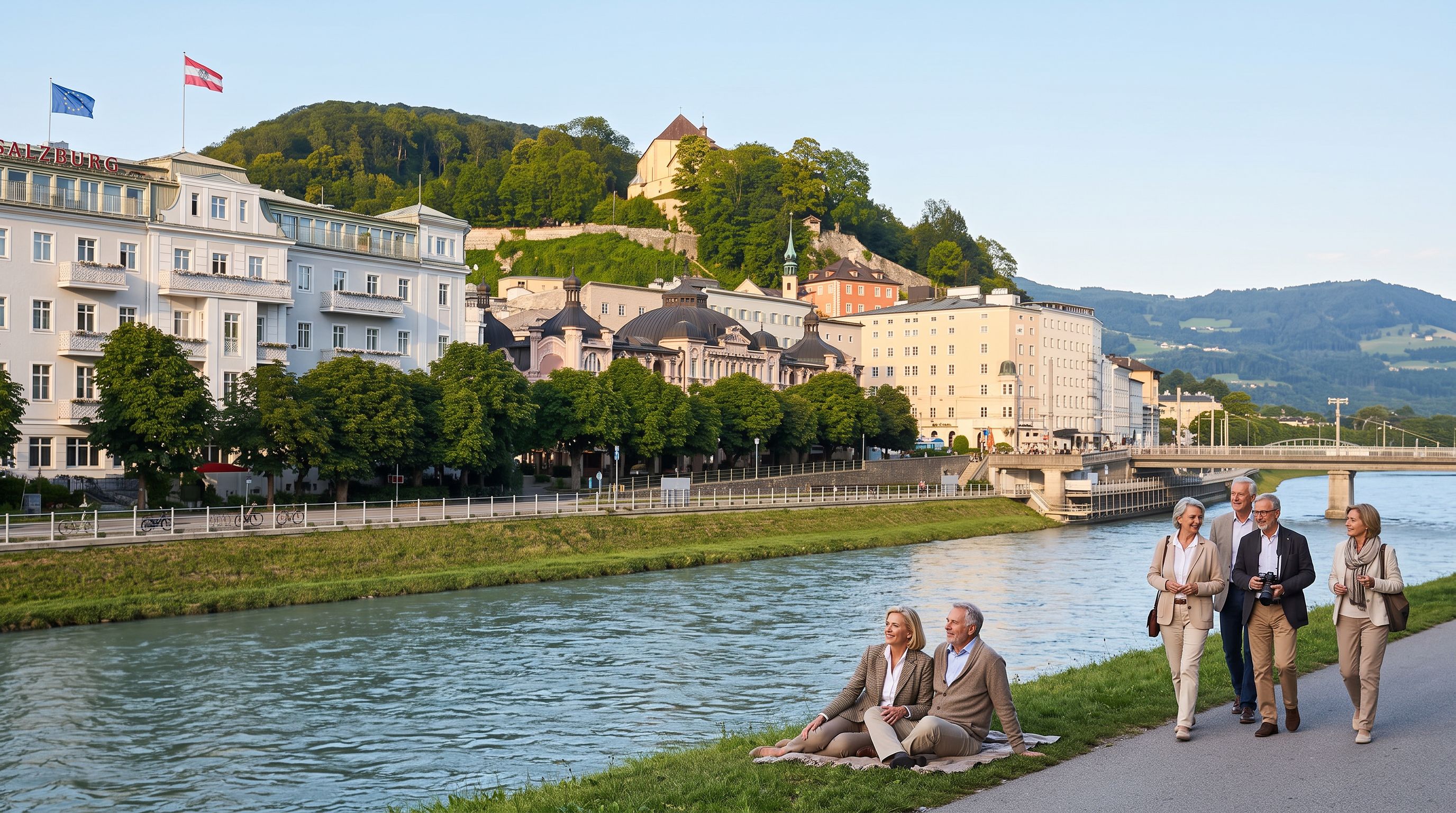 AI-edited
What tour formats suit travellers over 50 best?
Private guides and small-group minivan tours are the most comfortable formats for older travellers, as they allow flexible pacing, door-to-door transport, and fewer demands on your feet. A half-day private walk is priced per group, not per person: the Salzburg Guide Service lists €303 for up to four hours in English as of August 2026.
The Salzburg tour market splits into three practical categories. First, the classic guided walking tour, usually capped at 15 to 20 participants, covers the Old Town's highlights in about two hours. These are ideal if you walk comfortably on flat ground but want to avoid the fortress hill. Second, the private guided experience, where a certified local guide tailors the route to your interests and stamina. Third, the minivan or coach-based tour, which includes the Sound of Music locations and lakeside villages, where the vehicle does the heavy lifting. The private guide suits a half-day particularly well, because it removes route-planning stress and lets you stop for coffee when you need to. The published rates make the arithmetic clear: the Salzburg Guide Service charges a flat fee for a group of up to 25, so the cost per head falls with every person you bring. The four-day Salzburg itinerary for the over-50s in our magazine recommends a similar approach for your first morning in the city.How do I choose a Sound of Music tour that won't exhaust me?
Choose a minivan-based Sound of Music tour with a maximum of eight passengers rather than a coach tour, and confirm the entry step with the operator: the city tourism board's accessibility pages cover public transport, not guided tours. These smaller vehicles can access the narrow lanes of the Salzkammergut villages and offer a more personal experience, with guides who adjust commentary to your interests.
The Sound of Music tour is Salzburg's most popular organised excursion, and for good reason. The locations — Schloss Leopoldskron, the film house of the family, the gazebo at Hellbrunn Palace, and the basilica at Mondsee where the wedding was filmed — are spread across the countryside, making a vehicle essential. The family's real villa is privately owned and not part of these tours. The critical choice is group size. Coach tours pack 40 or more passengers and follow a rigid schedule. Minivan tours, by contrast, typically carry six to eight people, allow easier boarding, and can linger longer at each stop. Recent guest reviews consistently praise the personal attention of smaller formats. One Google reviewer in June 2026 valued "being in a van with only 8 others instead of on a 40 passenger bus", and a review left on Google in May 2026 describes the eight-seat van as "easy and fast to get in and out of which was a time saver". Bob's Special Tours, one of the operators the city tourism board names for online booking, caps its Sound of Music tours at eight people and runs them in an eight-seat minivan or a 19-seat mini-bus depending on demand. For the Mondsee basilica stop, note that regional bus 140 runs from Salzburg Hauptbahnhof to Mondsee via Eugendorf and Thalgau; the Mondsee tourist board puts the journey at about an hour, with express services over the motorway correspondingly quicker. The organised tour handles the logistics and provides context you would otherwise miss. If you prefer to combine the Sound of Music locations with a broader Salzkammergut tour, both Bob's Special Tours and Panorama Tours run full-day versions of eight hours or more. These are gentler on the feet but require a long day of sitting, so consider your back and circulation needs.What should I ask before booking any guided tour?
Ask four questions: How many people are confirmed on this tour? Is the vehicle step-free or ramp-equipped? How much walking is involved, and on what surfaces? And can the guide adjust the pace for a slower traveller? The answers will tell you everything about suitability.
The difference between a wonderful and a miserable tour often comes down to details you can clarify in one email. Group size is the first question because "small group" is a marketing term, not a guarantee. Some operators cap at eight; others at 20. Published caps vary widely, so check the fine print. In August 2026 the Fortress Hohensalzburg small-group tour took two to ten people at €65.50 each, including admission and the funicular both ways, and must be booked at least ten days ahead; your guide meets you at the funicular's mountain station. Transport access matters enormously. The city tourism board's mobility page states that public transport uses predominantly low-floor buses with a wheelchair ramp the driver folds out on request, but says nothing about guided tours, so ask the operator. Ask specifically whether the vehicle has a step-free entry or a ramp, especially if you use a rollator or have limited hip or knee mobility — Bob's Special Tours, for instance, asks guests using a wheelchair or rollator to bring someone who can help them in and out. Walking surfaces and distances are the third question. The Old Town's cobblestones are beautiful and unforgiving, and the classic guided walk crosses most of them: the Salzburg Guide Service route takes in the Cathedral, St. Peter's Abbey, the Residence, Mozart's Birthplace and the festival theatres in about two hours. Ask your guide to include riverfront promenade sections where the paving is smooth and flat. Finally, confirm that the guide is comfortable adjusting pace. Most professional guides are, but it helps to set expectations in advance.Is the Old Town walkable for someone with knee or hip concerns?
The Old Town is walkable but demanding. The flat riverfront promenades and Mirabell Gardens are gentle, while the Getreidegasse's cobblestones and the fortress hill are strenuous. A guided walk that includes the river and gardens, with an optional funicular ride, is the smart compromise.
Salzburg's historic centre is compact, which works in your favour. The main sights — Mozart's Birthplace, the Cathedral, Residenzplatz, and St. Peter's Abbey — sit within a roughly 500-metre radius. The challenge is the terrain. Cobblestones dominate the Getreidegasse and the squares, and the city rises gently from the river toward the fortress, with some steeper sections near the Nonnberg Abbey. The Salzach river promenades are the exception. These flat, smooth paths run along both banks and are the best option for a gentle stroll. Mirabell Gardens, with its level paths and plentiful benches, is another safe haven. The Salzburg Guide Service, the association of the city's certified guides, names two sights as less suitable for limited mobility: Mozart's Birthplace, a 14th-century house where preservation orders rule out installing a lift, and the fortress interior. The Mozarteum Foundation, which runs the Birthplace, states plainly that it is not barrier-free accessible. For the fortress, take the funicular. The fortress states that barrier-free access is possible via the FestungsBahn and that the footpath up is not barrier-free because of its steepness. The panorama terrace and bastion at the mountain station are fully accessible, and a lift in the bell tower reaches the courtyard, the armoury and the marionette museum; the Princes' Chambers are reached by roughly 120 steps. The fortress's own tour for seniors adapts pace and route, ran with or without those chambers at €18.60 per person in August 2026, or €21.70 with the funicular included, and needs fourteen days' notice.How much walking is typical on a guided tour?
A standard two-hour Old Town walking tour covers roughly 2 to 3 kilometres on mostly cobbled surfaces. A half-day private tour can be tailored to 1.5 kilometres with frequent rest stops. Minivan tours involve minimal walking, typically 200 to 400 metres per stop.
The numbers help you plan. The classic Old Town walk runs about two hours; add the fortress and a crossing of the Mönchsberg and you have a full day of movement that would fatigue most travellers over 60. The Mönchsberg lift takes the climb out of that equation: from Anton-Neumayr-Platz it rises 60 metres in about 30 seconds and gives barrier-free access to the plateau and the Museum der Moderne. The solution is to choose one guided walk per day and pair it with a vehicle-based excursion. For a gentler experience, ask your private guide to focus on the riverfront, Mirabell Gardens, and the Residenzplatz, with a coffee break at a traditional café. The Salzburg Guide Service writes that most of its tours are barrier-free and invites guests to call for advice; the city tourism board adds that its certified guides offer barrier-free tours on request. If you prefer a structured day without the walking, consider the city's hop-on-hop-off bus. Its year-round Yellow Line has ten stops and an audio guide in thirteen languages, and its tickets also cover selected city buses in zone S. The Salzburg Card likewise includes free use of public transport, which helps you cover longer distances between sights without taxing your feet.What about transport to the tour meeting points?
Most guided tours meet at Mozartplatz or the Salzburg Information office, which is a short, flat walk from the river and easily reached by bus from the main station. The tourism board puts the walk from Salzburg Hbf to the city centre at about 20 minutes, or 10 minutes on trolleybus lines 1, 2, 3, 5 and 6.
Getting to your tour meeting point should not be an ordeal. Trolleybus lines 1, 2, 3, 5 and 6 reach the Old Town from the main station in ten minutes, and the vast majority of those vehicles are low-floor with a ramp the driver folds out on request. Taxis cannot drive into the pedestrian zone, so ask your hotel where the nearest rank is; the drivers of Taxi 81-11 are obliged to carry wheelchairs apart from electric and non-folding models, and TaxiGoPlus specialises in accessible transport. For those staying in the Old Town, most meeting points are within a 10-minute walk. If you are staying further out, consider the quieter hotels near the Mirabell Gardens, which offer easy access to both the gardens and the river promenade. The walk from the station past Mirabell Palace toward the river is straightforward and serves as a useful orientation for your first day.What should I pack for a guided tour day?
Supportive walking shoes with grip are non-negotiable, alongside layers for Salzburg's changeable alpine weather, a light waterproof jacket, and a small day pack for water and medication. Walking poles help on the fortress hill and the Mönchsberg.
Salzburg sits in an alpine basin, which means weather can shift from sun to shower within an hour. Layering is your friend. A compact rain shell fits easily in a day pack and protects against sudden downpours in the shaded lanes of the Getreidegasse. Sun protection matters more than you might expect, especially on the open squares and river paths during warmer months. Our detailed guide to packing for Salzburg's cobbles and weather covers this in depth, but the essentials are simple. Bring your regular medication, copies of prescriptions, and any mobility aids you use. Walking poles are useful for the hill routes, particularly the fortress approach and the Mönchsberg climb. Carry water. Salzburg's sights are spread across a compact area, but the cumulative walking adds up, and dehydration amplifies fatigue. A small day pack keeps your hands free for balance on uneven surfaces and for holding onto railings where stairs are unavoidable.Where can I find pharmacies and medical help if needed?
The central pharmacy Apotheke zum Goldenen Biber at Getreidegasse 4 is open Monday to Friday 09:00–18:00 and Saturday 08:00–13:00, with 09:00–17:00 on Saturdays in Advent. The emergency hospital is Landeskrankenhaus Salzburg at Müllner Hauptstraße 48, and the ambulance number is 144.
Knowing where to find help before you need it is part of travelling well. The Goldenen Biber pharmacy sits in the heart of the Getreidegasse, convenient for most guided tour routes. The emergency hospital is a short taxi ride from the Old Town. In Austria, the general European emergency number is 112, and the ambulance-specific number is 144. For travellers with mobility concerns, it is worth noting that some historic buildings have limited access, so locating pharmacies and clinics in advance is sensible. The city tourism board publishes a brochure, "Salzburg without barriers", written for visitors with disabilities or limitations, which is worth reading before you set out. Most tour guides are happy to point you toward the nearest pharmacy if you need supplies during a walk.When is the best time for guided tours?
Late spring (May to June) and early autumn (September to October) offer the most comfortable conditions for guided walking tours, with mild temperatures and fewer crowds than July and August. Winter tours are possible but require more layers and careful footing on icy cobbles.
Salzburg's tourism season peaks in summer, when the Old Town can feel crowded and the heat amplifies the effort of walking on cobblestones. The shoulder seasons provide a better balance. May and June bring blooming gardens and comfortable temperatures. September and October offer crisp air, autumn colours in Mirabell Gardens, and shorter queues at the fortress funicular. The city tourism board states that guided tours are offered every day of the week and that Salzburg's guides are all certified, with around 80 different tours in 18 languages, as checked in August 2026. Tourist Info at Mozartplatz 5, itself step-free, is where to ask on arrival. The fortress is open all year round, and its senior tour adapts pace and route for older visitors, with or without the Princes' Chambers. If you visit in winter, book a morning tour to take advantage of the best light and avoid the afternoon chill. The Christmas markets season (late November to December) is magical but adds crowds and cold. A private guide becomes even more valuable during these periods, as they can navigate the busiest areas efficiently and find indoor rest stops.Is a private guide worth the extra cost?
For most travellers over 50, a private guide is worth every euro. The flexibility to set your own pace, stop for coffee, and skip crowded areas transforms the experience from a checklist to a conversation. At the August 2026 rate of €303 for a half-day of up to four hours in English, two people pay about €152 each and four about €76 — the price of a good dinner once there are four of you, because the fee covers the group rather than the head.
The value of a private guide lies in the tailoring. A good guide reads your energy levels and adjusts the route accordingly. If you are tired, they find a bench with a view. If you are fascinated by Mozart's childhood, they linger at the Birthplace and tell stories the crowds miss. Because the guide fee is a flat rate for the whole group, the cost spread across a couple or a small group of friends becomes reasonable. A Google reviewer in December 2025 described the vehicle-based version of the same logic: "We covered so much in 8 hours and walking was minimal as we drove to all sites." The alternative — a larger group tour — saves money but gives you less room to set the pace. If you value depth and personal attention, the private format is the clear winner. Where the arithmetic does not work, a small-group departure at a per-person fare usually does: in August 2026 Bob's Special Tours sold its four-hour Sound of Music tour at €75.09 per adult, against private city tours from €300 for two hours at Panorama Tours.What are the most important questions to ask before booking?
Ask about the confirmed group size, vehicle accessibility, walking distance and surfaces, guide experience with older travellers, and cancellation policies. These five questions will prevent most disappointments and ensure the tour matches your physical needs.
The city's guided tours page gives an overview of the formats and names Panorama Tours and Bob's Special Tours as booking partners. A quick email clarifying these points takes five minutes. Two answers are worth having in writing: the Salzburg Guide Service takes cash after the tour and generally cannot take cards, and cancellations must reach it in writing seven days ahead, with €100 charged after that until 24 hours before the start. For a fully organised day, Bob's Special Tours and Panorama Tours both sell private tours that combine guide and vehicle, which spares you from managing separate bookings."I am an older adult ... and had injured both knees. Each time we got in/out of the van, he provided a step stool and assisted me." — a guest wrote on Google in May 2026 about a small-group Salzburg tour
What practical details should I confirm before my tour day?
Confirm the exact meeting point, the guide's contact number, the tour duration, and whether entrance fees are included. Also confirm the language of the tour and the guide's certification, as Salzburg requires licensed guides for official city tours.
Arrive at the meeting point 10 minutes early, and exchange contact numbers with your guide in case of delays. Clarify whether the tour price includes entrance fees to sights like the fortress or Mozart's Birthplace, as these can add significantly to the cost. The Salzburg Guide Service does not include entrance fees in its rates, and in August 2026 Salzburg Cathedral charged a €5 conservation fee per person. Guiding is a regulated trade in Austria: the Gewerbeordnung 1994 lists Fremdenführer among the trades that require a licence, and Salzburg's certified guides are organised in the Salzburg Guide Service. Certification matters because it guarantees a certain standard of knowledge and professionalism. If you are booking through a third-party platform, check that the guide is locally certified. Finally, consider the Hotel Goldener Hirsch on Getreidegasse if you want to stay in the heart of the Old Town, a short walk from the main tour meeting points. Its central location minimises walking before and after your guided experiences, which is a quiet luxury when your feet have already done their work for the day.

