
For travellers aged 50 to 70 who prefer organised travel, the Zillertal valley in Tyrol offers a rare combination: genuine alpine grandeur without the burden of self-navigation. The secret lies in its network of guided hikes, private mountain guides, and small-group tours that handle the logistics so you can focus on the views. This guide cuts through the noise to tell you exactly what to look for, what to ask before booking, and how to choose the right experience for your pace and mobility.
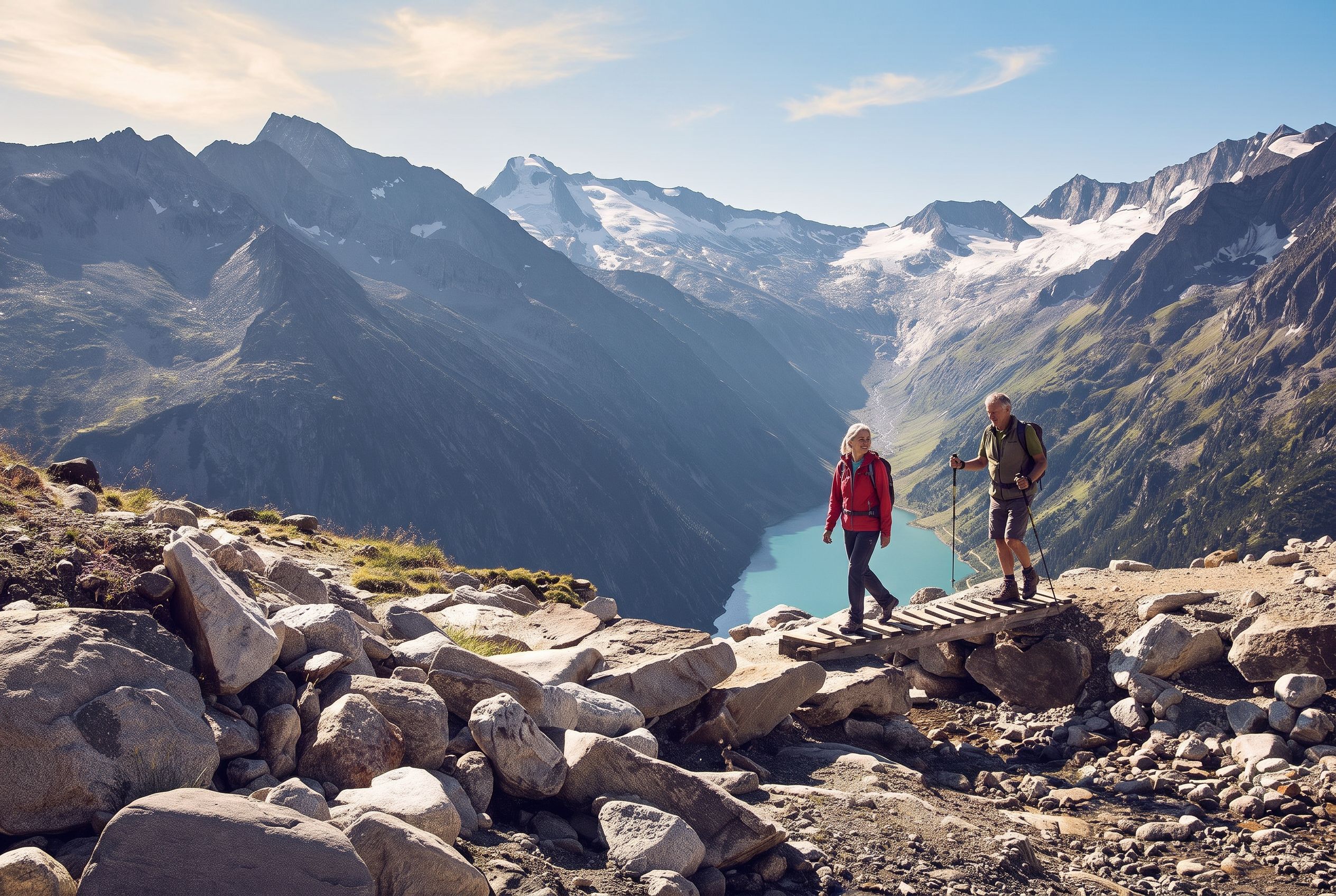 AI-edited
Why choose a guided tour in the Zillertal?
Guided tours remove the guesswork from alpine travel. You get a local expert who knows the terrain, weather patterns, and safest routes, and a published meeting point you travel to — a valley station, a tourist office or an inn. For older travellers, this means no map-reading stress, no last-minute route changes, and a pace that matches the group’s ability.
The Zillertal is 40 kilometres long, with 25 municipalities and close to 38,000 residents. Its hiking network spans 1,400 kilometres of trails, but trail quality varies enormously. A guided tour ensures you walk on surfaces suited to your comfort level — valley-floor paths, lift-accessed ridges, or gentle alpine meadows — rather than guessing from a map. A guest who booked a small-group tour with a Mayrhofen alpine school wrote on Google in August 2022 that they went out “with a group of 6 and everyone was over the moon,” praising a guide who was “very knowledgeable and a pleasant travel companion.”
For those who prefer organised travel, the valley’s guided programs are designed to be booked in advance, often with a minimum of four participants. The Fügen-Kaltenbach guided hiking program, for example, runs from early June to late October, with registration required by 4 pm the day before. This structure gives you certainty without rigidity — exactly what seasoned travellers appreciate.
What guided options exist for small groups?
You have three main choices: guided day hikes with a trained Nature Park guide, private mountain-guide bookings for custom itineraries, and small-group cable-car excursions that combine lift rides with short walks. Each suits a different comfort level and interest.
The most structured option is the summer programme of the Hochgebirgs-Naturpark Zillertaler Alpen, run from the Nature Park house in Ginzling, which offers more than 200 guided hiking tours from May to October covering more than thirty themes. They are led by trained Nature Park guides and are free of charge for guests of Nature Park partner businesses and members; registration closes at 8 pm the day before through the MyZillertal app or your accommodation. They are ideal for travellers who want a social, educational experience without the pressure of a private booking.
For greater flexibility, Zillertal mountain guides offer custom half-day or full-day itineraries. Two are based in the valley: the Mountain Sports alpine school in Mayrhofen (Google 4.9/5 from 208 reviews in August 2026) and the Zillertaler Bergführer at Stummerberg, who quote €415 a day for a group of up to six. Private guides can adjust the pace, choose easier terrain, or focus on photography stops — useful for travellers with specific mobility needs.
Small-group cable-car excursions are a third option, particularly for those who prefer less walking. The Penkenbahn in Mayrhofen and the Gerlossteinbahn in Hainzenberg both offer lift-assisted walks that take you to high viewpoints with minimal effort. Judge the walk at the top before you book: the Almpromenade from the Gerlosstein station to the Almtribüne viewing platform is described by the operator as an hour-long walk, and the Schlegeis reservoir is no cable-car destination at all — it is reached by the 13-kilometre toll Schlegeis Alpenstrasse, open mid-May to the end of October, and its dam tour is expressly not barrier-free.
How accessible are the tours for older travellers?
Accessibility varies by route, but the best options for travellers with limited mobility are valley-floor walks, cable-car-accessed trails, and guided programs marketed as “gentle” or “easy.” All Zillertalbahn trains are wheelchair-equipped and the Mayrhofner Bergbahnen list four of their gondolas as wheelchair-accessible, but neither amounts to a blanket step-free promise.
The Zillertalbahn runs from Jenbach to Mayrhofen in about 50 minutes, and its own timetable states that all its trains are equipped for wheelchairs. The lifting platform named in the official accessible-excursions leaflet belongs to the steam train, which runs Tuesday to Thursday from 2 June to 25 September 2026 and lies outside the regional fare system. For scheduled trains, the Tyrol transport authority shows per connection whether it is a low-floor train with a wheelchair space and accessible WC, and that space must be booked in advance on +43 5 17 17 5. From there, local buses and taxi-bus transfers connect to trailheads, and the cost usually falls to you: the Mayrhofen alpine school lists lift tickets and taxi fees as not included, while the Friday Fügen-Kaltenbach hike bundles its transfer into a €20 price, €15 with a guest card.
The useful source here is the cable-car trade association’s “Barrierefreie Bergwelt” datasheet series, dated November 2024. For the Mayrhofner Bergbahnen it lists the Penkenbahn, Ahornbahn, Kombibahn Penken and Möslbahn as wheelchair-accessible, but names only two wheelchair-navigable paths, both at the Penken top station rather than on the Ahorn. For the Zeller Bergbahnen the Rosenalmbahn valley station is given as the ideal barrier-free summer entry point, while the Fichtenweg from its top station is a surfaced forest road for which the datasheet expressly asks for a companion because of steeper sections. On the valley floor the riverside route is the Zillerpromenade, which its operator calls an easy walk also suitable for families with pushchairs — no wheelchair or asphalt claim is made for it.
The Krimmler Waterfalls are a seasonal outing rather than a winter one, and their operator documents barrier-free access as far as the Kürsingerplatz. It also states that the Wasserfallweg, the official path alongside the falls, is open only from mid-April to the end of October, so a winter visit means viewing the lower section rather than walking the full route. Always check snow and ice conditions before committing to a winter guided tour.
| Transport | Step-free access | Best for | Notes |
|---|---|---|---|
| Zillertalbahn (Jenbach–Mayrhofen) | All trains wheelchair-equipped | Valley-floor travel | 50-minute journey; wheelchair space to be booked on +43 5 17 17 5 |
| Ahornbahn cable car | Listed as wheelchair-accessible | Lift-accessed outings | Wheelchair-navigable paths are listed at the Penken top station, not on the Ahorn |
| Rosenalmbahn cable car | Valley station named as ideal barrier-free entry | Panorama walks | Fichtenweg from the top station: surfaced forest road, companion advised |
| Local buses | Varies | Short transfers | Check with operator for specific routes |
What should I pack for a guided tour?
Sturdy hiking boots with ankle support are non-negotiable, even for “easy” guided walks. Alpine paths can be uneven and steep. Layer a light fleece or vest under a waterproof rain jacket, and always carry sun protection — sunglasses, sunscreen, and a cap — because mountain sun is intense at any altitude.
Walking poles are welcomed on guided tours and can make descents much more comfortable. They take load off the knees on the long downhill sections, which is where most walkers over 50 feel a day out the next morning. Bring a backpack for day hikes; the Mayrhofen alpine school states that rental equipment is included in all its guided tours, so technical gear is one thing less to carry. Pack water and snacks, as not every route or hut provides immediate refreshment. Payment at huts is not uniform: the Berliner Hütte states you can pay in cash or by card, so check for the hut on your route instead of assuming either.
Personal medication and basic first-aid items are a must. The Mayrhofen alpine school publishes a packing list with every tour and singles out mountain boots of category B/C for multi-day walks. Carry your EHIC or travel insurance details, and keep prescriptions in original packaging. For a full packing list tailored to the Zillertal, see our dedicated guide: Packing for the Zillertal: Boots, Layers and Alpine Weather.
What healthcare and safety provisions exist?
For emergencies in Austria, dial 112 (general emergency) or 144 for an ambulance; in Tyrol, mountain rescue and the alpine emergency line is 140. The nearest hospital to the central Zillertal is in Schwaz, outside the valley. Before arrival, ask your hotel or tourist office for the nearest Apotheke (pharmacy), Hausarzt (GP), and Krankenhaus (hospital).
Guided tours in the Zillertal are weather-dependent and may be changed or cancelled at short notice. The Fügen-Kaltenbach program explicitly warns that changes are possible due to prevailing weather conditions. This is not a flaw — it is a safety feature. Your guide will prioritise safe routes over scenic ones, especially if snow or ice is present on higher trails.
For travellers over 50, the strongest safety advantage is staying with guided tours and registered programs rather than self-navigating. The Nature Park’s walks are led by trained Nature Park guides, and in Tux-Finkenberg the snowshoe outings are led by mountain guides. Always check the weather forecast and webcams before your tour, and be prepared to start early: the four weekly Fügen-Kaltenbach hikes set off between 8.30 and 9.30 am.
“With those guides you really feel safe every minute. Also their equipment is excellent.” — from a review of a Mayrhofen alpine school left on Google in August 2023
What questions should I ask before booking?
Ask about the guide’s certification, the group size, the walking time (not total tour time), the terrain type (valley path vs. mountain trail), and whether the tour includes lift tickets or transport. Also confirm the cancellation policy for weather-related changes.
Here are five specific questions to ask every operator:
- What is the maximum group size? Smaller groups (4–8 people) allow for a more personalised pace.
- What is the actual walking time? Good operators publish it separately: the four Fügen-Kaltenbach hikes are listed at four to five hours of walking with 300 to 900 metres of ascent.
- Is the route suitable for my fitness level? Be honest about your abilities. The Mayrhofen alpine school grades tours on five levels: level one is up to 400 metres of ascent or three hours on foot, level two 400 to 800 metres or up to five hours.
- Are lift tickets included in the price? Some tours require you to purchase cable-car tickets separately.
- What happens if the weather turns bad? A good operator will have an alternative route or a clear cancellation policy.
For winter guided snowshoe outings, ask about avalanche safety equipment. Your guide should carry a transceiver, probe, and shovel, and should brief the group on basic safety procedures. In the Hochgebirgs-Naturpark Zillertaler Alpen, guided snowshoe walks in the Zemmgrund run under the name “Winterzauber Ginzling” on Tuesdays and Thursdays until early March; in Tux-Finkenberg they are led by mountain guides, need no prior experience and are graded, with equipment for hire locally.
Where should I base myself for guided tours?
Mayrhofen is the most practical base for guided tours, with direct Zillertalbahn access, multiple cable cars, and a wide selection of guided programs. Fügen and Tux-Finkenberg are excellent alternatives for quieter, nature-focused experiences.
Mayrhofen sits at the valley’s southern end, where the Penkenbahn and Ahornbahn provide lift access to high-altitude trails. The town has a dense concentration of hotels, restaurants, and tour operators. For a premium stay, consider the Hotel Neuhaus, which offers a spa and wellness area that guests consistently praise — see our full dossier: Hotel Neuhaus, Mayrhofen: A Senior’s Dossier on the Zillertal’s New Spa Powerhouse.
Fügen, in the central valley, is quieter and closer to the Fügen-Kaltenbach guided hiking programme. The ASTER Boutique Hotel & Chalets (Google 4.9/5 from 322 reviews in August 2026) stands at Asterweg 3 in Fügenberg, on the terrace above Fügen, and guests consistently praise the hospitality and the mountain-view infinity pool. The hotel’s own account describes an underground garage with 18 spaces, two charging points and direct barrier-free access into the building; nothing else about steps or lifts is published, so ask first if that matters to you.
Tux-Finkenberg is the gateway to the Nature Park’s guided tours and the Hintertux Glacier, which operates year-round. This area is best for travellers who want a nature-focused experience with fewer crowds.
What do guided tours cost, and how do I book?
Guided day hikes span a wide range: the Fügen-Kaltenbach programme charges €15 per person, €10 with a guest card, while an alpine school day hike is quoted at up to €60. A private mountain guide costs about €415 a day for a group of up to six. Lift tickets are normally extra — an Ahornbahn or Penkenbahn return is €40, or €34 with a guest card, in summer 2026.
Booking is straightforward. For the Fügen-Kaltenbach programme, register by phone, email or at an information office. Nature Park walks are booked in the MyZillertal app, through your accommodation, or at the Nature Park house or a tourist office, where cash is accepted. Private guides take bookings by phone or through their own websites. Always check the published meeting point — none of these programmes collects you from your hotel.
For a comprehensive overview of the valley’s transport options, read our guide: Getting Around the Zillertal Without a Car: A Senior’s Practical Guide to the Valley’s Trains, Buses, and Lifts.
Final practical tips for a smooth experience
Start early, check the weather, and ask how your hut takes payment. Guided tours in the Zillertal are designed for comfort, but alpine conditions demand respect. Choose a guide who listens to your needs and adjusts the pace accordingly.
One final note on dining: the Zillertal’s mountain huts serve hearty Tyrolean fare like Kaiserschmarrn and Speckknödel. For a full guide to local flavours, see our article: What to Eat and Drink in the Zillertal: A Senior’s Guide to Tyrolean Flavours.
Self-guided itineraries are covered in a separate guide, but for organised travellers, the Zillertal’s guided tours offer the perfect balance of adventure and reassurance. Book with confidence, pack wisely, and let the mountains do the rest.


