
Located in the heart of the Austrian Tyrol, the Zillertal runs south from Jenbach, where the Zillertalbahn covers the 32 kilometres to Mayrhofen. For travellers aged 50 to 70 who prefer not to drive, this valley is one of the region’s most workable car-free destinations. The secret lies in a well-coordinated network of narrow-gauge railway, valley buses, guest-card benefits, and accessible cable cars. This guide covers exactly how to move through the valley without a car, focusing on the practical details that matter for comfort and confidence.
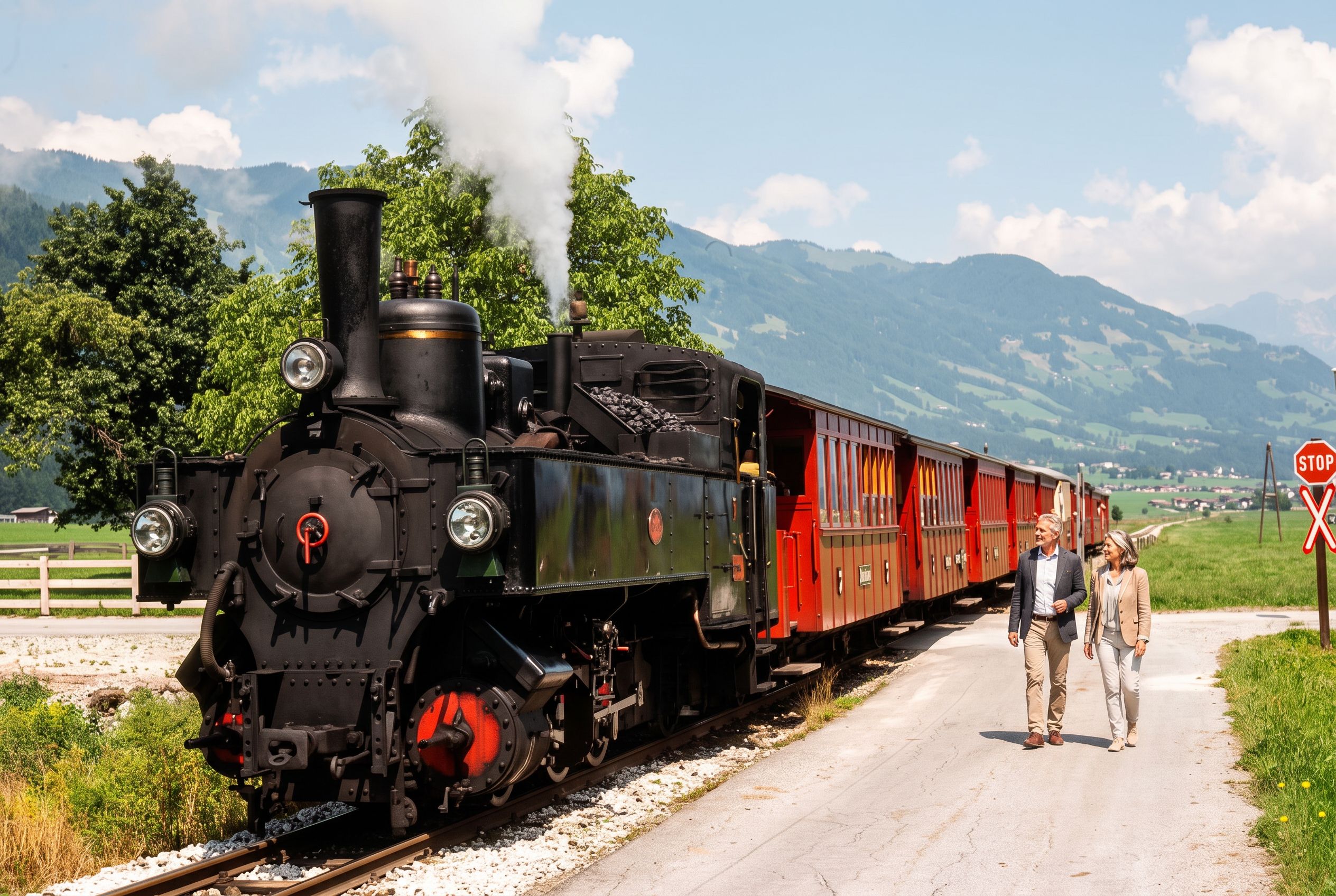 AI-edited
Why choose the Zillertal without a car?
The Zillertal is doable without a car because the Zillertalbahn railway runs the valley’s length every half hour, the paid Activcard covers most public transport in summer, and the Mayrhofner Bergbahnen lifts offer step-free access to mountain views. The valley floor is flat and walkable, while side valleys require planning around early last connections.
The Zillertaler Verkehrsbetriebe was founded in 1899 as a pure railway company and has run buses since 1935; the narrow-gauge line remains the backbone of car-free travel. The operator states that its trains run every half hour along the 32-kilometre stretch between Jenbach and Mayrhofen, which makes it possible to base yourself in one town and explore the valley without a rental vehicle. The same timetable carries a note that every Zillertalbahn train is equipped for wheelchair users. The lifting platform that regional material often mentions belongs to the historic steam train, which runs only in summer and is not covered by the regional fare. For seniors, this means you can travel comfortably between the main resort towns—Jenbach, Fügen, Zell am Ziller, and Mayrhofen—without worrying about parking or mountain roads.
The digital guest card has made one part of the journey easier, but only in one season. The Mayrhofen-Hippach tourist board states that the card works as a ticket for free travel on the Zillertalbahn from Jenbach to Mayrhofen and back between early December and mid-April, the validity period of the Zillertaler Superskipass. Outside that window the card does not cover the train, and you buy an ordinary VVT ticket or the paid Zillertal Activcard instead.
How does the Zillertalbahn work for seniors?
The Zillertalbahn is the valley’s most reliable car-free transport: it runs every half hour from Jenbach to Mayrhofen, takes about 50 minutes end to end, and stops at all the main villages, among them Fügen-Hart, Kaltenbach, Zell am Ziller and Ramsau. Tickets are available at stations or on board; the guest card covers the fare in winter only.
The railway is a narrow-gauge line that preserves a nostalgic character even after modernisation. Trains are clean, punctual, and generally uncrowded outside peak ski season. The journey itself is scenic, passing through farmland, past traditional Tyrolean farmhouses, and alongside the Ziller River. For seniors, the key advantage is that you can sit back and watch the valley unfold without navigating mountain switchbacks.
One practical detail: in the timetable valid from 14 June 2026 the last train leaves Mayrhofen for Jenbach at 19:47 and arrives at 20:36, while the last departure in the other direction is 20:05 from Jenbach. That is earlier than many urban services, so plan your day accordingly. Bus line 8330 between Mayrhofen, Jenbach and Innsbruck runs later than the train, and the Mayrhofen tourist board describes regular connections between Jenbach and Mayrhofen in the evening until around 22:30.
What guest-card benefits should I know about?
Two cards exist and it pays to keep them apart. The free guest card from your accommodation covers the summer shuttle buses. The Zillertal Activcard is a paid summer card, valid 23 May to 26 October 2026, covering one cable-car return a day on ten Zillertal lifts, free entry to six outdoor pools, and most public transport in the valley.
The guest card varies by accommodation and season, so check what your hotel offers. Zillertal Tourismus publishes the Activcard rates for 2026: €95.50 for three consecutive days, €137.50 for six, €186.00 for nine and €233.00 for twelve, with a €2 deposit on the chip card. For seniors, the appeal is that you stop buying individual tickets for each journey, but the card only pays for itself if you ride a cable car most days.
What the free guest card covers depends on the season. In summer it carries you on the Sommershuttle lines S1 and S2 and on the Gäste- und Dörferbus; in winter the local ski bus network is free with it. The Activcard, by contrast, covers most public transport in the valley all summer, with the historic steam train the one exception.
How reliable are the valley buses?
Valley buses supplement the railway, reaching side valleys and villages not served by the train. The main summer routes include line 4094 from Mayrhofen to Gerlos and Krimml, and line 4104 from Mayrhofen to Tux and Hintertux. In the summer 2026 timetable line 4104 runs roughly every half hour, with the last bus leaving Hintertux at 20:30 and reaching Mayrhofen at 21:08.
The bus network is most useful for reaching the side valleys that the railway doesn’t serve. For example, to visit the Schlegeis Alpine Road or the Hintertux Glacier, you take the Zillertalbahn to Mayrhofen, then transfer to bus line 4104. The journey from Mayrhofen station to the Hintertux glacier lift takes about 40 minutes in the summer 2026 timetable.
However, the buses have limitations. Evening frequency is limited, and some routes have reduced service on Sundays and public holidays. On line 4094 to Gerlos and Krimml, several departures run only on Tyrolean school days or only between early July and early September, so the same stop can have a noticeably different service two weeks apart. For seniors, this means planning earlier returns and carrying a printed or digital timetable.
The summer 2026 timetables published by Zillertal Tourismus show a denser service than the valley’s reputation suggests: on the Tux line, departures from Mayrhofen follow each other at roughly half-hourly intervals from six in the morning. The ski buses in winter are free with the guest card but have limited capacity, so arrive early at busy stops.
Which cable cars are most accessible?
The lifts documented as barrier-free are the Mayrhofner Bergbahnen: the operator states that Ahornbahn, Penkenbahn, Horbergbahn and Möslbahn all have lifts at the valley stations, and that the Penkenbahn has the highest measured level of accessibility. The Ahornbahn runs from 13 June to 31 October 2026, the Penkenbahn from 23 May to 4 October 2026.
For seniors who want mountain views without strenuous hiking, these lifts are ideal. The Ahornbahn is Austria’s largest aerial tramway and runs at fifteen-minute intervals; from its top station the operator offers wheelchair users and guests with limited mobility a transfer to the AdlerBühne viewing arena and back on the AdlerExpress. The Rosenalmbahn in Zell am Ziller climbs from 580 to 1,744 metres and has gentle walking paths around the summit station, though its operator publishes no accessibility statement.
The Hintertux Glacier cable car operates year-round, making it a reliable choice for high-alpine scenery. However, the top station sits at 3,250 metres, and the air is thin. Seniors with respiratory conditions should take it slowly. Weather decides the day here more than anywhere else in the valley, so check the webcam before heading up.
Seasons differ by lift and are worth checking before you commit to a base. The Penkenbahn runs from 23 May to 4 October 2026, the Isskogelbahn in Gerlos from 20 June to 11 October with a few extra days in late October, and the Gerlossteinbahn above Hainzenberg from 4 June to 18 October. Always check the current season’s opening dates on the official website before planning a trip.
Where are steps and luggage an issue?
Steps and luggage are most problematic at smaller Zillertalbahn stations, older village streets, and mountain-top platforms. The railway publishes no station-by-station step-free list, so check each connection in the VVT timetable enquiry, which shows whether a low-floor train, a wheelchair space and an accessible toilet are available. Village paths in side valleys can be steep and uneven.
For seniors travelling with luggage, the best strategy is to base yourself near a station. Bus stops sit directly at Mayrhofen station, and the Mayrhofen tourist board states that the buses carry a fold-out ramp or a kneeling suspension. Jenbach is a station for national and international rail services, so the change onto the Zillertalbahn happens inside one station rather than across town. One point to note when reading timetables: the line has no stop at Hippach, and the nearest stations are Ramsau i.Z. and Mayrhofen.
Once you leave the valley floor, terrain difficulty increases quickly. Side valleys like the Stilluptal or Zillergrund have narrow, winding roads with no footpaths. Mountain trails can be steep, uneven, and weather-dependent. The region is best for seniors who prefer gentle walking, lift-assisted outings, and short scenic stops rather than long mountain hikes.
If you are staying at the Neuhaus Zillertal Resort, the two walks are not the same length: the valley station of the Penkenbahn is about 0.9 kilometres away, roughly twelve minutes on foot, while the Ahornbahn is about 1.65 kilometres, closer to twenty. The hotel sits at Am Marktplatz, next to Mayrhofen station, and the tourist board lists a free pick-up service and luggage transport in its facilities entry.
What are the best car-free bases?
The best car-free bases are Mayrhofen, Zell am Ziller, and Fügen. Mayrhofen is the most practical for lift access and evening dining, Zell am Ziller is flatter and quieter, and Fügen offers good value and the Erlebnistherme spa. All three are on the Zillertalbahn line.
Mayrhofen is the valley’s main resort town and the southern terminus of the Zillertalbahn, with the barrier-free Ahornbahn and Penkenbahn and straightforward rail connections. It has the widest range of restaurants, shops, and evening entertainment. The tourist board keeps a list of barrier-free walking routes here: the Schwendauer Pfad and the Kunstfluss circuit, with the Easy Trail and the Stilluptal path listed as partly barrier-free. The downside is that some parts of the town are hilly, so choose accommodation near the station or cable cars.
Zell am Ziller is a quieter alternative, with a flatter layout and the accessible Rosenalmbahn. The town centre is compact and easy to navigate on foot. The Zillerpromenade starts at the Ziller bridge here: an easy 3.5-kilometre riverside walk that the Zillertal Arena describes as suitable for families with prams, running downstream on both banks towards Hippach, four kilometres away, and on to Mayrhofen at eight. It is the valley’s best level walking route, though no operator describes it as wheelchair-accessible.
Fügen is a mid-valley option with good value and the Erlebnistherme Zillertal thermal baths. The spa is a practical low-strain activity for rest days; it is a listed Activcard partner, and its own site describes barrier-free entrances and comfortable pool entries. The station here is called Fügen-Hart and lies on the Zillertalbahn, and the town centre is flat.
For a detailed breakdown of costs, see our What Does a Comfortable Zillertal Trip Cost? A Senior’s Honest Budget Guide.
What about winter car-free travel?
Winter car-free travel is possible but requires more planning. The Zillertalbahn runs year-round, and the local ski bus network is free with the guest card, which between early December and mid-April also covers the train from Jenbach. Evening mobility is limited, and some mountain roads close in snow.
Ski buses connect the surrounding villages with the slopes, and the Mayrhofen tourist board states plainly that use of the local ski bus network is free in winter. For seniors who ski or snowshoe, this is workable, but you need to return before the last bus. The Hintertux glacier lifts run year-round from 08:15 to 16:30, with the last ascent at 15:00, which makes them a reliable winter option for non-skiers who simply want snow views.
Winter walking paths are maintained on the valley floor, but side-valley trails may be icy or closed. Pack crampons or walking sticks with spikes for safety. The guest card covers the ski buses; there is no dedicated night bus, though line 8330 towards Jenbach and Innsbruck runs into the late evening. Plan your evenings around the hotel restaurant or a short walk to a nearby Gasthof.
Practical tips for a smooth trip
Here are the practical rules that matter most for a car-free trip in the valley:
- Leave earlier than you think. The last train leaves Mayrhofen for Jenbach at 19:47, so avoid late afternoon mountain plans.
- Choose a central base. Staying near the railway or a cable-car station saves energy and reduces transfers.
- Use lifts to shorten hikes. Take the cable car up, walk a manageable section, then ride back down.
- Carry a printed timetable. Mobile reception can be patchy in side valleys, and not all bus stops have digital displays.
- Check seasonal opening dates. Many lifts close in shoulder seasons (November and April/May), and some roads close entirely.
For a complete itinerary, see our Five Days in the Zillertal: A Relaxed Alpine Itinerary for Travellers Over 50. For packing advice, see Packing for the Zillertal: Boots, Layers and Alpine Weather.
The pattern behind all of this is simple enough. Plan around the last connection rather than the first, base yourself within walking distance of the railway or a cable-car station, and treat trains, valley buses and lifts as point-to-point tools for one outing a day rather than a way to see the whole valley at once.
How much does car-free travel cost?
Public transport is cheap, lifts are not. VVT single tickets start at €1.60 per zone, and the full Jenbach to Mayrhofen run is seven zones: €11.00, or €7.60 at the senior fare from 65. A return on the Ahornbahn or Penkenbahn costs €40.00 in summer 2026, or €34.00 on the guest-card rate, and the six-day Activcard is €137.50.
The table below shows the published 2026 prices for the key transport options:
| Transport | Adult fare (€) | Guest card inclusion | Senior discount |
|---|---|---|---|
| Zillertalbahn (Jenbach–Mayrhofen) | 11.00 end to end (from 1.60 per zone) | Free with Activcard | 7.60 end to end (from 1.10 per zone, 65+) |
| Valley bus (Mayrhofen–Hintertux) | about 6–7 one way | Free with Activcard | from 1.10 per zone (65+) |
| Ahornbahn or Penkenbahn (return) | 40.00 | One return a day | 34.00 on the guest-card rate |
| Rosenalmbahn (return) | 34.50 | One return a day | 32.00 on the guest-card rate |
| Hintertux Glacier (return, 3,250 m) | 56.00 | Only as far as 2,100 m | No general discount |
For a detailed budget breakdown, see our What Does a Comfortable Zillertal Trip Cost? A Senior’s Honest Budget Guide.
What about accessibility for reduced mobility?
The Zillertal is one of Tyrol’s better regions for accessible car-free travel, but it is not uniformly easy. The valley floor, major lifts, and railway are well-equipped, while side valleys and older village streets can be challenging. The region’s accessible-excursions leaflet, dated 2023, names the Zillertalbahn’s steam train, the Erlebnis Sennerei Zillertal and the panorama terrace above the Hintertux glacier, reached by Austria’s highest passenger lift.
For seniors with limited mobility, the best strategy is to stay on the valley floor and use the railway plus accessible lifts. The Mayrhofen-Hippach tourist board keeps the only official list of barrier-free walking routes in this part of the valley: the Schwendauer Pfad and the Kunstfluss circuit, with the Easy Trail and the Stilluptal path listed as partly barrier-free. The Erlebnistherme Zillertal in Fügen describes barrier-free entrances and comfortable pool entries, but documents no pool hoist.
However, some older village streets in Zell am Ziller and Fügen have cobblestones or uneven paving. Mountain-top platforms can be windy and cold, even in summer. Always check the weather forecast and dress in layers.
For a full accessibility guide, see our Zillertal Accessibility for Older Travellers.
Frequently asked questions
Can I use the Zillertalbahn with a walker or wheelchair?
Every Zillertalbahn train is equipped for wheelchair users, according to a note printed on the operator’s own timetable. The lifting platform that regional material often mentions belongs to the historic steam train, which runs in summer only and is not covered by the regional fare. For scheduled services, the Tyrol transport authority VVT advises checking each connection in its timetable enquiry, which shows whether a low-floor train, a wheelchair space and an accessible toilet are available; the wheelchair space can be reserved by phone on +43 5 17 17 5. No step-free list exists station by station, so ask when you book. Note that the line has no stop at Hippach.
How do I get from Innsbruck to the Zillertal without a car?
Jenbach is the gateway: the Zillertalbahn’s operator describes it as a station for national and international rail services, and the Zillertalbahn platform sits alongside. From Jenbach, trains run every half hour to Mayrhofen and take about 50 minutes; in the timetable valid from 14 June 2026 the last departure is 20:05. If you would rather not change trains, bus line 8330 runs directly from Innsbruck Hauptbahnhof through Jenbach to Mayrhofen in about an hour and twenty minutes. Tickets are sold at stations, on board and in the VVT app; the free guest card covers the train only between early December and mid-April.
Are there senior discounts on cable cars?
On the cable cars, no. The published 2026 price lists for the Mayrhofner Bergbahnen, the Zillertal Arena and the Hintertux glacier show adult, youth and child rates but no senior rate. What does exist is the guest-card rate: a return on the Ahornbahn or Penkenbahn costs €40.00 at the counter and €34.00 with the guest card, and the Rosenalmbahn €34.50 against €32.00. On public transport the picture is better. VVT single tickets start at €1.60 per zone, and travellers aged 65 and over pay from €1.10 per zone on the same trains and buses, on production of photo identification.
What happens if I miss the last bus or train?
The last train leaves Mayrhofen for Jenbach at 19:47 and arrives at 20:36 in the timetable valid from 14 June 2026, and the last train from Jenbach into the valley is at 20:05. Buses run later than that. The last summer bus on line 4104 leaves Hintertux at 20:30 and reaches Mayrhofen at 21:08, and line 8330 keeps running between Jenbach and Mayrhofen into the evening, until around 22:30 according to the local tourist office. Taxi firms are listed by that office but publish no fixed fares. Some hotels run a shuttle for guests, arranged in advance. The safest strategy is still to plan your day around the last return connection.


