
The Dolomites are not one destination with one transport system. They are a UNESCO World Heritage property of nine mountain systems, spread across three provinces, and each valley runs its own lifts, its own buses and its own summer card. That sounds like a complication. In practice it is the opposite, because the valleys that have built the strongest car-free infrastructure make it genuinely easy to leave the car at the accommodation and ride gondolas, funiculars and buses to the trailheads. The trick is knowing which card covers which lift before you buy it.
For travellers aged 50 to 70, this matters more than it does for a backpacker. The lift network removes the hardest part of a mountain day, the climb from the valley floor, and puts you on the plateau or the ridge with the walking ahead of you rather than below you. What follows is a practical primer on how the lifts work, what the passes cost, where the buses run and what the operators do and do not publish.
How do the cable cars and chairlifts actually work?
Lifts in the Dolomites are run by individual valley operators, not by one regional body. Each publishes its own season, hours, fares and boarding arrangements. The practical consequence is that you check the specific lift you plan to use, not a general Dolomites rule, because no single regional standard for boarding, steps or luggage is documented.
The lift types vary. You will meet large enclosed gondolas, smaller chairlifts, funiculars on rails and, in a few places, open chairs. The Seiser Alm cable car, for example, is documented by its operator as fully accessible with 16-passenger cabins and wheelchair priority boarding. That is a statement about that lift, on that route, and it does not transfer to the next valley.
What the gathered official material does not document is a Dolomites-wide rule for step-free boarding, the size of the gap between platform and cabin, seating assistance or how luggage is handled. Those points are set by each lift operator. The South Tyrol guidance is explicit that conditions for luggage, bikes, children's items and animals depend on the individual lift facility. If you use a walking aid or need a moment to board, the sensible move is to telephone the valley station the day before and ask what the boarding arrangement is at that specific lift.
Which lift pass should I buy?
There is no single Dolomites summer pass that covers everything. Dolomiti Supersummer is the broadest product, but it is not accepted on every lift, and several valleys sell their own card instead. Check that your chosen pass covers the lifts you actually plan to ride before you pay.
Dolomiti Supersummer is the summer version of the Dolomiti Superski pass. Val Gardena states it is valid from 14 May to 8 November 2026 and gives access to 130 lifts in the Dolomiti carousel, while Val di Fassa describes it as covering 140 lifts across 12 valleys in Trentino, South Tyrol and Veneto. The official pages do not agree on the exact opening window, which is route- and year-specific, so confirm the dates for your valley.
The important limitation is documented by Val Gardena and by South Tyrol pages: the Dolomiti Supersummer Card is not accepted for the Seceda ascent on the Ortisei–Furnes, Furnes–Seceda and Fermeda lifts. The card is also not transferable. Bike transport is included on the Val Gardena and South Tyrol pages.
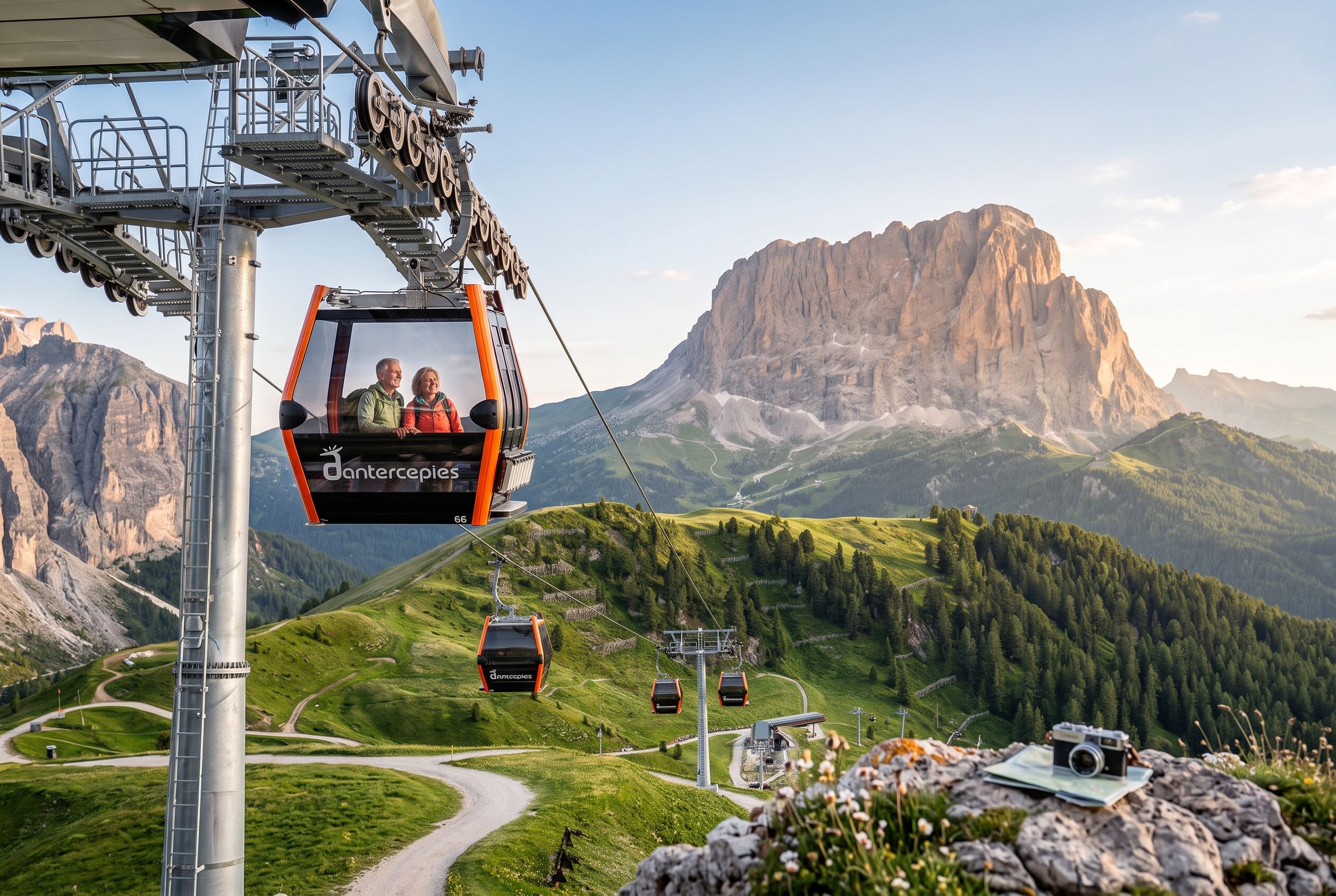
Valley cards work differently. The Gardena Card is valid 6 June to 11 October 2026 and costs €20 for one day, €30 for three days and €50 for seven days when it is not already included by your accommodation. Val Gardena says it covers 17 lifts in summer on one page and all 18 lift facilities in the valley on another, a discrepancy the official site itself carries. It can be bought at valley stations including Ciampinoi, Dantercepies, Col Raiser and Monte Pana, and dogs travel free with the card.
 AI-edited
Elsewhere the pattern repeats with different numbers. Alta Badia publishes its Summer Card for 2026 at €47 for one day, €72 for three of four days, €93 for five of seven days and €165 for twelve of fourteen days, with a seasonal card at €228. Babies under eight are free and juniors are aged 8 to 18. The Lagazuoi cable car at Passo Falzarego is not included in the Alta Badia card, though cardholders receive a discount there.
Two further examples show how local the rules are. The Mountain Card Pustertal gives access to 13 cable cars across the 3 Zinnen Dolomites, Kronplatz, Speikboden, Klausberg, Gitschberg Jochtal and Plose, and is free for children under eight. At Seiser Alm, the Card Gold is valid 1 June to 11 October 2026 and includes the Seiser Alm gondola, the Seiser Alm Express on Line 10, shuttle buses 2, 3, 3A, 5, 13 and 15, and the Almbus on Line 11.
Are there senior fares on the lifts?
Senior reductions exist, but they are not uniform across the Dolomites. Where they are published, they belong to a specific operator or museum. Seiser Alm is the clearest example in the official material: people born in 1960 or earlier pay €18 one-way and €26 return on the cable car in summer 2026.
That Seiser Alm figure is the one to hold on to, because it is stated plainly by the operator with its age bracket attached. The same page documents that wheelchair users, blind passengers and people with 100% disability travel free on the cable car, and that an eligible person must be present with valid identification.
Beyond that, the picture is patchy. The regional guidance notes that reduced-mobility discounts exist by product and area but gives no universal regional rule. Some operators document senior pricing, others do not. The Seiser Alm aerial cableway also publishes separate bike fares and child and junior reductions on its ropeway page.
For the winter season, Val Gardena states that seniors born in 1960 or earlier receive about a 10% reduction on adult prices for one- or multi-day ski passes, with a senior season-pass price also listed. Summer and winter are separate products, and a winter ski pass is not the summer ticket. In summer you generally buy single, return or day lift tickets, or a summer product such as Dolomiti Supersummer.
Where a valley publishes no senior fare, that is not a hidden discount. It is simply not documented, and the ticket office is the place to ask. Rates are indicative and vary by season and booking channel.
How do the valley buses and guest passes work?
Valley buses are the second half of the car-free system, and in several valleys they are free with your accommodation. Val Gardena's Guest Pass gives unlimited use of the valley and local ski buses for guests of member accommodations, excluding the Saltria–Monte Pana line and the Val Gardena Night Bus.
The Guest Pass is issued by participating hotels, guesthouses and B&Bs, so the first question to ask when booking is whether your accommodation is a member. Children up to six travel free on the Val Gardena service. The valley's own mobility page encourages guests to leave the car at their accommodation and use local services or the pass.
Val Gardena's bus schedule lists summer services to the Dolomite passes, including lines 471, 472 and 473, running from 7 June to 11 October 2026. Within the valley, Ortisei, Santa Cristina and Selva sit about five minutes apart by bus, which makes a single base practical for a whole stay.
Seiser Alm publishes its own bus fares where no guest card applies: shuttle-bus tickets cost €4 per day, €9 for three days or €11 for seven days. Public bus lines 170, 172, 176, 177, 179 and 185 run under South Tyrolean public transport fares and accept the Südtirol Guest Pass. The Almbus is €4 single or €7 return. Some services are tightly seasonal: Line 14 runs only 25 July to 9 September 2026, and the Compatsch to Spitzbühl buses only 25 July to 6 September 2026.
In Cortina d'Ampezzo, the municipal tourism site states that five new ski-bus lines start from 24 December, operating every 15 to 30 minutes, with free rides for valid ski-pass holders. Individual routes run to their own timetables: one every 30 minutes from 8:30 to 16:00, another every 30 minutes from 7:00 to 11:00 and from 14:30 to 20:00 with a 100-seater bus, and a third every 15 minutes from 8:30 to 17:30 with two coaches running at once. A route connecting Cortina to the Rio Gere ski area runs hourly from 8:45 to 12:45 and from 14:45 to 17:45. The service is free for children born after 01/01/2018 and ski transport is included in the ticket.
Can I reach trailheads without a strenuous climb?
Yes, and this is the single strongest argument for the lift network. The official lift cards are designed to reduce steep walking by letting you ride up to trailheads and ridge viewpoints rather than climb from the valley floor. Seiser Alm and Val Gardena connect gondolas, funiculars, shuttle buses and valley buses to hiking access points.
The UNESCO-linked accessible route programme, coordinated by the UNESCO Dolomites Foundation, documents 36 accessible trails and 13 panoramic viewpoints reached by fully accessible lift systems across the property, covering its nine mountain systems. The programme was created through cooperation among local administrations and associations focused on sport, accessibility and disability, and is intended to help visitors explore the property's universal values, its geology and its scenery. The interactive accessible-route map is the place to start planning which of those routes suits you.
Travellers describe using lifts to reach viewpoints and then doing easy-to-moderate walks from the top, rather than long uphill climbs from the valley floor.
Val Gardena's summer lift list includes the Ortisei–Alpe di Siusi cableway, the Ortisei–Rasciesa funicular, the Ortisei–Furnes cableway, the Furnes–Seceda cableway, the Selva–Ciampinoi cableway, the Selva–Dantercëpies cableway and the Passo Sella–Forcella Sassolungo cableway, among others. There are three major lifts from Ortisei alone, which means you can reach trailheads without a car.
One booking detail is worth knowing before you go. Seceda requires booking a specific time up to three days ahead, so it does not work as a spontaneous afternoon decision. If you plan a late-afternoon walk, confirm the lift times first, because the last descent is the one that matters.
If you would rather hand the logistics to someone else, our guide to small-group and guided tours of the Dolomites covers how those days are structured.
What about driving the passes?
A car is convenient in the Dolomites, not essential. Several travellers say a car helps, but also that buses are frequent, free with lodging and sufficient for a well-planned stay. Where the car genuinely earns its place is the shoulder season, when lifts are not running.
The strongest argument against driving in high season is not the mountain roads themselves but the restrictions on them. At Seiser Alm, private cars are not allowed on the road up to the plateau from 9:00 to 17:00 during the operating season. Holders of an official European Disability Card may drive up to Seiser Alm and Compatsch at any time, with prior registration and an access permit via the municipal portal.
Parking and traffic are the other considerations. Travellers who leave the car behind describe it as eliminating restricted traffic zones, parking searches and mountain-road congestion. If you do drive, the practical pattern is to park at the accommodation and use the valley bus for one leg and the lift for the other.
Infrastructure is being modernised across the region. Industry coverage for the 2024–25 winter season reported more than €95 million invested in lift infrastructure, with replacements in Kronplatz, Alta Badia, Val Gardena, Arabba-Marmolada, 3 Peaks, San Martino di Castrozza–Role and Gitschberg Jochtal Bressanone. In Val di Fiemme, a new 10-seater gondola at Latemar Dolomites–Pampeago replaces a 1988 four-seater chairlift, carrying 2,700 people per hour and cutting travel time to four minutes, alongside a new 200-space car park with a dedicated drop-off area. The Val di Fiemme season news sets out the details.
If you are arriving from outside Italy, that is a separate subject with its own dedicated guide, and it is worth reading before you decide whether to hire a car at all.
When should I go, and when are the lifts closed?
June, September and early July are the best compromise for open lifts, better weather and fewer crowds. July and August are the busiest months. May, October and November are the weakest for full mountain-service availability, with limited lift operations and some accommodation closures.
The lift seasons themselves stretch further than many visitors expect. The Seiser Alm gondola operates in summer from 22 May to 2 November 2026, daily until 18:00 and until 19:00 in high season. Val Gardena states that the last lifts close at the beginning of November 2026. In the Cortina area, summer 2026 schedules show the 5 Torri chairlift running until 11 October and the Lagazuoi cable car until 18 October, with the Marmolada cable car planned to run until 27 September.
What no one publishes is a single regional closure calendar. The gathered official material does not document a universal monthly closure schedule or maintenance timetable for all Dolomite lifts. Closures are published by each operator and valley page rather than by the whole region, so the lift you want may be closed for maintenance on a date when the valley next door is fully open.
Two practical consequences follow. First, build your day around the lift you intend to use, not around a general assumption that everything runs. Second, if you are travelling in the shoulder months, check whether your accommodation is even open, because some close in those windows.
Weather is the other variable. MMM Corones, which opens with the cable cars, has documented weather-related closures. A guest review of a Verona-based Dolomites trip noted that two travellers paid extra for the lift and saw nothing because of the weather. That is worth remembering before you commit to a summit ticket on a cloudy morning.
What about mountain museums and medical help?
Two of the Messner Mountain Museums sit at altitude and are reached by lift, and their access arrangements differ. MMM Dolomites at Monte Rite is documented as not suitable for disabled visitors. MMM Corones is documented as suitable for disabled visitors. Both publish senior fares for ages 65 and over.
MMM Dolomites at Monte Rite is open 1 June to 30 September, from 10:00 to 17:00 with last admission at 16:30, and closed on Tuesdays. MMM Corones opens with the cable cars and is open daily from 10:00 to 16:00, with last admission at 15:30. Dogs are allowed in the Reinhold Messner Haus.
On health, the Veneto Dolomites health guide states that 118 is the number to call for medical emergencies, and ULSS1 Dolomiti's CUP booking line is 0437 184 99 00, with published weekday and Saturday hours. The single European emergency number 112 is stated for mountain rescue across the Dolomites. A medical service in Selva di Val Gardena is listed with the phone number 0471 794266, operating daily in the main tourist season and closed on Wednesday.
What is not documented is the location of the nearest pharmacy or medical help to the Seiser Alm cable car, MMM Dolomites or MMM Corones. Those details are not published in the material available, so ask at your accommodation or the valley tourist office on arrival rather than assuming a pharmacy is within walking distance of a mountain station.
Cancellation terms for the listed lifts, museums and shuttles are also not documented. If you are booking a timed lift such as Seceda, or a museum entry, ask about the cancellation position at the time of booking.
For what to carry on a mountain day, our guide to packing for the Dolomites covers boots, layers and the weather swings that catch people out.
Where should I base myself without a car?
Ortisei is described as the handiest place for car-free access, with direct lifts from town and buses to Santa Cristina and Selva. Val Gardena is repeatedly recommended as the single base for a car-free trip, and the bus from Bolzano to Ortisei takes about an hour with frequent services.
One arrival detail is worth carrying with you. Walk to the bus station to catch it.
Within Val Gardena, the three main villages sit about five minutes apart by bus, so a base in any of them gives you access to the whole valley's lifts. The wider principle is to stay near a lift or a bus stop, which saves time and makes early and late departures much easier.
Alta Badia positions its summer card as a way to move from valley to valley and reduce car use. San Martino di Castrozza says its card helps you move freely on lifts and reach the heart of the Pale di San Martino and the Lagorai range. Val di Fassa describes its summer pass as a way to reach panoramic viewpoints, trails, hiking routes, bike parks and MTB tours without relying on a car for every move.
The system is easy for non-drivers, but it is not set and forget. Check bus timetables, lift hours and whether your hotel issues a pass, and do it before you arrive rather than on the morning you plan to use them. If you would like a ready-made structure, our five-day Dolomites itinerary for the over-50s builds a car-free trip around these connections.


