
The Amalfi Coast rewards a slow approach. Its towns climb vertical cliffs, its roads coil above the sea, and its ferries do the hard work for you. For travellers aged 50 to 70, the most comfortable strategy is the one experienced visitors repeat again and again: pick one base, unpack once, and let boats carry you between Amalfi, Positano, Ravello and Capri. This five-day plan does exactly that, with rest afternoons built in and an optional terrace walk for anyone who wants a little more.
The coast is a UNESCO World Heritage cultural landscape, inscribed in 1997, and its official heritage site describes it as a cultural landscape rather than a single monument (Amalfi Coast UNESCO). ferries are the least strenuous way to move between towns, because they avoid the winding SS163 road and cut the walking involved. The plan below is built around that principle.
Where should over-50s base themselves for five days?
Amalfi town is the strongest single base for this itinerary. Accessibility guides describe it as the coast's most manageable major town, with a flat seafront, a level Piazza Duomo and a central waterfront bus stop, while Sorrento is repeatedly recommended as the most accessible base overall. Positano, by contrast, is described as effectively inaccessible for independent exploration because steep stairs dominate the town.
Choosing between Amalfi and Sorrento is the first decision. Amalfi puts you inside the coast itself, a short ferry hop from Positano and a bus or taxi ride below Ravello. Sorrento sits at the peninsula's northern end, flatter and easier for luggage, and well placed for Capri and for onward connections. Forum contributors aimed at older travellers repeatedly endorse Sorrento as a base and warn against splitting the week across several hotels.
What both share is a warning worth taking seriously. Reviews of stays in central Amalfi cluster around night noise: church bells starting early, hallway noise and street noise. If you book in the historic centre, ask for a room away from the square and the main lane. That single request does more for a restful week than any other planning step.
How should you plan each day around the ferries?
Treat the ferry timetable as the spine of the day and the bus as backup. Ferries are seasonal and should be checked in advance, and operators advise arriving at the dock well before departure. Alicost states that all its vessels accommodate passengers with reduced mobility and that boarding assistance is available, with passengers asked to notify the company when booking and to arrive at least one hour early.
Two habits make ferry days calm. Second, never build the day around the last sailing of the afternoon; a 2025 traveller report advises always having a backup option and checking same-day updates, since cancellations are usually posted on the day.
On land, the SITA Sud bus network is the primary public transport along the coast road, and Amalfi's own tourist information page confirms that SITA Sud operates ground transport from Amalfi to other destinations throughout the day. Daytime bus hops that look short on a map can stretch in traffic. A 2025 report describes the Amalfi to Positano run taking 50 to 60 minutes between roughly 9am and 1pm, against about ten minutes at night.
Day 1: Amalfi on foot, at sea level
Spend the first day entirely in Amalfi, on the flat. The seafront, the level Piazza Duomo and the central streets are the documented low-strain zone, while the cathedral interior involves stairs. Keep the day short, learn the waterfront, and let the journey settle.
Amalfi's historic centre operates as a pedestrian island for the whole day, with short exceptions. The official town page states that the pedestrian area between Via Mansone I, Piazza Duomo, Via Lorenzo d'Amalfi, Via Pietro Capuano and Largo Spirito Santo prohibits vehicle circulation except in exceptional cases, with access allowed for hotel guests checking in, vehicles serving disabled persons who carry the personal markings, and taxis or NCC cars starting or ending a ride there (Comune di Amalfi). In practice that means the centre is quiet underfoot but not car-free at your hotel door.
Two gentle additions suit a first afternoon. The Paper Museum sits at Via Delle Cartiere 23, and its own information page gives daily opening from 10.00 to 19.00 with last admission at 18.20, plus a Monday closure and 10.00 to 17.00 hours with last admission at 16.30 in another part of its published calendar. Confirm the current pattern before setting out. For an accessible swim, the Comune documents an inclusive beach area at Marina Spiaggia with a walkway, floating chairs, a Job chair, sunbeds and umbrellas, from June to October, with free assistance organised by L'Alveare Social Cooperative.
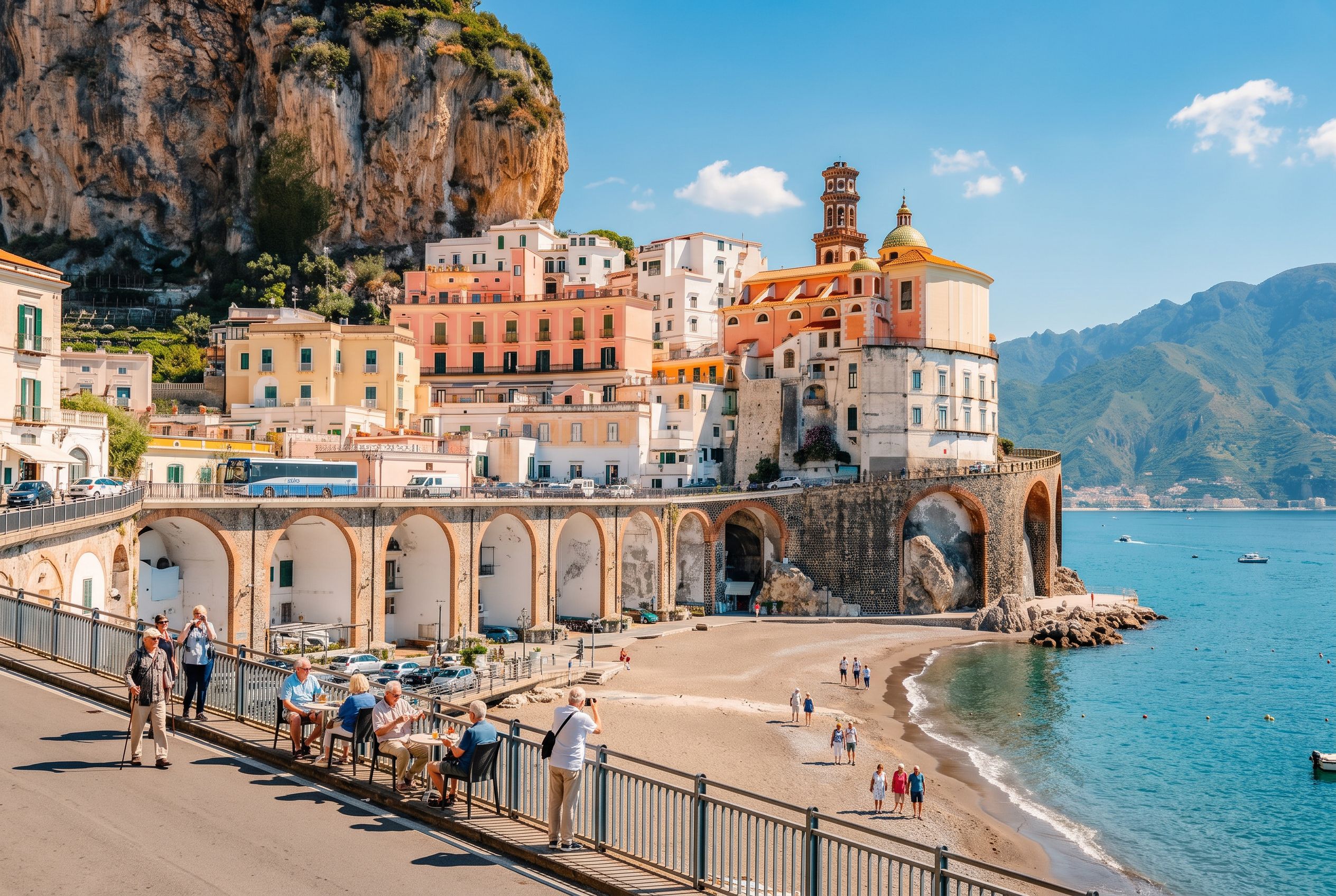 AI-edited
Day 2: Positano, seen from the water
Go to Positano by ferry and treat it as a view and a lunch stop rather than a walking town. One accessibility guide advises viewing it from the boat or a road belvedere instead of attempting the stairs, and describes the town as effectively inaccessible for independent exploration.
The ferry approach is the point. Positano's drama is vertical, and from the water you see the whole amphitheatre of painted houses without climbing a single step. Stay on board for the arrival, disembark if you wish, and keep your ambitions modest: a table near the beach, a slow coffee, and an early return sailing.
If you would rather not disembark at all, the crossing itself is the excursion. The return to Amalfi leaves the afternoon free for the rest that this itinerary deliberately builds in. Travellers who want to understand what a stay in Positano involves, rather than a visit, can read our separate review of Le Sirenuse in Positano; hotel choice on this coast is its own subject and has its own guide.
Day 3: Ravello and its gardens
Ravello is a hilltop town reached by bus, taxi or arranged transfer from Amalfi, and it is best for visitors who can manage some elevation.
The trade-off is terrain. Ravello sits high, with stairs and slopes between its lanes and its gardens, so plan the visit around a vehicle rather than a walk up. A forum contributor describes it as charming and not too hilly once you are there, and reachable by bus or taxi from Amalfi; the same traveller advice treats it as a bus or taxi add-on rather than a walkable stop from the coast.
Go early, take the gardens slowly, and build in a long lunch. The climb back down is the same road in reverse, and the afternoon is yours to rest. Anyone who wants more time on their feet can add the terrace walk described further down this guide, on a day when the weather is kind and the legs are willing.
Day 4: A boat day to Capri
Capri works as a full boat day from the Amalfi Coast, and the documented advice for older travellers is to take the funicular or a taxi from the port up to the main town rather than walking the climb. Ferry services on this route are seasonal and several operators publish their own timetables.
Recent coverage shows the route expanding. As of March 2026, Alicost was reported to be restarting spring ferry service on 21 March with new direct Salerno to Capri routes, and Grassi Junior was reported to be launching its 2026 season with new direct Positano to Salerno and Salerno to Capri lines. Schedules shift with the season, so check the operator's own page for the week you travel.
Once on Capri, the day is a series of short, supported movements: the funicular or a taxi up, a wander through the main town, and the same route back down with time to spare before the return sailing. Keep the afternoon light. The crossing home is the rest.
Day 5: A gentle beach day, or Atrani
For a final day without stairs, the accessible-travel sources point to Marina di Praia as a practical beach stop, and one accessibility guide describes Atrani as mostly flat at sea level and reachable from Amalfi by a flat tunnel walkway. Maiori and Minori are also documented as gentler coastal towns with easier walking.
Atrani is the shortest outing: a level walk from Amalfi through the tunnel, a small square, and a return the same way. The flat-walkway detail comes from that accessibility guide rather than from official tourist materials, so treat it as a documented report rather than a municipal guarantee.
Marina di Praia suits anyone who wants beach access without tackling a cliff town's stairs. Maiori and Minori, further along the coast, are described as having accessible beachfronts and easier walking than the cliff villages. Any of the three makes a soft landing for the last full day before travel home.
Can you add a scenic terrace walk if you are active?
Yes, with care. Ravello's gardens and viewpoints are the documented scenic walks, and the coast's gentler walking is found in Amalfi's waterfront area and Sorrento's central flat areas. Positano's stairs make it the wrong choice for an added walk, and the coast overall is described as not easy for mobility-limited travellers.
The sensible version of an active day is short and shaded: a morning in the gardens at Ravello, or a level stretch along Amalfi's seafront, with the afternoon kept free. Forum reports from travellers around 50 describe being exhausted by the end of a full day on the coast, which is useful calibration for anyone planning a longer walk.
Footwear matters more here than on most trips. Our guide to packing for the Amalfi Coast, shoes, steps and summer heat covers what actually holds up on these surfaces.
When should over-50s plan this trip?
May and September are the months most often recommended, with April to June described by official tourism as the best period for fewer crowds and better conditions. The season runs from around Easter or early April to the end of October, and June to late August is the busiest stretch.
Winter changes the coast substantially. From November to March, some hotels, restaurants, ferries and hydrofoils reduce service or close, particularly in smaller towns, and ferry schedules are seasonal throughout the year. Anyone travelling outside the main months should confirm sailings before booking accommodation.
For a fuller picture of weather, crowds and timing, see our separate guide to when to visit the Amalfi Coast for warm days and small crowds. And if you plan to bring home a bottle of the coast's signature drink, our piece on lemons and limoncello on the Amalfi Coast explains what you are tasting.
Practical questions before you book
Book ferries and any accessible transfers in advance, confirm access details with each property, and keep the emergency numbers to hand.
On health, the documented picture for Amalfi is that there is no hospital in town, with the nearest hospital services in Salerno and a first-response facility, the Presidio Ospedaliero Costa d'Amalfi at Via Civita 70 in Ravello, serving the central coast. Serious cases are transferred onward to larger hospitals in Sorrento, Salerno or Naples. Amalfi has at least one pharmacy, with one guide listing a pharmacy at Piazza dei Dogi and the phone number 089-871063.
On safety, a 2026 safety guide describes the coast as broadly manageable, with the main risks being petty theft, crowded transport and summer mobility challenges rather than violent crime (safety guide). The same guide notes that in the Amalfi area, summer rescue may arrive by sea or helicopter, which can be faster than a road ambulance in difficult terrain. Emergency numbers used locally include 112 for police and general emergencies, 118 for ambulance and medical emergencies, and 115 for fire and rescue.
Hotels on this coast do not uniformly publish step counts or lift dimensions. Ask directly when booking.
The five-day plan at a glance
The shape of the week is simple: two days on the water, one hilltop day, one beach day and one day on foot in Amalfi itself, all from a single base. Each day has a rest afternoon built in, and the optional walk slots into whichever morning suits you best.
| Day | Plan | Terrain documented | Rest window |
|---|---|---|---|
| 1 | Amalfi on foot | Flat seafront and level Piazza Duomo; cathedral has stairs | Afternoon |
| 2 | Positano by ferry | Steep stairs dominate the town; view from the sea | Afternoon |
| 3 | Ravello gardens | Hilltop with stairs and slopes | After lunch |
| 4 | Capri by boat | Funicular or taxi from the port up to town | On the crossing |
| 5 | Marina di Praia, Atrani, Maiori or Minori | Gentler beachfronts and easier walking | All afternoon |
One caveat applies to the whole week. This itinerary reduces the strain rather than removing it. Confirm access details with every property and operator before you book, and let the boats do the climbing.


