
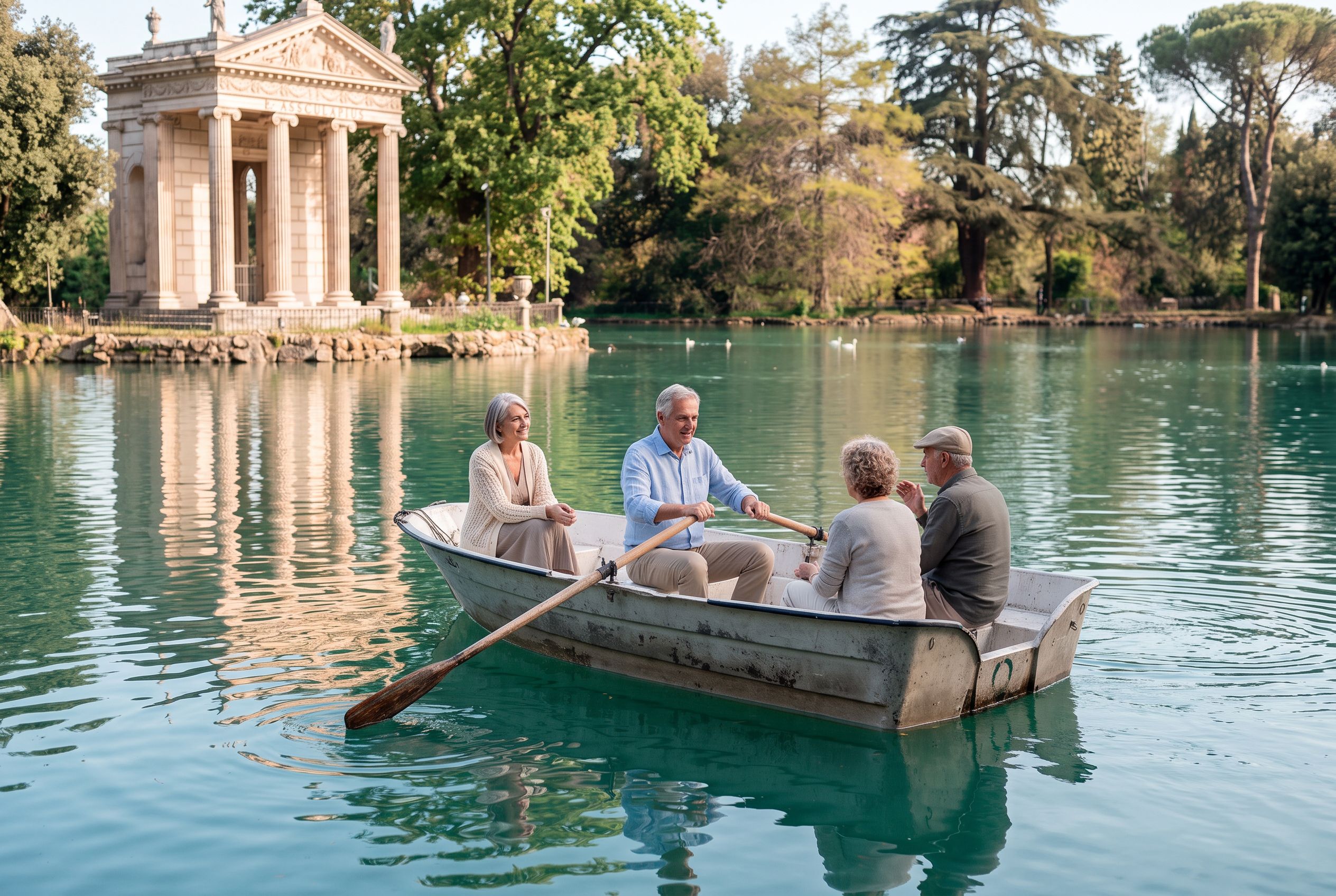
Rome rewards a multigenerational group because its headline sights are close together and each one can be finished in an hour or two. The Colosseum holds a child's attention for roughly 1 to 1.5 hours if the visit stays simple and focused, according to museumticketsrome.com, and the Trevi Fountain sits a short walk from a dozen gelato counters. Villa Borghese, an 80-hectare park with a rowing lake and wide paths, gives both generations somewhere to sit down. The workable rhythm is one monument, one sweet stop, one shaded break, then an easy seated activity.
This guide covers the gladiator sites, the coin toss, a boat on the Tiber, the park, pizza breaks and rest points, with the practical detail that matters when one traveller is 70 and another is seven. Adult-only nightlife and long forced marches are out of scope. A neighbouring subject, the city's evening restaurant culture for grown-ups, has its own dedicated guide and is not covered here.
Is Rome worth visiting with grandchildren?
Yes, and the reason is scale rather than spectacle. Rome's ancient core packs the Colosseum, the Forum and the Palatine into one ticket and one afternoon, while the Trevi Fountain and the Pantheon sit within a short walk of each other. Children get gladiators and coins in a fountain; grandparents get benches, cafés and short hops between them.
The Colosseum is the largest amphitheatre ever built, completed around AD 80 and once seating roughly 50,000 spectators for gladiator combat, according to colosseum-rome.co. That single sentence does more work with a nine-year-old than any guidebook paragraph, and it is delivered by the building itself.
Guest feedback across the Colosseum's Google reviews, where it holds 4.8 out of 5 from 507,207 reviews as of September 2026, repeatedly singles out the arena floor, the upper levels and the underground hypogeum with its cages, tunnels and lifts as the most memorable areas. Guided tours, including small-group and underground access, are described in those reviews as adding substantial historical context, while self-guided visitors report that audio guides and signage cover less ground.
How do you do the Colosseum with a grandchild?
Book a timed slot on the official site, arrive about 15 minutes early for airport-style security, and carry photo ID for the gate. The ground floor is the flattest and easiest area, pushchairs are permitted there and on the first two levels, and the lift serves both. Keep the visit to about 90 minutes.
Tickets matter more here than anywhere else in Rome. EU citizens under 18 enter free of charge but must still book a free timed entry ticket in advance, and all children under 6 enter free regardless of nationality, according to colosseum-rome.co. Non-EU children aged 6 and over pay the same rate as adults on the official site, which is €18. The park's published opening season runs year-round with seasonal hours, and the first Sunday of each month is a free-entry day for everyone.
Strollers and pushchairs are permitted inside the Colosseum on the ground floor and first two levels, accessible via elevator, though the underground chambers and upper Attic levels are not accessible with a stroller. The main Sperone Valadier entrance is step-free and stroller-friendly, and the elevator to the first and second levels accommodates strollers alongside a maximum of two wheelchairs, so a short wait is possible. The arena floor is only accessible via a guided tour.
 AI-edited
For grandparents, the park's own accessibility pages are unusually specific. Inside the Colosseum a lift connects the first and second tiers for people with reduced mobility, and a second lift reaches some of the underground sections. Three wheelchairs are available on the first floor at the reception and security office, and five more are available at the main entrances to the Roman Forum and the Palatine Hill. There are eight benches on the second level, positioned along the visitor's path through the Colosseum Museum and temporary exhibition areas.
The site is largely open and unshaded, and reviewers who visited in summer report intense heat and crowding, with early morning or evening visits repeatedly recommended. There is a water fountain inside for refilling bottles. The Colosseum guide states the site is closed on 1 January, 1 May and 25 December in the published 2026/2027 schedule, and that summer 2026 hours extended to 7:15 p.m. with last admission at 6:15 p.m.
Should you add the Forum and Palatine Hill?
Only with children who can walk extensively. The Roman Forum and Palatine Hill share the Colosseum ticket, but the terrain is uneven, with changes in level and irregular paths, and the park describes these areas as only partially accessible. A full historic visit takes two to three hours, which is a long stretch for young legs and older knees alike.
The park has laid out about 70 benches across the archaeological area, most of them near drinking fountains, at points including the Vicus Argentarii and Tabularium, the south-east corner of the Basilica Giulia, the Horti Farnesiani, and the Palatino and Domus Augustana with the southern path. Those benches are the difference between a manageable hour and an abandoned afternoon.
There is also a tactile trail of 11 panels across the park, accessible to all, with three in the Roman Forum, three on the Palatine Hill, four inside the Palatine Museum and one at the Colosseum. For a grandchild who learns by touching, that is a genuine route rather than an afterthought.
If the group's energy is uncertain, the honest answer is to treat the Forum as optional and decide on the day. The Colosseum is the more manageable of the ancient sites, with barrier-free routes, lifts and accessible entry points documented by the park, while the Forum and Palatine are only partly accessible. For a lower-exertion alternative across the city, see our guide to seeing Rome with little walking.
Where does the Trevi Fountain fit into a family day?
Treat Trevi as a 30-minute stop, not a destination. The fountain sits in the city centre and pairs naturally with a gelato counter in the same streets, which makes it a short outing between bigger sights. The coin toss is the whole point for children, and the tradition is tied to returning to Rome.
Rome's official tourism body lists the Trevi Fountain as a major stop within the city centre, and the coin toss is the tradition most families come for. The fountain area is listed as an accessible experience, though no detailed mobility infrastructure is documented for the immediate surroundings, and no booking terms are documented because none are needed.
Timing is the practical question. What is documented is that the busiest sightseeing days and the hottest months reward earlier starts and longer rest breaks, which is planning advice rather than a schedule.
Nearby, the Spanish Steps themselves are not accessible, and the piazza and fountain at the foot are the practical viewing area. That is useful to know before promising anyone the view from the top.
What about a boat on the Tiber and Villa Borghese's rowing lake?
Both work, with one caveat. Rome runs scheduled boat services on the Tiber from central river stops, operated as sightseeing cruises rather than long excursions, which suits a slower family pace. Villa Borghese's lake offers rowboat rental at about €5 for 20 minutes, with turtles and birds visible in and around the water.
Independent accessibility coverage says the Tiber cruises are not accessible because the quays are reached by stairs. That is a documented limitation at the riverboat level rather than a blanket statement about riverside walks, and it is worth checking before booking if anyone in the group uses a mobility aid.
Villa Borghese is the better documented option for a mixed-age group. Independent accessibility coverage describes the park as having wide paved avenues and step-free park gates, and a Rome accessibility roundup notes that its broad paths make it a useful low-stress area for mixed-age outings. The Galleria Borghese can be entered step-free from the rear door, though the upper-floor lift may not take a large wheelchair. Reservations should be made in advance for accessibility-related needs.
Guest feedback on the park, which holds 4.6 out of 5 from 95,793 Google reviews as of September 2026, describes it as spacious, shaded and quiet, a calm break from the crowds of central Rome, with free entry. Reviewers note wide, flat pathways and abundant benches, along with bike, pedal cart, golf cart and small train rentals for covering the 80-hectare grounds. Cafés and snack bars are inside the park, and public toilets exist, though some reviewers note a fee.
One guest wrote on Google in July 2026:
"It is beyond beautiful, perfect if you are looking to spend the morning in a quiet place far from the noise of the city. There are also multiple fountains so you can hydrate yourself."
The park also publishes seasonal family entertainment, including puppet-theatre style children's programming, which makes it useful as a rest point between more demanding sightseeing stops. The precise accessibility of every family attraction inside the park is not fully documented; ask at the park entrances. Our guide to Rome's parks and gardens for a restful afternoon covers the wider picture.
How do you pace a day that suits both generations?
Keep plans small. Travellers in Rome family-trip forum threads most often recommend private or very small tours and slow days, because Rome tires mixed-age groups quickly. The strongest firsthand theme is mobility management: cluster a few walkable areas and use taxis to avoid long cross-city transfers.
A Rick Steves forum poster planning Rome with children and seniors says a very small or private tour group is best where someone has mobility issues, because it can be tailored to the group. Another thread describing a Rome family trip with two grandparents and three children framed the whole visit around age-sensitive pacing and logistics rather than coverage. The clearest warning in that material is not to overload the schedule: one thread explicitly advises setting the schedule ahead of time and sticking to it, to avoid exhaustion and friction.
Forum advice also points to low-strain outings such as the Appian Way and the catacombs, with one thread noting that children enjoyed walking the Appian Way and going to the catacombs. Another recommends Villa Borghese's row boats and the Pincio overlook above Piazza del Popolo, noting that Sunday is especially lively there for children. Largo Argentina's cat sanctuary was raised as a possible stop for older children. Our senior-friendly day trips from Rome covers options beyond the city walls.
How do you get around Rome with grandchildren?
Children travel free on the city network. ATAC says children up to 10 travel free on public transport in the territory of Roma Capitale when accompanied by a fare-paying adult, with exceptions for special connections. On Cotral vehicles, children up to 10 travel free inside Roma Capitale, and outside it only if under one metre tall when accompanied by a paying adult.
On Trenitalia vehicles, ATAC says children are free up to their fourth birthday if accompanied and not occupying a seat. Rome's public transport senior fares were not documented in the official material gathered here; ask at an ATAC ticket office.
Metro works have reshaped several central stations in recent years, and the pattern is worth knowing because the affected stops are the tourist ones. In April 2024, local tourism and transport reporting said Metro A was closing early Sunday to Thursday, with shuttle buses after 9 p.m., to complete track replacement and station upgrades before Jubilee 2025. Spagna station at the Spanish Steps was reported closed from 15 July to 3 October 2024 for restyling, and Ottaviano, the Vatican-area station, was reported closed from 22 July to 9 September 2024 for renovation. Reporting said Cipro, the Vatican Museums stop, was under renovation but remained open, so it was less disruptive than the fully closed stations. In December 2024, reporting said Metro A was due to return to normal nighttime hours from 6 December, showing that the most disruptive phase was temporary. In February 2026, local reporting said Rome started work on four new Metro C stations, including Chiesa Nuova, Piazza Pia, Ottaviano and Mazzini, with the wider package projected for 2037.
Expect route changes near the Vatican, the Spanish Steps and central Rome, and build in extra time if planning to use trams, which were repeatedly replaced by buses during depot works.
What do tickets cost, and when is entry free?
The Colosseum, Roman Forum and Palatine share one timed ticket at €18 for adults, with free entry for EU citizens under 18 and all children under 6, though free tickets still need advance booking. Rome's civic museums are free on the first Sunday of every month, subject to site capacity.
The city museum network lists free admission for children under 6, for visitors with disabilities and a family member or carer, and reduced admission for non-resident visitors aged between 6 and 25. The network also states that people with disabilities plus one accompanying person enter free. One guide states that the city museum network offers free admission on the first Sunday of each month and a 50% reduction for non-resident visitors in the last two hours of opening on Wednesdays.
Senior concessions are less clear-cut than families often assume. The museum network lists reduced admission for EU citizens over 65, and one Rome admission guide states that EU citizens aged 65 and over are among the reduced-fare categories for Rome city museums and archaeological sites. However, one source notes that the Colosseum, Forum and Palatine complex has conflicting published age concession information, with some material citing free entry for EU citizens over 65 and some official pages focusing instead on reduced fares for EU citizens aged 18 to 25. The material does not provide a single consistent senior fare for that complex. Check the official ticketing page for the date you plan to visit.
The Pantheon is listed as open Monday to Sunday, 9:00 am to 7:00 pm, with last entry times stated on its page, at €7 full price and €2 reduced for EU citizens aged 18 to 25. No senior or over-65 discount is listed there. Visitors with disabilities or reduced mobility may enter via the external ramp on the Via della Minerva side.
At the Vatican Museums, the prices page gives €10 without online booking and does not list a senior discount. Disabled visitors with a certified invalidity of at least 67%, and a companion if the visitor is not self-sufficient, receive free entry and priority skip-the-line entry. The standard visitor route includes stairs, and disabled visitors can request an alternative accessible route, but accessibility needs should be booked in advance online. The last Sunday of the month is subject to the museum's calendar of openings and closures.
Rates are indicative and vary by season and booking channel.
What should grandparents know before booking?
Verify the room, not just the hotel. Rome reviews mention very tiny lifts, no lift at all, stairs between the street and the room, and shower access that involved steps or awkward high risers. Some guests flagged leaky shower doors, broken shower holders, or showers that were hard to use safely.
Noise is the other recurring theme in Rome guest feedback. Several properties were praised for quiet rooms or blackout curtains, while others drew repeated criticism for street, corridor, tram or thin-wall noise that disrupted sleep. One Rome hotel was described as having no corridor noise and being very quiet, while another was praised for good soundproofing. Guests at one property specifically praised blackout curtains that let them sleep in without light interruptions. On the other side, guests reported being unable to sleep because of nearby rooms, lobby noise, early cleaners or tram noise starting before dawn, and one Tripadvisor review said the curtains were quite thin and not enough to guarantee darkness.
Beds drew mixed reports too. Reviews for Rome hotels repeatedly mention comfortable or large and comfortable beds, while one Tripadvisor review described the beds as hard and very small, with a complaint that tall adults would not fit comfortably. Reception staff were frequently praised as friendly or helpful, and breakfast was often described as good, excellent or abundant, with a mix of sweet and savoury items, though one B&B was criticised because breakfast was served along the corridor, creating early-morning disturbance.
The practical translation: ask for a room on a higher floor away from streets, bars, trams and lifts, confirm blackout curtains and soundproofing in writing, and ask specifically about lift size, step-free access and walk-in or low-threshold showers. Rome reviews show these features are inconsistent between properties. For a gentler look at the city's squares, see Rome's prettiest piazzas and easy strolls.
One more practical note: Italy's emergency number is 112, according to one Rome guide. No exact Rome-wide emergency number was documented for the individual sites covered here, so it is not stated for them.
What should you plan around, and what can you skip?
Skip the Spanish Steps as a climbing exercise; the piazza and fountain below are the practical viewing area. Treat the Forum and Palatine as optional. Build the trip around the Colosseum, Villa Borghese and short hops on public transport, with free child fares and rest breaks between them.
The strongest documented family choices in Rome for this topic are the Colosseum, Villa Borghese and easy public-transport days. The published structure of Rome's major family-friendly sights supports short outings: one major monument, one sweet stop, one shaded park break and, if the group still has energy, one boat trip.
Vatican Museums tickets and St Peter's Basilica are a separate day and a separate set of logistics. A source says there is a ramp to enter St Peter's, the basilica interior is accessible once inside, and the wheelchair-accessible roof is open, while the dome top requires stairs. Large wheelchair-accessible bathrooms are mentioned on the roof level, and a source says to use the wheelchair entrance and security lane.
For everything else, the advice from families who have done this trip is consistent: fewer sights, more sitting, and a schedule agreed in advance that everyone sticks to. Rome does not need to be conquered. It needs to be walked slowly, with gelato.


