
Salzburg is one of those rare cities that works for both generations at once. The historic center is compact, the river promenade is flat, and the marquee attractions—the fortress, the trick fountains, the science museum—are engineered for easy access. For grandparents who want to share Mozart's hometown with their grandchildren without exhausting themselves, this is the sweet spot.
The key is pacing. You don't need to see everything; you need to see the right things at the right speed. This guide focuses on the stops that reward both ages: water games that make kids shriek with delight, a funicular that spares your knees, a science museum that turns learning into play, and enough ice-cream stops to keep everyone smiling.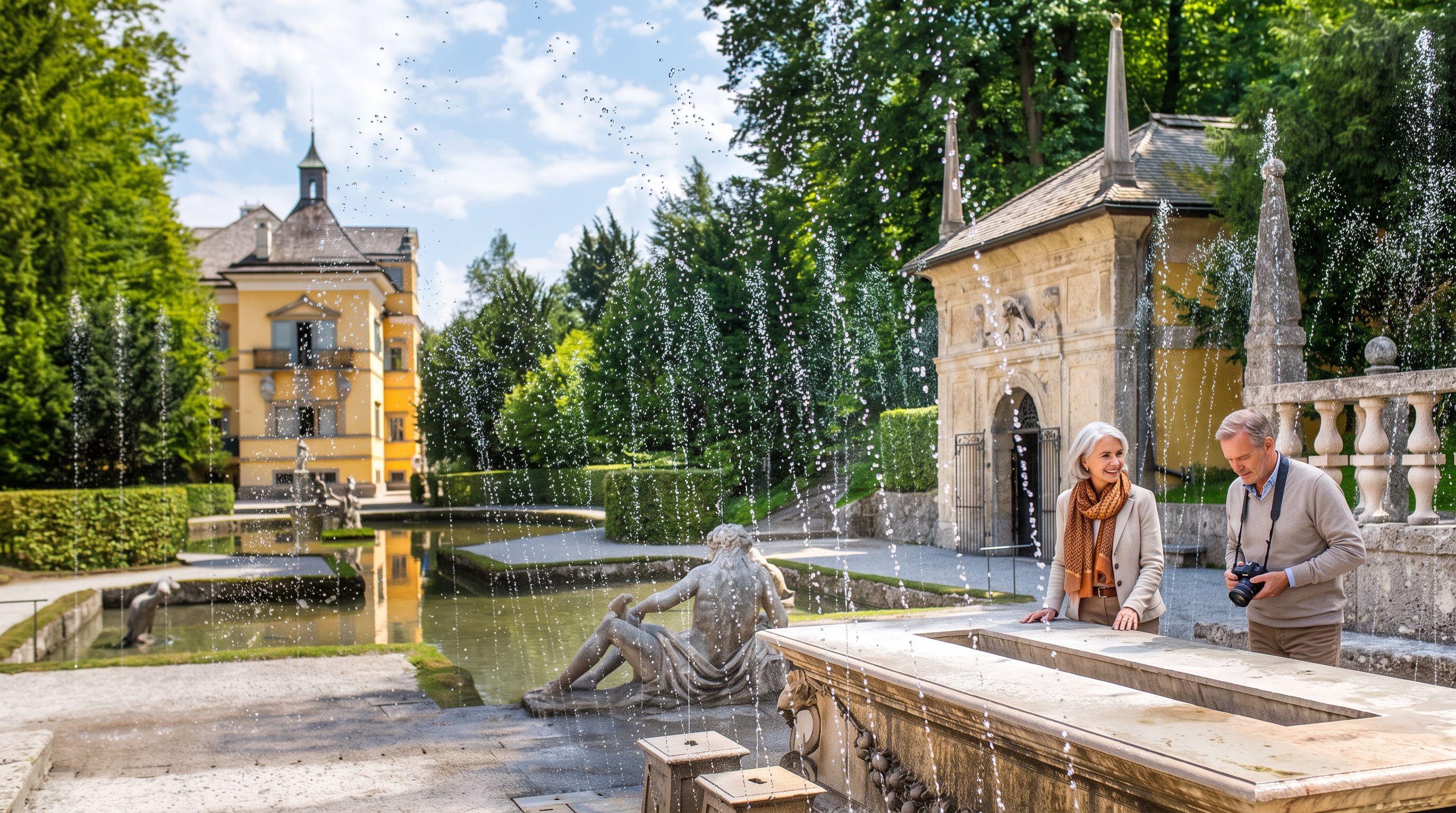 AI-edited
Is Salzburg easy to navigate with grandchildren?
Yes, Salzburg is genuinely manageable for a multigenerational group. The Old Town is compact, the main sights cluster along flat riverfront paths, and the fortress is reached by funicular rather than a steep climb. The vast majority of public transport vehicles are low-entry with a fold-out ramp, and most hotels sit within a short walk of the action.
The historic center is a UNESCO World Heritage Site, and its cobblestone lanes can be uneven underfoot, so comfortable shoes are non-negotiable. But the distances are short. Mirabell Gardens to the Old Town is a ten-minute stroll across the footbridge. The river promenade runs flat for kilometers in both directions, perfect for a slow morning wander or an after-dinner ice-cream walk. For longer transfers, the Salzburg Verkehrsverbund carries small children free up to the day before their sixth birthday, when accompanied by a paying passenger. If you are staying overnight anywhere in the province of Salzburg you also receive a Guest Mobility Ticket at check-in: since 1 May 2025 it covers the entire public transport network in the province for the whole of your stay, funded by a mobility fee of €0.50 per person per night. Day visitors without it can buy the Freizeit-Ticket Salzburg, which costs €25 under the tariff in force since 1 January 2026 and covers two people plus up to four children under 15 for one day.What should we see first with grandchildren?
Start with Mirabell Gardens in the morning, when the light is soft and the crowds are thin. The baroque flowerbeds, the Pegasus fountain, and the Zauberflötenspielplatz give children space to run while grandparents enjoy the views of the fortress overhead.
Mirabell is free to enter and is listed by Salzburg's tourism office as barrier-free—one of the easiest major sights in the city for both generations. The gardens feature in The Sound of Music, and you can point out the steps where Maria and the children sang "Do-Re-Mi" before moving on. The gardens have their own playground, the Zauberflötenspielplatz, which gives younger grandchildren somewhere to burn off energy while you sit. One Google reviewer noted in June 2026 that the gardens are "beautifully maintained" and that "our entire family enjoyed the walk through to enjoy the scenery." From Mirabell, cross the footbridge over the Salzach River and you're in the Old Town. Getreidegasse, with its ornate wrought-iron shop signs and Mozart's Birthplace, is best enjoyed as a slow wander rather than a destination. Let the grandchildren spot the golden signs—a bakery, a tailor, a bookbinder—while you pause at the cafés for a mid-morning break. For a gentler alternative, the river promenade offers a flat, shaded walk with benches at regular intervals. Our guide to easy river walks and garden strolls in Salzburg covers this route in more detail.Is the Hohensalzburg Fortress worth the visit?
Absolutely, but take the funicular. The FestungsBahn climbs from the Old Town to the fortress in under a minute, saving grandparents a steep 20-minute uphill walk. The views from the top are the payoff, and the medieval interiors keep children engaged for about two hours.
The fortress has grown since the 11th century into one of the largest castle complexes in Central Europe, covering 32,000 square metres, and its position on a hill above the city makes it the defining landmark of Salzburg's skyline. The funicular ride itself is step-free, covers 198.5 metres in 54 seconds and runs every ten minutes. Once at the top, the operator is candid about the limits: there are many steps and inclines, and the interior of the fortress is not barrier-free. The panorama terrace and the bastion by the mountain station are fully accessible, and a lift in the bell tower reaches the castle courtyard, the armoury exhibition, the tavern, the Kuenburg bastion and the Marionette Museum. Plan for about two hours: the funicular ride, the panoramic views over the Old Town and the Alps, the fortress museum with its armor and weapons, and the Marionette Museum, which showcases the history of Salzburg's famous puppet theater. The café at the top has seating with a view, a good spot for a rest before descending.What about the Hellbrunn Trick Fountains?
Hellbrunn is the highlight of any family trip to Salzburg. The trick fountains are a 400-year-old water park where hidden jets spray unsuspecting visitors, and children absolutely love them. The catch: you will get wet, so bring a change of clothes.
The palace and gardens sit on bus line 25, which Hellbrunn's own arrival page gives as the connection from the Rathaus stop in the city centre and from the main station: about 25 minutes from the centre, 30 minutes from the station. The trick fountains, built in the early 17th century by Prince-Archbishop Markus Sittikus, are a series of grottoes, pools, and mechanical figures that spray water at unpredictable moments. The guide leads you through the experience, and the children's shrieks of surprise are part of the fun. Allow about 50 minutes for the guided trick-fountain round, plus time to explore the grounds. The same ticket also covers the SchauLust palace exhibition, about 30 minutes, which is less engaging for children and easy to skip if energy is flagging—and it is reachable only by a stairway. Zoo Salzburg Hellbrunn is next door at Hellbrunnerstraße 60 in Anif and opens daily from 9 am, making it an easy combination for a half-day outing. The Salzburg Museum is converting the old outbuildings at the park entrance into a seasonal museum called "Sound of Music Salzburg," due to open in autumn 2026 right beside the famous gazebo.Is the Haus der Natur science museum good for kids?
Yes, the Haus der Natur is Salzburg's best indoor attraction for grandchildren, with hands-on exhibits on dinosaurs, space, and the human body. Getting between the floors is straightforward: the museum states that a passenger lift with a wide enough door serves every storey, with stair lifts to the space hall and the reptile and amphibian zoo.
The science museum is a favorite rainy-day option, and for good reason. The dinosaur hall shows original fossils, high-quality casts and a roaring, moving Allosaurus replica; the outer space hall has a Vision Globe that turns into the sun or any of the eight planets at the touch of a button, plus the Crater Theater; and in the Science Center children can launch a rocket with compressed air or build a bridge and test it on the spot. The aquarium holds feedings four times a week, and the reptile and amphibian zoo reopened in March 2025 after a full rebuild. The museum is well-suited to mixed-age groups because children can explore at their own pace while grandparents take it slowly. One Google reviewer described it in April 2026 as covering "everything from aquariums and reptiles to insects, terrestrial animals, and dinosaurs," and called it "a perfect destination for both kids and adults." The museum is open daily from 9 am to 5 pm, with last admission at 4.30 pm, and children pay the reduced rate from the age of four. Two hours works well in the afternoon, after the morning's outdoor activities.What about the Salzburg Marionette Theatre?
The Salzburger Marionettentheater is a magical evening option for families. The puppets are exquisitely crafted, and the house stages both full-length classics such as The Sound of Music and hour-long fairy tales recommended from age four, so you can match the running time to your grandchildren.
The theatre gave its first public performance on 27 February 1913, and in 2016 the Austrian UNESCO commission designated its playing technique a "most highly developed form of puppet and figure theatre" and added it to Austria's national list of intangible cultural heritage. Running times vary far more than you might expect. The fairy tales—Rumpelstiltskin, Snow White—last an hour and the theatre recommends them from age four, while The Sound of Music runs 1 hour 45 minutes and The Magic Flute 2 hours 10 minutes, both with an interval. Check the running time and the age recommendation for the specific production before you book. Book tickets in advance, especially during the summer festival season. The theatre is at Schwarzstrasse 24, on the Mirabell side of the river between the Mozarteum Foundation and the Landestheater rather than in the Old Town proper, and the evening timing means it pairs well with a relaxed dinner beforehand. One family itinerary on the Rick Steves forum paired the marionette show with a short Old Town wander rather than making it the only event of the day.Where should we eat and rest?
Salzburg is full of cafés and ice-cream parlors that welcome families. The key is to plan rest stops around the main sights: a coffee at the fortress café, a gelato on Getreidegasse, a bench in Mirabell Gardens. These pauses keep everyone's energy up.
For ice cream, look for the Italian-style gelaterias near the Old Town—they're a reliable hit with grandchildren. For lunch, the traditional Gasthäuser (guesthouses) serve schnitzel, dumplings, and apple strudel in portions that can be shared. Many have outdoor seating, which is ideal for letting children move around while adults linger over coffee. The Mirabell Gardens area has several cafés with views over the flowerbeds, and the river promenade has benches at regular intervals. If you need a pharmacy, the Elisabeth-Apotheke at Elisabethstraße 1A is near the station and the Mirabell area. For any medical concerns, the Landeskrankenhaus Salzburg at Müllner Hauptstraße 48 is the main hospital, and its Kinderzentrum is the central children's hospital for the whole province of Salzburg. Two numbers are worth noting before you travel: 144 for an ambulance, and 1450 for the round-the-clock health advice line, where a trained nurse tells you whether the out-of-hours doctor, a surgery visit or the hospital is the right call.How many days do we need in Salzburg?
Plan for at least three nights, ideally four. This gives you two full sightseeing days plus a slower day for the trick fountains and a river cruise. Cramming everything into one day will exhaust both generations.
A comfortable three-day rhythm looks like this:- Day 1: Mirabell Gardens, Old Town wander, Getreidegasse, fortress by funicular, marionette show in the evening.
- Day 2: Hellbrunn trick fountains and zoo by bus, then a relaxed afternoon at the river promenade.
- Day 3: Haus der Natur in the morning, a river cruise in the afternoon, and a final ice-cream walk through the Old Town.
What about transport and logistics?
Salzburg's public transport is excellent for families. Most vehicles have low-entry doors, children travel free until their sixth birthday, and overnight guests ride free across the whole province on the Guest Mobility Ticket issued at check-in.
If you're driving, be aware of recent changes. As of summer 2026, Salzburg introduced round-the-clock car restrictions on selected routes through the historic center from 1 July to 31 August, pushing visitors toward Park-and-Ride facilities with a €7.50 day pass covering up to five people and city transport. It is not a blanket closure: the city exempts hotel guests with a booking confirmation for a property inside the zone, and holders of a §29b disabled parking permit. From 14 September 2026 the Neutor is closed to motorised traffic—buses included—for the "Festspielbezirk 2030" works, in a first phase running to roughly the end of March 2027; the pedestrian passage stays open and cyclists push through. Bus routes and departure times around the Festspielbezirk change from that date, so check your line before you set out. For most visitors, the simplest approach is to stay centrally and walk, using buses only for Hellbrunn and the zoo. The Salzburg Card can be useful if you plan to visit multiple paid attractions, as it includes public transport and admission to many sights."Our group of 8, which included 6 children, was so fun… There was an English audio tour available on handheld devices given to us as we entered the gardens, it even kept the younger children entertained… We all left a little damp but had the best time." — a guest wrote on Google about Schloss Hellbrunn in June 2026
When is the best time to visit?
Late spring (April to June) and September are the sweet spots. Temperatures are gentle, crowds are thinner than in July and August, and the Hellbrunn trick fountains run daily from 28 March to 1 November 2026. Winter is cold: the mean January high is 3.6°C.
May and June are pleasant but can be wet, so pack rain jackets. July and August are the warmest months, with mean daily highs of 25.2°C and 25.0°C, and August is also the wettest month of the year, and the festival season brings extra crowds and atmosphere. September is often the most comfortable balance of weather and crowd levels. According to the official climate normals of GeoSphere Austria for the Salzburg Airport station (1991–2020), September brings a mean daily high of 20.0°C and 120 mm of rain against August's 161 mm—easier going for walking and outdoor activities. If you're flexible, aim for mid-September, when the summer crowds have thinned but the gardens are still in bloom.Is Salzburg accessible for mobility issues?
Salzburg is well set up for visitors with mobility needs. The Old Town is compact, the fortress funicular is barrier-free, and the vast majority of buses are low-entry with a fold-out ramp. The main challenges are cobblestones and some stepped entrances in historic buildings.
The city's tourism office actively promotes accessible experiences, and the FestungsBahn is repeatedly described as the easiest way up to the fortress for visitors with limited mobility. Accessible public toilets are expanding and can be opened with a Euro-Key. The river promenade and Mirabell Gardens are flat and easy to navigate, and Salzburg's tourism office lists Mirabell Palace and Gardens as barrier-free. At Hellbrunn, the trick fountains and the historical park are fully accessible for wheelchair users and a wheelchair can be borrowed free of charge against ID at the ticket office, but the palace exhibition is reachable only by stairs. For grandparents with grandchildren, the practical advice is to use short walking segments, prioritize seated breaks, and rely on the funicular and buses for longer transfers. The Mönchsberg and Kapuzinerberg walks are better saved for a separate trip without grandchildren, as they involve steeper terrain.What should we pack?
Comfortable shoes are the most important item for grandparents. For grandchildren, pack a change of clothes for the trick fountains, a rain jacket for sudden showers, and a small backpack with snacks and water.
Salzburg's weather can change quickly, especially in spring and autumn. Layers are essential: a light jacket for mornings, a t-shirt for midday, and a warm layer for evenings. In summer, sun protection is important for the fortress terrace and the gardens. If you're traveling with a stroller, note that the Haus der Natur takes pushchairs up to 110 cm long and 65 cm wide and has a lift to every floor, but larger ones have to stay in the foyer—and some Old Town lanes have steps. A carrier or sling is more practical for younger children. For older grandchildren, a small daypack with their own water bottle and a camera or phone for photos keeps them engaged.What about The Sound of Music?
The Sound of Music is woven into Salzburg's family appeal, and several central landmarks are film locations. Mirabell Gardens, the Residenz fountain, and the Hellbrunn gazebo are all easy to visit without dedicated tours.
For grandparents who grew up with the film, sharing these locations with grandchildren is a special experience. The Mirabell Gardens steps where Maria and the children sang "Do-Re-Mi" are free to visit, and the gazebo at Hellbrunn is a short walk from the trick fountains. Our guide to The Sound of Music filming locations in Salzburg offers a self-guided route that avoids the crowds. The Salzburg Marionette Theatre also performs The Sound of Music, which is a wonderful way to introduce the story to grandchildren in a format that holds their attention.What are the costs?
Salzburg is moderately expensive by European standards, but family-friendly options exist. The Salzburg Card offers good value if you plan to visit multiple attractions, and many of the best experiences—Mirabell Gardens, the river promenade, the Old Town—are free.
| Item | Cost (€) | Notes |
|---|---|---|
| Fortress funicular + museum (adult/child) | €15.50 / €6.30 | Basic ticket incl. funicular; child rate 6–14 |
| Hellbrunn trick fountains (adult/child) | €16.50 / €6.50 | Daily 28 Mar–1 Nov 2026; child rate 4–18 |
| Haus der Natur (adult/child) | €16 / €10.50 | Child rate 4–15; family 2+2 €48 |
| Marionette theatre tickets | €15 child / from €28 adult | Child price up to age 12; book in advance |
| Bus day pass (Freizeit-Ticket) | €25 | 2 people + 4 children under 15; overnight guests travel free anyway |
| Ice cream (per scoop) | €2–€3 | Essential daily stop |
Any final practical tips?
Book the marionette theatre and fortress tickets in advance during summer. Visit major sights in the morning when children have more energy. And remember: the trick fountains will get you wet, so bring that change of clothes.
For a relaxed evening, the river promenade is lovely at dusk, with the fortress illuminated above the Old Town. Let the grandchildren run ahead while you walk at your own pace. This is what Salzburg does best: it gives both generations room to enjoy the city on their own terms."We saw The Magic Flute which lasted about 1h. The setup was entertaining, seeing people interacting with the puppets. The actual show as well was lovely… They have extra pillows available for children, to raise up the seat level." — from a Google review of the Salzburger Marionettentheater, July 2026


