
Salzburg rewards the unhurried traveller. For those of us who prefer our sightseeing at a gentle pace, with a bench in sight and no steep climbs ahead, this compact city offers a surprising amount of level ground. The Salzach River cuts through the heart of town, and its paved promenades, along with the manicured paths of Mirabell Gardens, form the backbone of a truly effortless visit. This guide focuses exclusively on the flat, the easy, and the beautiful — the walks you can enjoy without checking your knees at the hotel door.
 AI-edited
Where are the flattest walks in Salzburg?
The flattest, most senior-friendly walking surfaces in Salzburg are the paved paths along the Salzach River, particularly the left bank stretch from Staatsbrücke to Müllnersteg, and the wide, barrier-free avenues of Mirabell Gardens. Both offer level terrain, regular benches, and no climbing whatsoever.
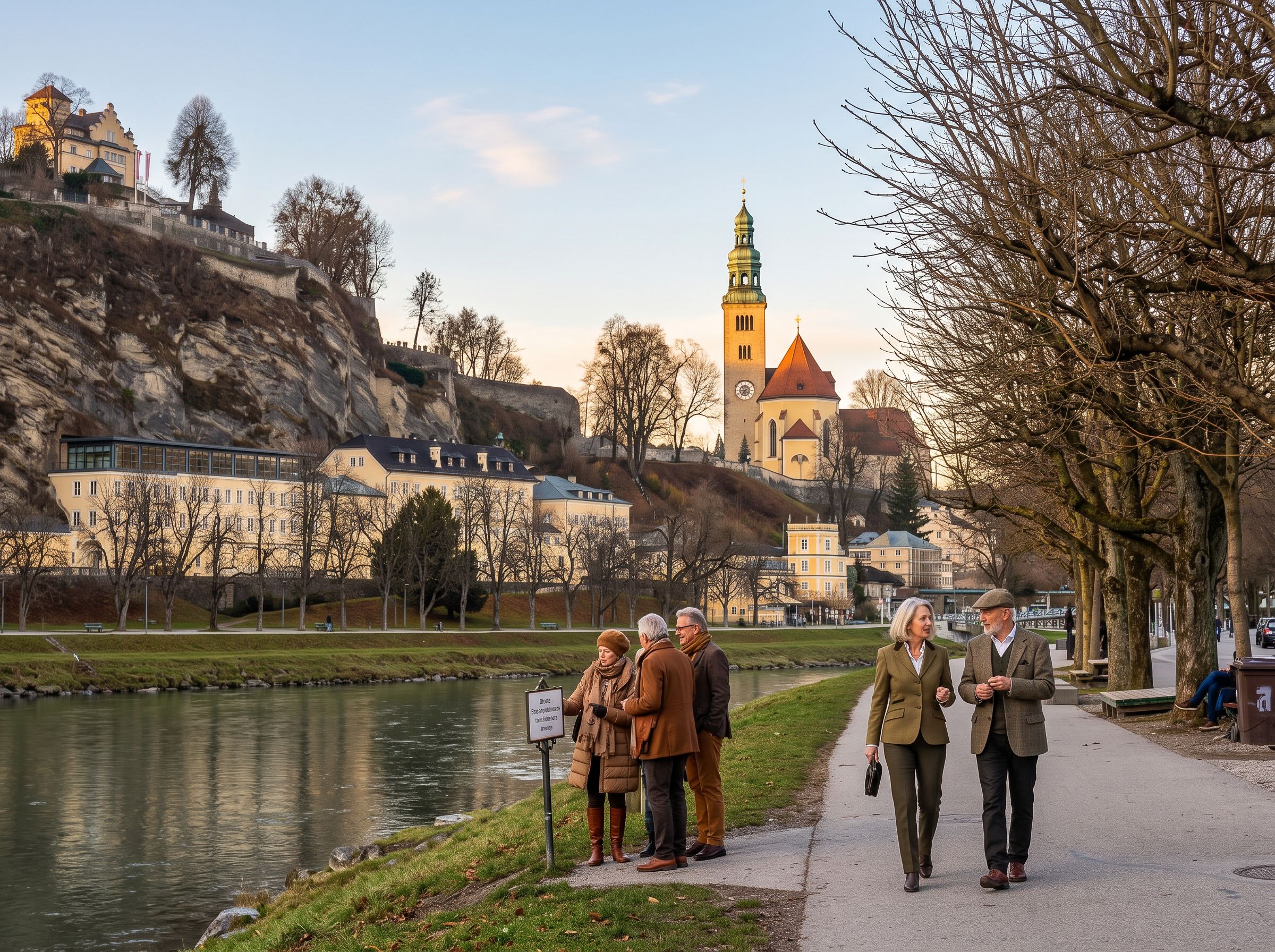
The Salzach riverfront is Salzburg's answer to a seaside promenade. The city's parks department tends and plants the embankments, which in its own words "invite you to linger" with their views across to the Old Town — and on a sunny afternoon you will see why, as people line the stone steps, books in hand, under the fortress high above. The path itself is wide and level, and it is shorter than its reputation suggests: barely 700 metres separate the Staatsbrücke from the Müllnersteg footbridge. This is the stretch to prioritise.
For a garden experience, Mirabell Gardens offers a different kind of flatness. The main parterre is a masterpiece of Baroque symmetry, whose main avenues the city last resurfaced in 2020/21. The gardens are officially designated as barrier-free, and the city's own accessibility guide names the step-free way in: across the forecourt of the Landestheater. A few features sit off that level route — the steps up to the rose hill, where the Trapp family line up at the end of "Do-Re-Mi", are the best known. As of August 2026, the gardens hold a 4.7/5 rating on Google from almost 16,000 reviews, with reviewers writing on Google in July 2026 noting the "ample shade and seating" and grounds that are "well kept".
How long is the Salzach river promenade walk?
The classic flat river walk runs about 700 metres one way, from the Staatsbrücke to the Müllnersteg footbridge. At a slow strolling pace of roughly 3 km/h that is around fifteen minutes each way, plus time to sit and watch the river go by.
The promenade is best enjoyed as an out-and-back stroll, or as a one-way route with a bus return. The surface is made up and smooth; Barrierefreier Tourismus Info, which surveys destinations for wheelchair users, calls Salzburg's riverside promenades "well developed". Benches appear at regular intervals, many positioned to catch the afternoon sun. The views change character as you walk: the fortress dominates the skyline to the south, and the wooded Kapuzinerberg rises on the opposite bank right beside the Staatsbrücke, where you set off (a hillier walk that has its own dedicated guide, Getting Around Salzburg on Foot and by Bus). Further north the banks open out and the crowds thin.
One practical note: the riverbank near the Old Town and Getreidegasse can be busy and noisy, with traffic on both sides. The quieter, more scenic section begins north of the Marko-Feingold-Steg — the footbridge many people still call the Makartsteg, officially renamed by the city in May 2021. From there it is a few hundred metres to the Müllnersteg, where the city seems to exhale and the path opens up into green spaces perfect for a rest.
| Segment | Distance | Walking Time | Surface |
|---|---|---|---|
| Staatsbrücke to Marko-Feingold-Steg (Makartsteg) | about 210 m | 5 min | Paved, busy |
| Marko-Feingold-Steg to Müllnersteg | about 470 m | 10 min | Paved, quiet |
| Full out-and-back | about 1.4 km | 30 min | Paved, level |
Are Mirabell Gardens easy to walk for seniors?
Yes. Mirabell Gardens are the most accessible green space in Salzburg, with wide, level, barrier-free paths, free entry, and benches throughout. The main parterre offers direct fortress views with zero climbing required.
The gardens are open all year and entry is free. The city gives the gates as 5 a.m. to 11 p.m. from April to September and 7 a.m. to 10 p.m. from October to April, with parts of the grounds closed off in winter. The central walkway is the star attraction — a straight, flat avenue lined with flowerbeds, fountains, and sculpted hedges, all aligned to frame the fortress on the hill behind. It is a photographer's dream and a stroller's delight, all in one.
Salzburg's tourist board records the gardens as barrier-free, and the city's gardeners set out up to 50,000 spring plants and some 15,000 bulbs each year, so the beds change with the season. The Pegasus Fountain and the Dwarf Garden sit on side paths that add interest beyond the main parterre, though the latter, along with the Hedge Theater, closes during winter months. If you visit between November and March, stick to the main avenues and the Orangery, which is open all year, daily from 9 a.m. to 4 p.m.
One gentle caution: the gardens are popular, and crowds build quickly after 9 a.m. Early morning, before the tour groups arrive, is the most peaceful time. A Google reviewer writing in May 2026 found the gardens "incredibly peaceful before about 8.30-9.00 a.m", and left once "the huge groups of tourists started appearing from everywhere".
"Garden is beautifully sculptured with trees and flowers. So spacious and relaxing. Plenty of benches around the garden. Everything was well kept and the flowers were blooming in multi colors" — from a review left on Google in June 2026
How do I get to the Mönchsberg viewpoint without climbing?
Take the MönchsbergAufzug from Gstättengasse 13 on Anton-Neumayr-Platz, right on the riverbank. A return ticket costs €4.80 for adults in 2026, the ride takes 30 seconds, and it sets you down at the entrance of the Museum der Moderne with the city spread out below.
The elevator is the senior-friendly secret to Salzburg's best viewpoint. The lift ends inside the Museum der Moderne itself — there is no connecting path to walk — and a second lift within the museum carries you on to the outer terrace and the Café Bar Restaurant m32. That inner lift runs only during museum opening hours (Tuesday to Sunday 10 a.m. to 6 p.m., Thursdays to 8 p.m., closed Mondays), so time a step-free visit to the terrace accordingly. The higher viewing platform above the museum is reached only by steps. One Google reviewer noted in July 2026 that the "viewpoint is worth it alone and taking the lift up", and another, writing in August 2025, described the ground behind the museum as having "a viewing platform where folk take city view photos" and a café with patio seating.
This is the place to come for that iconic photograph of the fortress, the river, and the Alps beyond — without earning it through a steep climb. The Mönchsberg itself has hillier trails that are a separate topic, but the elevator terrace is firmly in the easy category. For a fuller picture of low-exertion sightseeing in the city, see our guide to Seeing Salzburg With Little Walking.
What about Hellbrunn Palace gardens?
Hellbrunn's park, about 4 km south of the centre, is free and open all year, daily from 6.30 a.m. to 9 p.m. The palace and famous trick fountains run from late March to 1 November and cost €16.50 for adults in 2026, but the park alone makes a pleasant half-day outing.
Reach Hellbrunn on bus line 25 in the direction of Untersbergbahn, from the Rathaus stop in the Old Town or from the main station; Hellbrunn reckons 25 minutes from the centre and 30 from the station, and the bus drops you at the palace gates. Salzburg's tourist board records that the park and the trick fountains are wheelchair accessible while the palace itself is not, and a wheelchair can be borrowed free of charge at the trick-fountain ticket desk. Visitors with a disability pass pay €14, and a companion named on the pass goes free. The paths are gravel throughout, so a stick or a companion is worth having in wet weather.
The park is free and, in the operator's own words, "stays open all year"; only the palace and the trick fountains work to a season and a ticket. For planning, Salzburg's tourist board gives the trick fountains as about 50 minutes, with entry every 15 to 20 minutes, and the palace exhibition as about 30 minutes — so a visit that takes in the park as well is comfortably a half day.
For those who prefer not to navigate public transport, Hellbrunn can also be reached by bicycle — the tourist board reckons about 25 minutes from the city centre — though the bus is the lower-effort option. If you are planning a longer day out, our guide to Day Trips Worth Making from Salzburg offers further suggestions.
Where are the best benches for resting?
The most rewarding benches in Salzburg are along the Salzach promenade north of the Marko-Feingold-Steg, where you can watch the river and the fortress in peace, and in Mirabell Gardens, where the central parterre benches face the flowerbeds and the castle on the hill.
Bench placement is not random in Salzburg — the city has thoughtfully positioned seating at regular intervals along the riverfront. The stretch between the Marko-Feingold-Steg and the Müllnersteg has the best combination of shade, view, and tranquillity. Several benches sit directly on the embankment steps, allowing you to dangle your feet above the water like the locals do.
In Mirabell Gardens, the benches along the central parterre are the most sought-after, particularly the ones near the Pegasus Fountain. The rose garden lies along the south front of the palace and is quieter; the city replanted it with some 1,600 roses and 2,500 perennials and built a wheelchair-accessible entrance at the same time. The gardens' elevation is such that you get the fortress view without any of the climb.
For a rest with refreshment, m32 at the top of the Mönchsberg elevator has outdoor seating with uninterrupted views; the city's accessibility guide records its garden terrace as flagstones, reached step-free by the lift. It is slightly pricier than the average Salzburg café (€€), but the setting justifies the cost, and the restaurant gives its guests a free ticket for the ride back down.
What surfaces should I expect on these walks?
The river promenade is fully paved and smooth, suitable for wheelchairs and walkers. Mirabell Gardens uses wide gravel paths that are compacted and level. The Mönchsberg terrace is paved. The main caution is the Old Town's cobblestones, which are beautiful but uneven.
Here is a quick surface guide for the easy walks covered in this article:
- Salzach promenade: Smooth, made-up paving on the main path. Barrierefreier Tourismus Info, which surveys destinations for wheelchair users, calls Salzburg's riverside promenades "well developed" and the inner city largely level and easy to wheel.
- Mirabell Gardens: Wide main avenues, resurfaced by the city in 2020/21 and firm underfoot. Side paths may be softer.
- Mönchsberg terrace: Flagstones and level at the museum and the m32 terrace. The higher viewing platform above them is reached only by steps.
- Hellbrunn gardens: Gravel paths throughout — the city's accessibility guide records them as "Kieswege / gravel paths" — with wheelchairs to borrow at the trick-fountain ticket desk.
- Old Town (for short strolls only): Cobblestones, often uneven and slippery when wet. Best for short, paced walks rather than long distances.
If you are using a walking stick or a rollator, the river promenade and Mirabell Gardens are your best options. The Old Town is manageable for short stretches, but save it for the morning when you are fresh. For more on navigating the city's surfaces, see Getting Around Salzburg on Foot and by Bus.
When is the best time for these easy walks?
Early morning, before 9 a.m., is the golden window for both the river promenade and Mirabell Gardens. The light is soft, the crowds are absent, and the temperatures are pleasant even in summer. Late afternoon, from 4 p.m. onwards, is the second-best option.
Salzburg's tourism patterns are predictable. Tour groups arrive from about 9:30 a.m., and the Old Town and Mirabell Gardens fill up quickly. By mid-afternoon, the riverfront near the centre can feel congested. The remedy is simple: go early or go late.
Seasonally, the gardens are at their best from May to September, when the flowerbeds are in full bloom. The river promenade works year-round, though winter visits require sturdy shoes for potential frost. As of 2026, the city has been actively improving pedestrian routes: it reported the foot and cycle path in Franz-Josef-Straße between Faberstraße and Paris-Lodron-Straße finished, with further work between Paris-Lodron-Straße and Haydnstraße running from March to May 2026. That street lies in the Neustadt a few blocks back from the water rather than on it, so check for diversions only if your route crosses it.
| Time of Day | River Promenade | Mirabell Gardens | Mönchsberg Terrace |
|---|---|---|---|
| 7:00–9:00 | Quiet, peaceful | Nearly empty | Lift runs from 8:00 |
| 9:00–12:00 | Moderate | Busy | Moderate |
| 12:00–15:00 | Busy | Very busy | Busy |
| 15:00–18:00 | Moderate | Moderate | Pleasant |
| 18:00 onwards | Quiet, golden light | Open to 23:00 in summer | Lift to 21:00, Mon 19:00 |
Can I combine these walks into one easy itinerary?
Yes. A half-day easy itinerary covers Mirabell Gardens, the river promenade, and the Mönchsberg elevator terrace in about 3 to 4 hours, with minimal walking distance and no climbing. This is the perfect orientation for your first day in Salzburg.
Here is a suggested route, all on level ground:
- Start at Mirabell Gardens (30–45 minutes): Enter from Mirabellplatz, walk the central parterre, rest at the Pegasus Fountain.
- Cross to the river (10 minutes): Exit the gardens toward the Marko-Feingold-Steg, crossing to the left bank.
- Walk north along the promenade (15 minutes): Follow the river to the Müllnersteg, enjoying the quiet stretch.
- Return south (15 minutes): Walk back along the same path, or cross at the Müllnersteg and return on the opposite bank for different views.
- Take the Mönchsberg elevator (1 hour): The lower station stands on the riverbank itself, at Anton-Neumayr-Platz, Gstättengasse 13. Ride up, enjoy the terrace, have a coffee.
- Descend and rest: Take the lift back down, then find a café in the Old Town for a well-earned break.
Total distance: approximately 2 km. Total climbing: zero. Total benches available: dozens. For a guided version of this gentle route, consider one of the small-group tours designed for travellers over 50.
What should I wear and bring for these walks?
Comfortable, broken-in walking shoes with good grip are essential, especially for the Old Town's cobblestones. Bring a light layer, sun protection, and a water bottle — the river promenade has limited shade in the afternoon.
The surfaces in Salzburg are mostly forgiving, but the cobblestones demand respect. Shoes with a firm sole and a low heel are ideal. In wet weather, the stone paths can become slick, so consider shoes with a treaded sole. A small daypack with a water bottle, a snack, and a light jacket will cover most contingencies.
For the Mönchsberg elevator, note that the terrace is exposed to the elements — it can be windy even when the streets below are calm. A scarf or light jacket is wise even in summer. The gardens and riverfront have shaded areas, but the promenade's northern stretch is open to the sun for much of the day.
Finally, carry a printed map or have one on your phone. Salzburg's signage is good, but the winding streets of the Old Town can be disorienting. Knowing that the river is always downhill and to the west is a useful mental anchor.


