
Salzburg sits in a fortunate position, wrapped by the Austrian Alps on one side and the Bavarian border on the other. Within a two-hour radius lie some of Central Europe’s most celebrated landscapes: the mirror-still lakes of the Salzkammergut, the dramatic karst peaks of the Berchtesgaden Alps, and villages that look as though they were painted rather than built. For travellers aged 50 to 70, the question is rarely whether these places are worth seeing—they are—but rather how to reach them without turning a day of pleasure into a test of endurance.
The good news is that most of these excursions are genuinely manageable. The planning challenge is not distance but terrain, stairs, and the number of transfers involved. This guide focuses on four day trips that reward the effort: Hallstatt and the Salzkammergut lakes, Königssee across the German border, Hellbrunn Palace with its trick fountains, and Werfen’s ice cave and fortress. We have kept the scope tight, with travel times, effort levels, and the kind of practical logistics that make the difference between a memorable outing and a tiring one.
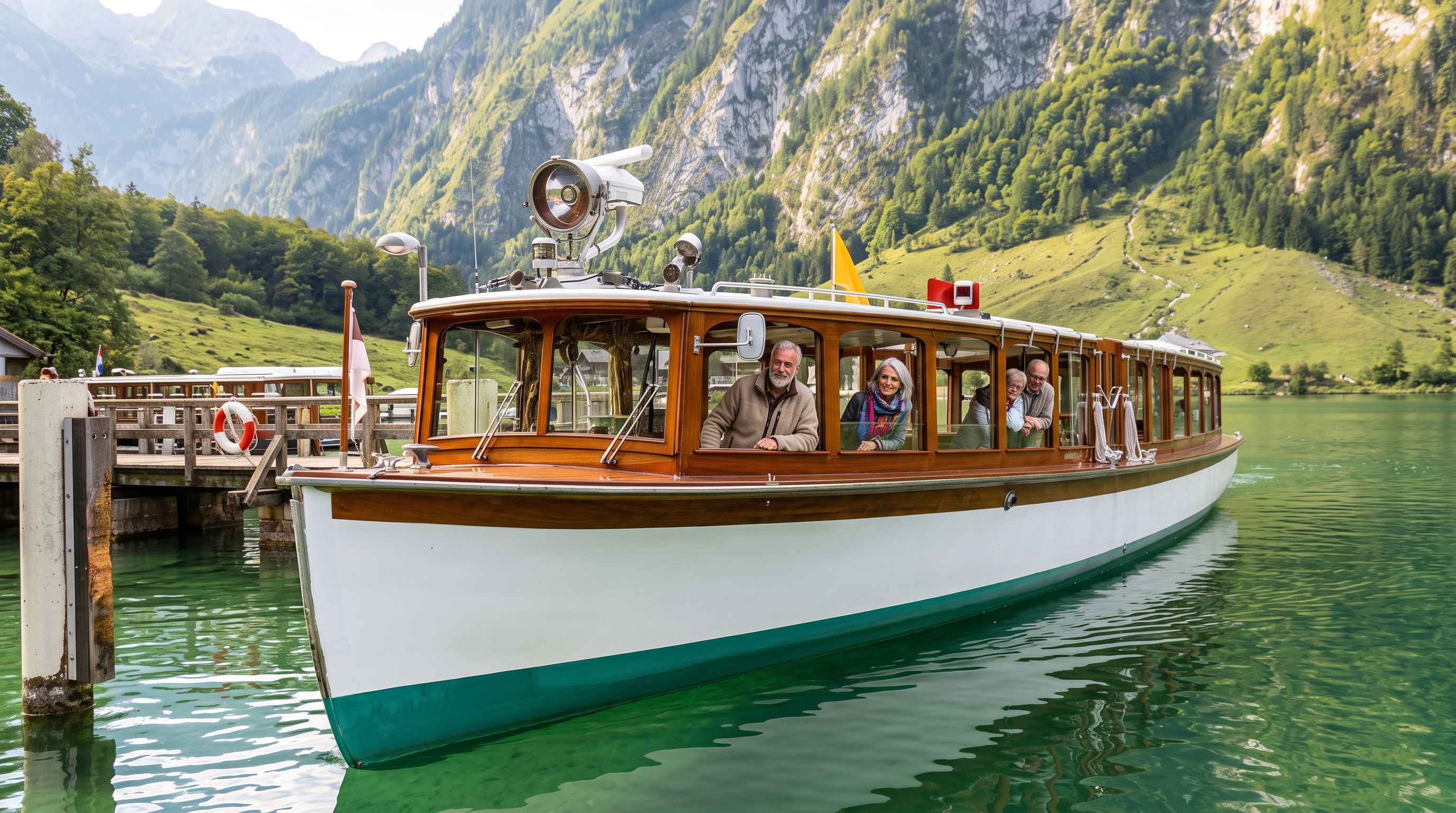 AI-edited
How do I get to Hallstatt without exhausting myself?
Hallstatt is reachable from Salzburg in a little over two hours by public transport, with one or two changes on the way. The all-bus route runs bus 150 to Bad Ischl, then bus 541, changing at Gosaumühle into bus 543 for Hallstatt; the rail route ends at Hallstatt station on the far shore and adds a short ferry crossing.
There is no direct train or bus from Salzburg to the village itself, which is part of the charm and part of the challenge. The train option requires a change at Attnang-Puchheim, followed by a ferry from Hallstatt station across the lake to the village. Travellers on forums consistently describe this ferry crossing as the most scenic way to arrive, with the village revealing itself gradually across the water. However, the station sits on the opposite shore from the town, so you must coordinate your arrival with the boat schedule.
Driving cuts the journey to roughly one hour and fifteen minutes, but you cannot drive into the village itself: Hallstatt's tourist board states plainly that visitors have no car access to the historic centre. You park on the signposted visitor car parks instead, and they are not cheap — the operator's 2026 tariff runs from €5 for one hour to €12 for five to six hours and €20 for a full day. For those who prefer not to manage multiple connections, a guided coach tour removes the logistical burden entirely, though you will share the experience with a full bus.
| Method | Travel Time | Transfers | Effort Level |
|---|---|---|---|
| Bus 150 + 541 + 543 | ~2h 10m | 1–2 changes | Moderate |
| Train + ferry | ~2h 10m | 1 change + ferry | Moderate |
| Car | ~1h 15m | None | Low (but parking stress) |
| Guided tour | 5½h (full day 8–9½h) | None | Lowest |
Once you arrive, the village itself is compact but built on uneven, sloping ground with narrow lanes and some stairs. The lakefront promenade and market square are manageable for most, but the upper viewpoints and the salt mine add significant physical demand. The salt mine and its funicular were closed for rebuilding through 28 August 2026 and reopen on Saturday 29 August 2026 at 9 a.m., with online tickets on sale from 1 September. Allow more time than you might think: the operator asks visitors to be at the funicular valley station 45 minutes before their tour, the guided tour alone runs about 90 minutes, and a roughly 15-minute walk leads from the panoramic lift to the mine entrance — at least three hours in all. The funicular and the bistro are step-free; the mine itself is not wheelchair accessible. If you want a gentler day, stick to the lakeside promenade. The Bone House, with its more than 600 painted skulls in the 12th-century St. Michael's Chapel, is worth the detour but is not itself a gentle one: the tourist board notes that the ascent runs over numerous steps, or over the somewhat steeper Kirchenweg. It opens daily from 10 a.m. to 5 p.m., admission €2, and takes cards as well as cash.
Recent guests consistently note that the village can be extremely crowded, particularly in peak season, with buses arriving continuously. Carry some cash: the lake ferry states plainly that no card payment is possible, while the Bone House and the regional buses do take cards. The return leg is not simply the outward one reversed — the local buses run back as lines 544 and 542, and coach tours often return through Gosau and Abtenau, so allow extra time before your connection.
“Our boat trip on the lake in Hallstatt was one of the most magical experiences of our journey. The views are absolutely breathtaking, the charming village reflecting on the lake felt like a scene from a fairytale.” — a guest wrote on Google in September 2025
For a deeper look at how to navigate Salzburg itself before you set out, see our guide to getting around Salzburg on foot and by bus.
Is Königssee easier than Hallstatt for a day trip?
Yes, Königssee is generally the lower-stress option. Bus 840 runs from Salzburg to Berchtesgaden station in about 55 minutes, then bus 841 or 843 continues to the lake. From the bus car park it is a five-minute walk to the piers, the cruise itself requires minimal walking, and the outing fits comfortably into a day.
The Bavarian lake sits in a protected natural setting within Berchtesgaden National Park, and the electric boats preserve the silence of the water. Travellers over 50 consistently report that the scenery is spectacular—crystal-clear water, sheer limestone walls, and the onion-domed chapel of St. Bartholomä rising from the shore. The boat ride is the highlight, and you can choose to go all the way to Salet, then walk a short, flat path to the smaller Obersee lake.
As of August 2026, the seasonal timetable matters. The operator states that the boats run to Salet from the end of April to the middle of October; outside that window they turn at St. Bartholomä. If you visit in spring or late autumn, check which stop is operating before you plan your day, because the full run to Salet is a summer proposition.
Accessibility needs a closer look. The operator says the piers themselves are reached without steps, and that public toilets, including an accessible one, are at the car park and the lakeshore. Boarding is another matter: the way onto the boats is narrow, steep and goes down three steps, the crew help, and there is room for only one or two wheelchairs per boat. Electric wheelchairs cannot be carried at all, precisely because they cannot manage those steps; a mechanical one can be borrowed free of charge at the ticket office, in limited numbers, by asking the duty officer. Larger groups of wheelchair users are asked to register in advance. There are no toilets on the boats, so use the accessible ones at Seelände, St. Bartholomä or Salet before you sail.
Recent guests praise the organization of excursions to Königssee, with clear instructions on ferry tickets and boat schedules. The beauty of the lake remains undiminished even in rainy weather, which is worth knowing if your travel dates are fixed. The main recurring drawback is crowds and noise on the boat during peak season. The operator names the pressure points—the summer holidays, summer weekends, public holidays, bridge days and reliably the first fine day after a spell of rain—and advises setting out before 10.30 a.m. and starting back by 2.30 p.m. on those days.
What about Hellbrunn Palace and its trick fountains?
Hellbrunn Palace is the easiest day trip from Salzburg: bus 25 covers Mirabellplatz to Schloss Hellbrunn in 16 minutes, and the palace advises allowing about 25 minutes from the city centre or 30 from the main station. The trick fountains are a delightful, low-effort attraction, though you will get wet if you stand too close—bring a light rain jacket.
This is the perfect half-day outing for travellers who want culture without alpine logistics. The palace itself is a Renaissance summer residence built in the early 17th century, but the real draw is the Wasserspiele, or water games. These are mechanical fountains hidden in the grottoes and gardens that surprise visitors with sudden sprays of water. The tour is guided and lasts about 50 minutes; the same ticket also covers the palace exhibition SchauLust, roughly another half hour, and the Folk Museum in the Monatsschlössl about ten minutes' walk further on.
The grounds are largely flat and well-maintained, making them suitable for those who prefer gentle strolling — the palace states that the trick fountains and the historic park are fully accessible for wheelchair users. Palace and fountains open daily from 28 March to 1 November 2026, from 9.30 a.m., closing at 5.30 p.m. in spring and October and as late as 7 p.m. in July and August. Line 25 runs every 15 minutes on weekdays and every 20 minutes at weekends, and the stop is a short walk from the entrance. This is an ideal option for a day when you want to be out but not far, and it pairs beautifully with a relaxed afternoon back in Salzburg.
For those who want to combine Hellbrunn with other sights, the zoo is adjacent, though it involves more walking and some slopes. The palace exhibition, though, is reached only by a stairway, and the palace is not wheelchair accessible; the fountains and gardens are. A wheelchair can be borrowed free of charge at the ticket office against ID, there are barrier-free toilets in the passage to the palace and beside the playground, and visitors with a disability pass pay a reduced €14, with free entry for a companion named on the pass. The trick fountains are particularly popular with grandparents bringing younger family members, as the interactive nature of the water games delights all ages.
Is Werfen’s ice cave worth the effort for older travellers?
Werfen’s Eisriesenwelt is spectacular but demanding: the train from Salzburg takes about 40 minutes and runs half-hourly. From the visitor centre it is a 20-minute walk up to the cable car and another 20 minutes on foot to the cave mouth, and inside you climb 1,400 steps. The operator advises against it for anyone with serious mobility or heart problems.
The ice cave is the largest in the world, a labyrinth of more than 40 kilometres, and the guided tour leads through chambers of frozen formations. There is deliberately no electricity inside: visitors carry historically recreated carbide lamps, and the guides light the great chambers with burning magnesium. The experience is genuinely awe-inspiring, but the physical demands are significant. The walk from the cable car station to the cave entrance is uphill on a gravel path, and inside you gain 134 metres in height — the operator compares it to climbing the stairs of a forty-storey building. Even in summer the temperature is usually below freezing, so warm clothing is essential, and you should allow about three hours from arrival to departure.
The nearby Hohenwerfen Castle, on its rock above the village, solves the climb differently. You cannot drive up: the ascent is either on foot, about half an hour up the 155-metre rock cone, or by the inclined elevator, which does it in under a minute and a half and is the only barrier-free way in. From Werfen station the footpath takes about half an hour, or you can order a shuttle an hour ahead. The interior can be seen only on the guided tour — about 50 minutes and 300 steps — and the falconry demonstration is reached by a steep descent and 100 more, so the operator marks both as not accessible. Only the castle courtyard is barrier-free, and the views over the Salzach Valley are the reward.
For travellers who want to see Werfen without the ice cave’s physical demands, the castle alone makes a pleasant half-day trip. The train from Salzburg takes about 40 minutes and runs every half hour, and the castle opens from 1 April to 2 November — daily from May to September, and closed on Mondays in April, October and November. If you are considering the ice cave, be honest with yourself about your fitness level—this is not a trip to attempt if you have knee or hip issues, as the descent from the cave is as demanding as the ascent.
How do I choose between these day trips?
Match the trip to your energy level and interests. Königssee offers the best scenery-to-effort ratio, Hellbrunn is the gentlest option, Hallstatt is the most iconic but busiest, and Werfen’s ice cave is for active seniors who want a physical challenge.
The table below summarises the key factors for each destination. Consider your walking tolerance, how many transfers you are willing to manage, and whether you prefer lakes, mountains, or cultural attractions.
| Destination | Travel Time | Walking Load | Crowds | Best Season |
|---|---|---|---|---|
| Hallstatt | ~2h 10m | Moderate | High | May–Sep |
| Königssee | ~1h 15m | Low–Moderate | Medium | Apr–Oct |
| Hellbrunn | ~16 min | Low | Medium | 28 Mar–1 Nov |
| Werfen | ~40 min | High | Low–Medium | 1 May–1 Nov |
If you are based in Salzburg for several days, you might consider a two-trip approach: one full day for Königssee or Hallstatt, and one half-day for Hellbrunn. This balances the more demanding outings with a gentler cultural experience. For those who prefer not to self-drive, the public transport systems are reliable and well-signposted, and the savings compared to guided tours are significant.
Forum discussions among travellers over 50 repeatedly advise using public transport rather than tours for both Hallstatt and Königssee, because the systems are good and the savings are substantial. However, if you have mobility concerns or simply want a stress-free experience, a guided tour removes the need to manage connections and timetables. See our guide to small-group and guided tours of Salzburg for a considered comparison.
What should I book in advance?
For Königssee, book your boat tickets online in advance during peak season to avoid queues. For Hallstatt, consider reserving a seat on the bus or train, and always check the ferry schedule before committing to a return time. Hellbrunn and Werfen can usually be booked on the day.
The Königssee boat service is operated by the Bavarian state, and tickets can be bought at the pier — in cash or by card — or online. During summer the queues can be long, so advance booking saves time. The published timetable is only a minimum: the operator runs boats from every 30 minutes in poor weather to every 10 minutes in fine holiday weather, with up to 19 in service on an August day. The crossing takes about 35 minutes to St. Bartholomä and just under an hour to Salet, so the full return is close to two hours afloat before any stops. You may come back on any boat.
For Hallstatt, the ferry from the station to the village runs to the train arrivals — the operator notes that departure times can change if trains are delayed — but the early 07:32 crossing runs only Monday to Friday on school days. At weekends and in the school holidays the first boat is 08:35 and the last is 18:30; the crossing itself takes seven minutes. The connection is not guaranteed in both directions: a Google reviewer writing in March 2026 reported that “the boat left without waiting for the train to arrive, even though many passengers were clearly depending on that connection”, leaving a group waiting outside for about an hour with no shelter. This is the kind of detail that can turn a smooth day into a stressful one, so check the seasonal timetable before you travel.
Hellbrunn’s trick fountain tours run regularly throughout the day, and you can usually join the next available tour without booking. Werfen’s ice cave tours are timed, and during peak season they can sell out, so arriving early is wise. The Eisriesenwelt opens daily from 1 May to 1 November 2026: the ticket desk from 8.30 a.m. to 3 p.m., the cable car from 8.45 a.m. to 3.20 p.m., and the last cave tour starting at 3.45 p.m.
What about the wider Salzkammergut lakes?
The Salzkammergut region offers several lake towns beyond Hallstatt that are easier to reach and less crowded. St. Gilgen on Lake Wolfgang is about 45 minutes away on bus 150 and Mondsee about an hour on bus 140, and the shore path out of St. Gilgen is level walking with benches along the way.
St. Gilgen is a charming lakeside village with a pleasant promenade, cafés, and views of the surrounding mountains. Bus 150 gets there in roughly 45 minutes, and the village is compact enough to explore without strenuous effort. The shore path towards Brunnwinkl and Fürberg is level and firm, described by Salzburg's disability advocacy office as well suited to wheelchair users and lined with benches; it is two kilometres to Brunnwinkl and four to Fürberg, and the lake boat brings you back. Mondsee is slightly further, but its basilica—where the wedding scene from The Sound of Music was filmed—is a draw for many visitors. Both make excellent half-day trips if you want to see the lake district without the crowds of Hallstatt.
Bad Ischl, the former imperial summer residence, is also worth considering. It sits on the bus 150 route to Hallstatt and offers the Kaiservilla, a pastry shop called Zauner that has been serving cakes since 1832, and its Zaunerstollen, a local specialty. If you take the bus route to Hallstatt, a stop in Bad Ischl breaks up the journey and adds a cultural dimension to the day. One caution for day-trippers: the regional tourist board warns that no bus runs from Bad Ischl towards Hallstatt, Gosau, Obertraun or Bad Goisern in the evening — the last one leaves Bad Ischl station at 18:16.
For a comprehensive look at the city itself before you plan your excursions, our guide to seeing Salzburg with little walking offers a gentle introduction to the Old Town and its easy-access sights.
What about the Eagle’s Nest?
The Eagle’s Nest is reachable but fiddly: bus 838 from Berchtesgaden station to the Obersalzberg car park, then a special Kehlstein bus about 15 minutes up the mountain road, then a 124-metre tunnel on foot and a brass-clad lift that rises 124 metres in 41 seconds straight into the house. The road closes all winter.
The logistics deserve more space than this guide can give them, so we will not cover it in depth here. If you are considering combining it with Königssee, note that the routing matters—going via Königssee first can be out of the way for the Eagle’s Nest bus connection.
For most travellers over 50, Königssee alone offers a more rewarding and less complicated day. The Eagle’s Nest is historically significant, but the logistics are more demanding, and the site itself is relatively small. If you have a particular interest in Second World War history, it is worth the effort; otherwise, the lake is the better use of your day.
What practical advice should I keep in mind?
Start early, carry cash, wear comfortable shoes, and check seasonal schedules before you go. The difference between a good day trip and a stressful one often comes down to preparation rather than the destination itself.
Carry some cash even if you usually pay by card: the Hallstatt lake ferry takes no cards at all, and it is the one link you cannot avoid on the rail route. Comfortable, broken-in walking shoes are essential for all four trips, as even the easiest options involve some uneven surfaces.
Seasonal schedules matter more than you might expect. As of August 2026, the Königssee boats reach Salet only between late April and mid-October. The Eisriesenwelt opens from 1 May to 1 November. Hellbrunn’s palace and fountains run from 28 March to 1 November. Always check the official websites before you travel, as weather can cause last-minute changes.
Finally, consider your accommodation location. If you are staying in the Old Town, you are within easy walking distance of the main bus stops and the train station. If you are further out, factor in travel time to the departure points. Our hotel dossier on the Hotel Goldener Hirsch offers insights into a central base that minimises pre-trip logistics.
“The electric boat tour on Königssee is pure magic. Gliding silently across the crystal-clear emerald water with dramatic mountain walls rising all around feels like something out of a postcard. We took the full round trip to Salet (Obersee) and it was absolutely worth it.” — one Google reviewer wrote in July 2026
Salzburg rewards those who venture beyond its borders. The four trips covered here each offer something distinct: the fairy-tale village of Hallstatt, the serene alpine lake of Königssee, the playful elegance of Hellbrunn, and the frozen wonder of Werfen. Choose based on your energy, your interests, and your tolerance for transfers. With a little planning, any of them can become the highlight of your journey through Austria.
For timetables and current conditions, go to the operators themselves: the Bayerische Seenschifffahrt publishes the Königssee boat schedule and its detailed accessibility notes, and Eisriesenwelt lists the cave's opening times and the physical requirements for the tour.


