
Located in the heart of Europe, Salzburg holds a special place in the hearts of anyone who grew up with Julie Andrews twirling across alpine meadows. For travellers aged 50 to 70, revisiting these filming locations isn't just sightseeing—it's a pilgrimage through memory. The good news? You don't need a crowded tour bus to experience the magic. Most of the iconic spots sit within a compact, walkable Old Town, and with a little planning, you can explore them at your own gentle pace, savouring each moment without being herded from stop to stop.
 AI-edited
The city's connection to the 1965 film runs deep, though locals have a complex relationship with it. As of August 2026, Salzburg's official tourism board continues to promote the locations while maintaining a wry smile about the movie's historical liberties. What matters for you is this: the places are real, they're beautiful, and they're remarkably accessible if you know how to approach them. This guide focuses exclusively on the film's locations, showing you how to see them independently, at your own pace, and without the rush that plagues organised tours.
Which locations are easiest to reach on foot?
Mirabell Gardens, Residenzplatz, and the Nonnberg Abbey exterior form a manageable city loop of roughly 4 kilometres that most active seniors can complete in 2 to 3 hours with rests. The terrain is mostly flat with some cobblestones, and the entire route stays within Salzburg's pedestrian-friendly core.
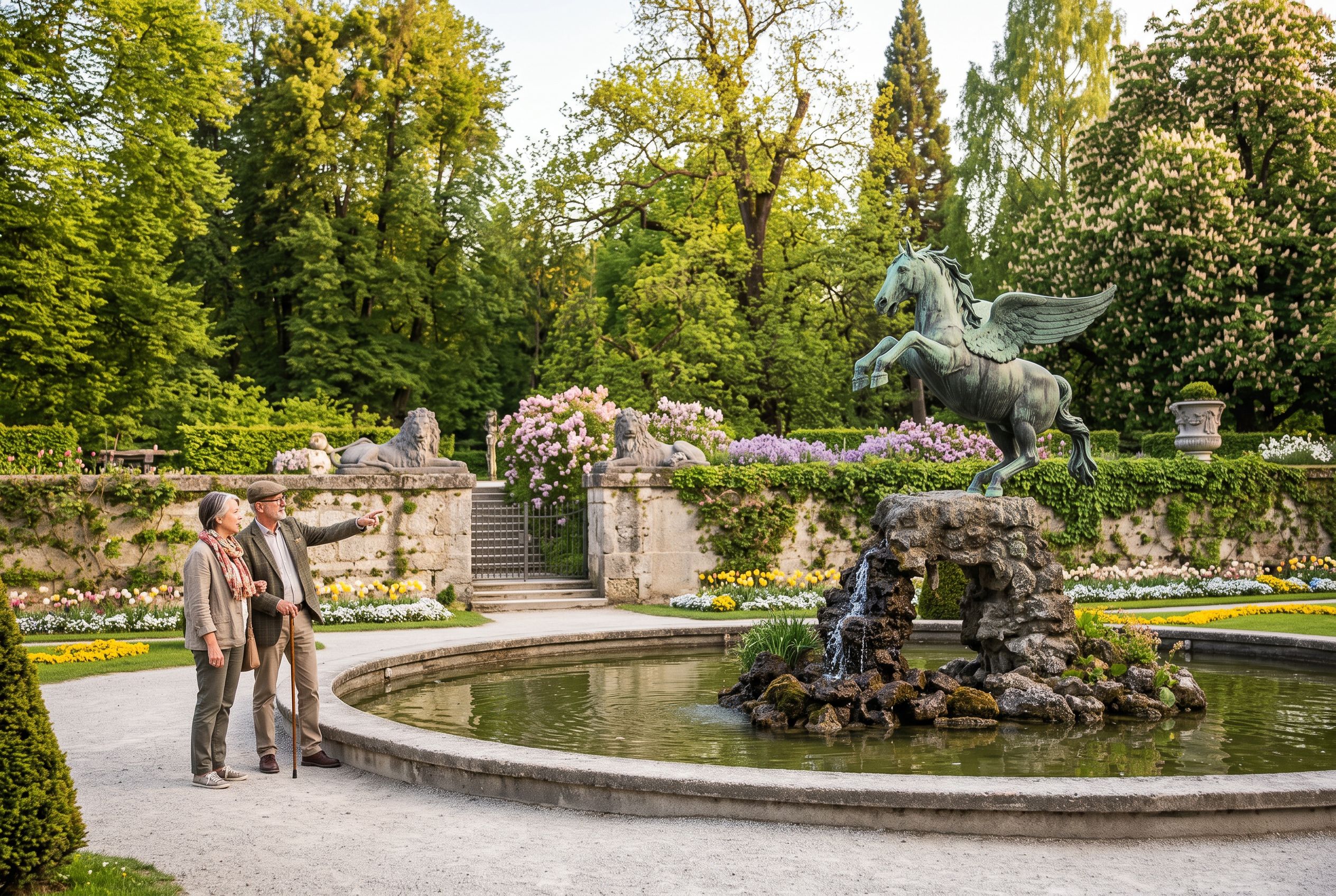
Start your morning at Mirabell Palace and Gardens, where the "Do-Re-Mi" sequence unfolded around the Pegasus Fountain. Admission is free, the gardens open daily from about 6 a.m. until dusk—with parts of them closed over the winter—and the paths are wide and flat, with benches scattered throughout. As of August 2026 the gardens hold 4.7 out of 5 on Google from just under 16,000 reviews, and they are at their quietest before the tour groups arrive. The central walkway offers a direct view of Hohensalzburg Fortress—a photo opportunity that requires minimal effort.
From Mirabell, cross the Salzach on the Makartsteg, the footbridge the city describes as linking the Neustadt—Mirabell's own side of the river—with the Old Town. The walk takes about ten minutes at a relaxed pace. The Mozartsteg crosses to the Old Town too, but it lies further upstream and adds a detour along the right bank. You'll arrive at Residenzplatz, where Maria sang "I Have Confidence" amid the horse-drawn carriages. The square is a public space with no admission fee, and several cafés offer outdoor seating where you can rest and watch the world go by. The fountain itself, the Residenzbrunnen, is the largest baroque fountain north of the Alps.
How do I reach Nonnberg Abbey without exhausting myself?
Nonnberg Abbey sits on a hill above the Old Town, a steady uphill walk of about 10 to 15 minutes from Kapitelplatz. The abbey church and its cemetery are open free of charge, usually all day until dusk, but the convent itself cannot be visited, and both marked approaches involve climbing: a staircase from the Kaigasse or a narrow lane from Nonntal.
The convent where Maria von Trapp served as a novice is one of the film's most authentic connections—and the real wedding took place here in 1927, not in Mondsee, which the film used instead. The exterior you see today looks much as it did in the movie, and the courtyard is where the nuns sang "Maria". However, the uphill approach can be challenging. The Nonnbergstiege is a flight of steps; the lane from Nonntal is the gentler of the two ways up. If neither works, admire the abbey from below—the view from the Kapitelplatz is still rewarding.
For those who make the climb, the effort feels worthwhile. The abbey church interior, with its gothic arches and quiet atmosphere, offers a contemplative pause. The abbey asks for that restraint itself: its church, it says, is a place of prayer and silence, so loud conversation and guided tours are not welcome there. St. Peter's Cemetery, which inspired the film's cemetery scene (though the scene itself was rebuilt in a Hollywood studio), lies back down in the Old Town at the foot of the Mönchsberg rather than beside the abbey. It is reached through St. Peter's courtyard without steps, which makes it the gentler of the two stops—and a fair substitute if the climb to Nonnberg is too much.
If you prefer to avoid hills altogether, our guide to seeing Salzburg with little walking offers alternative routes that keep you on level ground while still capturing the city's essence.
Is Leopoldskron Palace worth the trip outside the centre?
Leopoldskron Palace, used for the exterior and lakeside scenes of the family home, sits about 2 to 3 kilometres from the Old Town. The palace and its park are closed to the public, so most visitors look across from the lakeside path—but the house does sell a guided palace tour, and you need not be a hotel guest to book one.
The palace's rococo facade and the lake in front of it create one of the film's most memorable images—the boat scene where the children fall into the water. Both the regional tourism board and the house itself place those scenes here: the terrace and lake views that stood in for the family home are still recognisable, and the lake beside the palace is where the children fall out of the boat. What is no longer here is the gazebo—it stood in these gardens during filming and was later moved to Hellbrunn.
If you do decide to visit, the approach involves a pleasant walk along a biking and walking path that cars cannot access. The palace tour, if you book one, is described by the house as going through rooms that otherwise stay closed. Even without it you can sit down here: the Meierhof at the edge of the park serves coffee, drinks and food to visitors as well as house guests, daily from 10 a.m. For most visitors, the lakeside view suffices—it's a beautiful spot for a picnic and a moment of reflection.
"The views of the lake, the flowers blooming in the gardens, the outdoor seating, and the charm of the Schloss are top notch. We were able to walk to nearby restaurants, take a stroll around the lake and explore the area while there." — from a Google review of Schloss Leopoldskron, June 2026
Consider combining Leopoldskron with a walk along the Salzach River. Our guide to easy river walks and garden strolls in Salzburg suggests routes that connect the palace with other green spaces without requiring excessive walking.
How do I get to Hellbrunn and the famous gazebo?
Hellbrunn Palace and its gazebo sit about 5 kilometres south of the Old Town. Bus line 25 reaches the palace gates in 16 minutes from Mirabellplatz. The park is free and open all year from 6.30 a.m. to 9 p.m., but the trick fountains and the palace exhibition cost €16.50 per adult in 2026 and run only from 28 March to 1 November.
The gazebo—the glass pavilion where Rolf and Liesl sang "Sixteen Going on Seventeen"—was relocated to Hellbrunn from the original filming location so visitors could reach it without trespassing on private property. As of August 2026, you can view the gazebo from outside, but you cannot enter it. The palace grounds themselves are lovely, with manicured gardens and the famous trick fountains, built for Prince-Archbishop Markus Sittikus when Hellbrunn went up between 1612 and 1615.
Here's what you need to know about the practicalities. The bus stops at the palace entrance, and the palace itself advises allowing 25 minutes from the centre or 30 from the main station—more than the timetable's 16, which is worth knowing if you are catching a particular fountain slot. If you would rather walk part of the way, the marked walking and cycling route along the Hellbrunner Allee runs from Nonntal to the palace and passes Frohnburg Palace, whose facade, courtyard and front gate served as the front of the von Trapp villa. The grounds are flat and easy to navigate. The Folklore Museum in the Monatsschlössl, which your ticket also covers, sits up on Hellbrunn Hill: the direct ascent is a walk of about ten minutes on a hiking trail, and a flatter forest route past the stone theatre takes about 45 minutes. The on-site café has an outdoor terrace, and the park makes a fine picnic spot if you would rather bring your own.
One important development: Salzburg Museum is converting the old coach house and the hunters' and zookeepers' lodges at the park entrance into a seasonal branch called "Sound of Music Salzburg", opening on 20 September 2026. Its closing room is a replica of the pavilion that visitors will be able to walk into, with a 360-degree projection of "Sixteen Going on Seventeen"—something the real gazebo in the park does not allow. Until then, construction may affect access and visitor flows. If you prefer a calmer experience, visit early in the morning before tour groups arrive.
Should I take the bus tour or go self-guided?
For travellers aged 50 to 70 who value unhurried exploration, self-guided is almost always the better choice for the central locations. The popular bus tours cover far more ground, but they do it on a fixed four-hour circuit, so the time at each stop is set for you. Choose a tour only if you specifically want the out-of-town stops like Mondsee.
The Original Sound of Music Tour and its variants have operated for decades, and they serve a purpose: they transport you to all the key locations in a single day, including the Mondsee basilica (the wedding scene) and the lake district. The trade-off is the clock: Panorama Tours runs its Original Sound of Music Tour® to a fixed schedule, so the stops are timed rather than yours to stretch.
For the city locations, self-guided exploration offers clear advantages. You control the pace, you can linger at the Pegasus Fountain as long as you like, and you avoid the awkward shuffle of 40 people trying to photograph the same spot. Mirabell Gardens and Residenzplatz are about ten minutes apart on foot. You don't need a coach for that.
Consider this comparison:
| Factor | Bus Tour | Self-Guided |
|---|---|---|
| Time at each stop | Set by a fixed 4-hour itinerary | Unlimited |
| Total walking | Minimal | 4 km over 2–3 hours |
| Cost | From €70 per person | Free (gardens) + €16.50 (Hellbrunn) |
| Commentary | Included | Self-guided audio or guidebook |
| Mondsee included | Yes | Requires separate trip |
If you do choose a tour, make sure it includes Mondsee: it is the one stop that is genuinely awkward to combine with the city locations on the same day. The wedding church is genuinely moving, and the lakeside setting is beautiful. For everything else, your own two feet and a good map will serve you better.
What's the best time of day and year to visit?
Early mornings, before 9 a.m., offer the quietest experience at Mirabell Gardens and Hellbrunn. September provides the best balance of pleasant weather and manageable crowds, while July and August bring peak crowds and higher rainfall.
Salzburg's climate data shows September as the sweet spot for comfortable walking tours—milder temperatures than midsummer and fewer visitors. June, July, and August are the rainiest months, which can dampen both your spirits and your photo opportunities. If you visit in late spring or summer, the gardens are at their most lush, but arrive early to beat both the heat and the tour groups.
For the outlying locations like Leopoldskron and Hellbrunn, weekday mornings are noticeably quieter than weekends. The lakeside path at Leopoldskron is particularly peaceful before 10 a.m., when the first tour buses arrive for their brief photo stops.
What should I know about accessibility and mobility?
Salzburg's public transport is well-equipped for reduced mobility. All 108 trolleybuses are low-floor with a fold-out ramp, and the tourism board describes the vast majority of the wider fleet the same way. The FestungsBahn reaches the fortress step-free, though the fortress interior is not. The Old Town's cobblestones and hills still need a realistic look at your stamina.
The official barrier-free transport pages confirm that all trolleybuses have at least one wheelchair space by the second door, where the driver lowers the bus and folds out the ramp on request. Bus 25 to Hellbrunn is not a trolleybus but a diesel line operated by Albus, so check the wheelchair symbol in the free Salzburgmobil app before you count on a ramp. For the central locations, the city's own accessibility guide names the step-free way into the Mirabell Gardens: across the forecourt of the Landestheater. Residenzplatz is also manageable. Nonnberg Abbey, Hellbrunn's Folklore Museum, and the lake-district sites are progressively more demanding due to grades, stairs, or transport requirements.
If you have limited mobility, focus on the central loop and consider skipping Nonnberg Abbey's hill. The view from below is still lovely, and you'll save your energy for the flatter locations. For Hellbrunn, the trick fountains and the historic park are described by the palace as fully accessible to wheelchair users, and a wheelchair can be borrowed free of charge at the ticket desk against an ID; the palace exhibition, by contrast, is reachable only by a staircase. The city's accessibility guide adds one detail the palace leaves out: the paths there are gravel. Allow about 50 minutes on foot for the trick fountains.
For those who prefer minimal walking altogether, our guide to seeing Salzburg with little walking offers strategies that prioritise comfort without sacrificing the experience.
What about Mondsee and the lake district?
The Basilica of St. Michael in Mondsee, where the wedding scene was filmed, sits about 30 kilometres from Salzburg and makes a half-day trip. Bus 140 leaves Salzburg Hauptbahnhof about every half hour on weekdays and Saturdays and hourly on Sundays, taking 41 to 57 minutes depending on the run. This is the one location where a tour might make sense.
The wedding church is genuinely worth the journey. The late-Gothic interior, with Hans Waldburger's early-Baroque high altar rising up to 18 metres, provides a moving conclusion to your Sound of Music pilgrimage. The former monastery church is open daily from 9 a.m. to 7 p.m., entry is by voluntary donation, and the way in is via a ramp—though the regional tourism board notes that wheelchair users may need a hand. The lakeside town of Mondsee itself is charming, with cafés and a relaxed atmosphere that invites lingering.
If you're considering a tour primarily for Mondsee, weigh the cost against the convenience. Salzburg Verkehr prices regional single tickets by zone, from €2.60 for one zone up to €9.40 for seven (full fare, from 1 January 2026), so even on the most generous reckoning the return trip costs a fraction of the €70 that Panorama Tours charges—and you can stay as long as you like rather than working to a coach timetable. The journey itself is scenic, passing through the Salzkammergut lake district that features in the film's opening aerial shots.
For a broader perspective on what the region offers beyond the film locations, consult our guide to day trips worth making from Salzburg—it covers Mondsee and other destinations with senior travellers in mind.
If you're planning to explore the hills and viewpoints around the city, our guide to the Mönchsberg and Kapuzinerberg walks provides routes suited to active over-50s who want the panoramic views without excessive strain.
How do I make the most of my visit?
Rewatch the film before you go. This single piece of preparation transforms your experience, helping you recognise locations and appreciate the differences between the movie's Salzburg and the real city. Then plan your route around the central loop, add one outlying stop per day, and build in generous rest breaks.
The film was shot in 1964, and Salzburg has changed considerably since. The city's official tourism board maintains a map of filming locations, and the shooting locations page provides authoritative details about what was filmed where; for walking the route it points to the free SmartGuide app, which carries a city walk called "On the Trail of The Sound of Music". Cross-reference this with forum advice from travellers who have DIY'd the route to get realistic expectations about access and logistics.
Remember that many interior scenes were filmed on Hollywood sound stages, not in Salzburg. The gazebo at Hellbrunn is a relocation, not the original site. Frohnburg Palace on the Hellbrunner Allee, not Leopoldskron, supplied the front of the von Trapp villa. Knowing these facts beforehand prevents disappointment and allows you to appreciate the locations for what they are: beautiful places that inspired a beloved film, not exact replicas of the movie's sets.
Finally, build in time for spontaneity. The best moments often happen between locations—a café terrace you hadn't planned to visit, a bench with a perfect view, a conversation with a local who remembers the filming. The Sound of Music is about joy and freedom, and your visit should reflect that spirit.
"I loved it as I am a massive Sound of Music fanatic — it has loads of magnificent statues and fountains. There are a few locations from the movie that are found here including the infamous steps at the end of Do Re Mi. But also the gardens themselves are maintained to a really high degree and really clean." — a guest wrote on Google about the Mirabell Gardens in June 2026


