
Salzburg rewards the slow traveller. This baroque city, wrapped around the Salzach River and crowned by a mighty fortress, is far kinder to those who prefer not to walk far than most European destinations. The secret lies not in avoiding the city, but in choosing your tools wisely: a funicular that glides up the cliff, a horse-drawn carriage that clips along cobbled lanes, a river cruise that drifts past the skyline, and a handful of flat, bench-lined squares where you can simply sit and absorb the atmosphere.
For travellers aged 50 to 70 who want to see the best of Salzburg without logging ten thousand steps a day, this guide is your practical companion. We have focused entirely on the low-effort, high-reward experiences: the fortress by funicular, the Mönchsberg views by lift, a gentle river cruise, a traditional Fiaker ride, and the level paths of Mirabell Gardens. We will also tell you which hilly lanes to skip and exactly where to rest your feet.
 AI-edited
How do I reach Hohensalzburg Fortress without climbing?
Take the FestungsBahn funicular from Festungsgasse. It runs from the Old Town up to the fortress in under a minute, is barrier-free, and the standard fortress ticket includes the round-trip ride, so you never have to tackle the steep cobbled path.
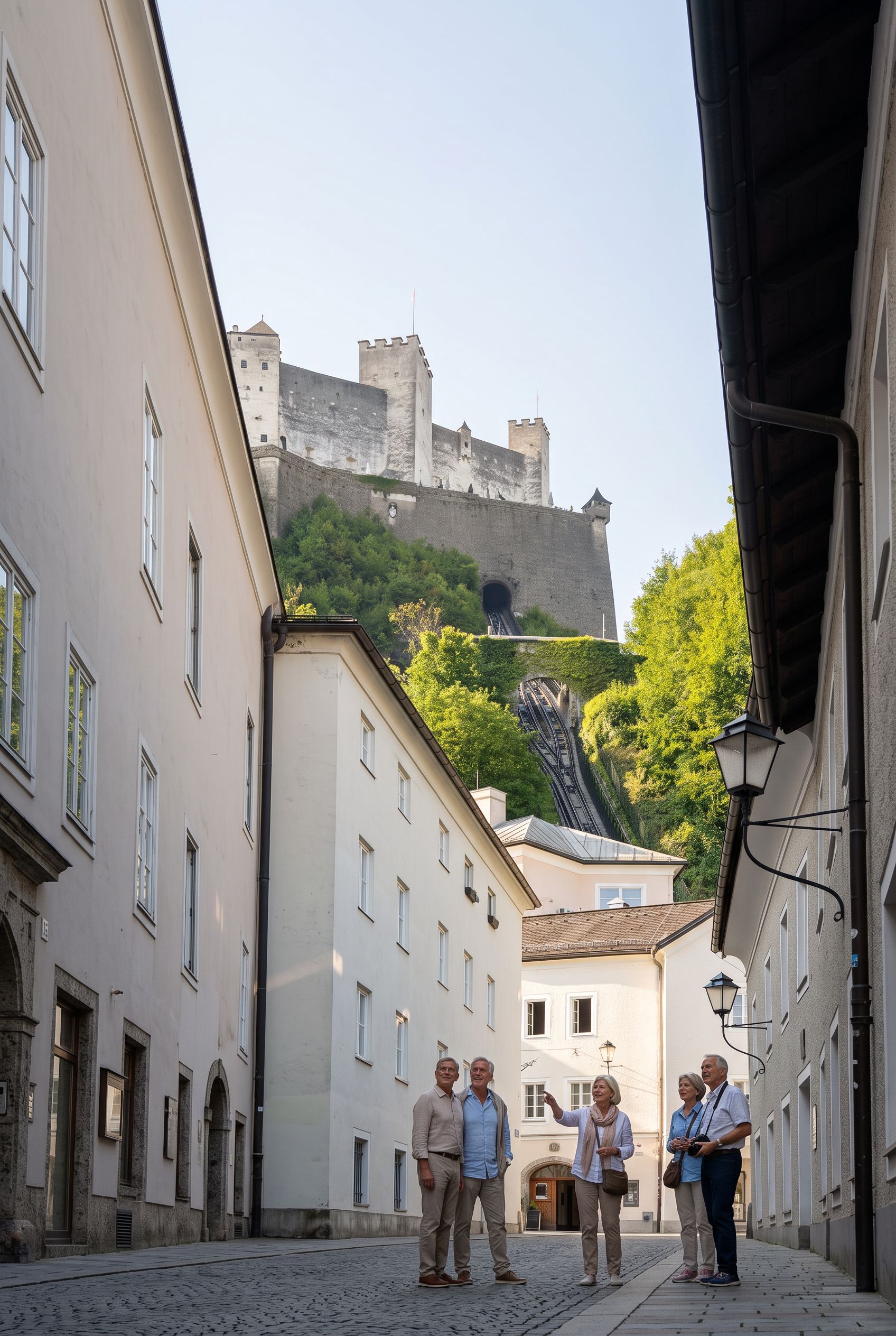
The FestungsBahn is the single best investment in Salzburg for anyone who prefers not to walk uphill. The funicular departs from a station just off Kapitelplatz, a short, mostly level stroll from the cathedral. The ride itself is a gentle glide of 198.5 metres of track in 54 seconds, with a departure every ten minutes, and the views over the red-tiled rooftops begin immediately.
Salzburg's official tourism information does say plainly that the FestungsBahn is barrier-free, and the fortress itself names the funicular as the barrier-free way up while stating that the footpath is not. The fortress ticket that includes the ride up and down costs €15.50 for adults on the Basic Ticket and €19.20 on the All-inclusive Ticket; the fortress sells adult and child tickets only, so there is no senior rate on the ticket itself. The funicular runs almost all year with hours that stretch into the evening in summer, but it closes for maintenance from 9 to 13 November 2026 and again from 11 January to 14 March 2027, when the fortress can only be reached on foot.
Once at the top, be selective — but not more selective than you need to be. The operator warns of many steps and inclines inside, yet the panorama terrace and the bastion by the mountain station are fully accessible, and a lift in the bell tower reaches the castle courtyard, the armoury exhibition, the tavern, the Kuenburg bastion and the marionette museum. Stay with those, take in the sweeping views over the Old Town and the Alps, and perhaps enjoy a coffee at the fortress restaurant, where one of the two wheelchair-accessible toilets is. This approach gives you the iconic Salzburg photo opportunity without the exertion.
"If you don't feel like walking, this is one of the best, fastest, and most enjoyable ways to get to the castle. A little waiting in line, a little payment, and you're there in no time." — one Google reviewer wrote of the FestungsBahn in October 2025
Can I enjoy the Mönchsberg views without a hike?
Yes. The MönchsbergAufzug at Gstättengasse 13 carries you 60 metres up in about half a minute and sets you down inside the Museum der Moderne itself, on a mostly level ridge with panoramic views and almost no walking.
The Mönchsberg is Salzburg's green ridge, rising above the Old Town's western edge. While hikers tackle the winding paths, you can take the modern glass elevator instead. The lift costs €3.40 for adults one way and €4.80 for the return trip, and the exit places you directly on a flat, well-maintained promenade. A companion rides free if that is noted on the disability pass.
There is no walk between the lift and the Museum der Moderne at all: the cabin opens inside the museum building, which Salzburg's tourism board describes as barrier-free access to the museum. The restaurant m32 in the same building offers one of the best coffee views in the city, looking out over the fortress and the Salzach Valley. If you feel energetic, the ridge path continues for about 30 minutes of easy walking, but you can also simply enjoy the viewpoint and take the lift back down.
Step out of the museum and the ridge path is smooth and wide, with benches along the way. This is one of the rare spots in Salzburg where you can feel completely removed from the city bustle while being only minutes from the centre.
Is a river cruise worth it for a gentle sightseeing day?
Absolutely. The 40-minute Salzach city round trip offers comfortable seating, shade, and a completely different perspective on the city. In 2026 the boat runs from 26 March to 1 November, with several departures daily from the Old Town landing stage at the Marko-Feingold-Steg (formerly Makartsteg), Franz-Josef-Kai 1a.
The Salzach River splits Salzburg into its historic Old Town and the newer right bank. A cruise lets you appreciate the city's relationship with the water without navigating its cobbled streets. The Amadeus Salzburg is a shallow-draught boat built specifically for the Salzach, 16.45 metres long and drawing only 38 centimetres, with room for 80 people — 62 indoors and 18 on the covered outdoor deck — so you can choose river air or shelter as you prefer.
The city round trip lasts about 40 minutes and follows an eight-kilometre stretch of the river towards Hellbrunn and back, with views of the Old Town from the water, the mountain ranges around the city and the green flank of the Kapuzinerberg. The pace is deliberately relaxed. Tickets are €19.00 for adults in the standard indoor category and €22.00 for the premium category with pre-boarding; there is no senior rate, but there is a reduction on presentation of a disability pass, and the Salzburg Card covers one standard Tour 1 ride.
There is one operator on this stretch of the Salzach, Salzburg Stadt Schiff-Fahrt, and one longer variant: Tour 2 carries on to the Hellbrunn landing stage, where a London double-decker bus covers the last four minutes to the palace. One caveat matters here more than anywhere else in this guide: because of the way the boat is built, wheelchairs can only be taken on board to a limited extent, there is no ramp, and the crew asks you to register in advance so they can help. Either way, the cruise is an excellent way to rest your feet while still seeing a great deal of the city.
What is the easiest way to see the Old Town without walking?
Take a Fiaker, Salzburg's traditional horse-drawn carriage, from Residenzplatz. A 20–25 minute ride covers the main Old Town sights while you sit back and let the horses do the work.
The Fiaker is not just a tourist novelty; it is a living tradition, and Salzburg's tourism board dates the tourist carriage trade in the Old Town at some eighty years. Fourteen carriages line up on Residenzplatz, the grand square in front of the cathedral, running daily from about 10:00 to about 16:00 in winter and until about 21:00 in summer, and drivers offer two standard routes. The short round lasts 20 to 25 minutes and the long one 50 minutes; Fiakerei Süss, one of the firms on the Residenzplatz stand, lists €61.00 for the short round and €122.00 for the long one, which adds the Neustadt, the Hotel Sacher, the Mirabell Gardens and a stretch along the Salzach. Agree on route and price with the driver before you climb in.
The carriages are well-sprung and comfortable, with a step to help you board. The drivers are knowledgeable and often share stories about the city's history as you clip-clop through the narrow streets. This is the most atmospheric way to see the Old Town, and it requires zero walking.
For those concerned about the horses, the city's Markt- und Veterinäramt supervises the trade and can stop it. On 2 July 2025 the municipal veterinary officer walked the carriage routes with a heat meter and Fiaker operations in the city were suspended from 3:30 pm because of the heat on the route. The gentle pace of the ride is part of its charm.
Which parts of the Old Town are flat and easy to manage?
The area around Residenzplatz, the cathedral, and Mozartplatz is almost entirely flat and paved with large, even stones. The riverfront promenade on both banks is level and wide, and Mirabell Gardens offers smooth paths with plenty of benches.
The historic centre is compact, and the main squares are connected by short, level walks. The Getreidegasse, Salzburg's famous shopping street, is also flat, though its narrow width and cobblestones require careful footing.
Mirabell Palace and Gardens, on the right bank of the Salzach, is a particular delight for low-walking travellers. The gardens are laid out on level ground, with wide gravel paths, ornate flower beds, and the famous Pegasus Fountain. Benches are plentiful, and the views of the fortress from the garden terrace are among the best in the city. Salzburg's tourism board lists Mirabell Palace and its gardens as barrier-free, and there is an induction loop in the Marble Hall for visitors with hearing aids. The hall itself can be viewed on Mondays, Wednesdays and Thursdays from about 8am to 4pm and on Tuesdays and Fridays from 1pm to 4pm — but not when a special event is on, and it sits on the first floor.
For a rest stop, Café Glockenspiel at Mozartplatz 2 has an outdoor terrace on the square and appears in the city's official barrier-free guide. Café Tomaselli at Alter Markt 9 is another excellent choice: it dates its founding to 1700 and calls itself the oldest café in Austria, and Salzburg's tourism board lists it as wheelchair accessible, with level access at the entrance — a threshold of at most 3 cm — and an accessible WC.
Which streets should I avoid to save my energy?
Avoid the steep lanes leading up to the fortress from the Old Town, particularly the Festungsgasse footpath and the winding stairs near the Nonnberg Abbey. Also skip the Kapuzinerberg hill on the right bank, which has a punishing zigzag path.
While the Old Town's main squares are flat, several side streets climb sharply towards the surrounding hills. The most tempting but tiring route is the footpath up to the fortress, which the operator puts at 15 to 20 minutes and about 100 metres of climb, partly gravelled, with uneven paving and steep stone steps in places — and which it states plainly is not barrier-free. Even the approach to the FestungsBahn valley station at Festungsgasse 4 has a short incline. The nearest disabled parking bays are at Residenzplatz 9, Toscaninihof 1 and Max-Reinhardt-Platz, and the bollards in front of the Festspielhaus and on Mozartplatz can be operated with a Euro-Key.
On the right bank, the Kapuzinerberg offers wonderful views but rises to 640 metres, and the way up from the Linzer Gasse leads through the Franziskuspforte and past eleven Stations-of-the-Cross chapels to the Capuchin monastery — a climb of roughly 200 metres. Skip it; the Mönchsberg lift sets you down on the ridge at 485 metres with no effort at all. The Linzer Gasse, while flat, is the main artery of the right-bank Old Town and runs from the Platzl by the Staatsbrücke out to Schallmoos, so it is longer than it looks; break it with a bench or a coffee rather than walking the whole length.
For a comprehensive look at Salzburg's overall accessibility, including transport options and pavement conditions, see our honest city-wide reading on Salzburg accessibility. For detailed bus routes and timetables, our practical guide to getting around Salzburg by bus is an essential companion.
Where are the best places to rest between sights?
Salzburg is generous with seating. The Mirabell Gardens, the riverfront promenade, and the courtyard of the Residenz all have plentiful benches. For indoor rest, the cathedral's side chapels offer quiet seating, and the major museums have cafés.
Plan your day around rest stops rather than pushing through. A sensible low-walking itinerary might look like this:
| Time | Activity | Walking Effort |
|---|---|---|
| 10:00 | Mirabell Gardens stroll | Low – flat paths, benches |
| 11:00 | Coffee at Café Glockenspiel, Mozartplatz | Seated rest |
| 12:00 | FestungsBahn to fortress terrace | Minimal – funicular |
| 13:30 | Lunch at fortress restaurant | Seated rest |
| 15:00 | Fiaker ride from Residenzplatz | Zero – carriage |
| 16:00 | River cruise departure | Zero – boat |
This itinerary involves perhaps 30 minutes of actual walking spread across the day, all on flat ground. The rest is seated sightseeing at its finest.
For those who prefer guided experiences, our guide to small-group tours in Salzburg includes options that incorporate the funicular and Fiaker, removing all navigation stress. And if you are considering where to stay, our detailed dossier on the Hotel Goldener Hirsch covers a central, historic option with excellent accessibility.
How can public transport reduce my walking further?
Since 1 May 2025, overnight guests in Salzburg receive the Guest Mobility Ticket, which provides free use of all public transport in Salzburg Province for their entire stay. Salzburg has trolleybuses rather than trams; the ticket covers urban transport, regional buses, suburban and regional trains and even long-distance trains, making it easy to hop between sights without walking.
The Guest Mobility Ticket is a game-changer for low-walking travellers. It is funded by a small mobility fee added to your accommodation bill — €0.50 per person per night for guests aged 15 and over, rising to €1.10 from 1 May 2027 — and it covers the entire provincial network. This means you can take a trolleybus from your hotel to the Old Town, or a regional train to nearby villages, without buying separate tickets. One thing it does not cover is the FestungsBahn, which always needs its own ticket.
Salzburg's tourism board says the vast majority of vehicles have low-entry doors with a ramp that folds out as needed, and Salzburg AG runs 108 barrier-free low-floor articulated trolleybuses with a kneeling function, a fold-out ramp at the second door and at least one wheelchair space beside it; raise a hand at the stop and the driver will lower the bus and put the ramp out. The main Old Town stops are Rathaus, beside the Staatsbrücke, and Ferdinand-Hanusch-Platz, both within a short level walk of the main sights. Taxis are readily available for short hops, and the drivers of Taxi 81-11 are obliged to carry wheelchairs, with the exception of electric and non-folding models.
For a detailed breakdown of routes and fares, consult our practical guide to Salzburg transport. The city's official tourism website also publishes current schedules and accessibility information.
When is the best time for a low-walking visit?
Late spring (May–June) and early autumn (September–October) offer the best combination of mild weather, manageable crowds, and comfortable conditions for sitting outdoors. July and August are warmest but busiest, while winter is cold but magical.
Salzburg's climate is moderate: in the official 1991–2020 normals for the Salzburg Flughafen station, average daily highs are 25.2°C in July and 25.0°C in August, easing to 20.0°C in September and 15.1°C in October. The shoulder seasons are ideal for low-walking travellers because you can enjoy outdoor seating at cafés, river cruises, and garden visits without the summer heat or the winter chill.
In the same GeoSphere Austria climate records, May to August carry the most days with measurable rain — between 13 and 15 a month — so pack a light waterproof layer. October averages fewer than ten such days and is still pleasant for sightseeing, making it an excellent choice for a gentle visit.
Winter, from December to February, transforms the city into a festive scene with Christmas markets, but the cold can make extended outdoor sitting less comfortable. If you visit in winter, plan for shorter outdoor segments and more indoor rest stops at museums and cafés.
"If you're looking for a viewpoint without the hassle of going up to the fortress, I highly recommend this… it takes you to the top of a cliff that overlooks the city. You can see the fortress and across the valley." — a review left on Google in December 2025 describes the Mönchsberg lift
What should I know before I go?
Book your fortress ticket online to skip the queue, confirm the FestungsBahn hours for your visit date, and consider the Salzburg Card if you plan to visit multiple attractions, as it includes fortress admission and the funicular.
A little planning goes a long way. The Salzburg Card, available for 24, 48, or 72 hours, includes one free admission to each sight — the fortress with the funicular, the MönchsbergAufzug, the Salzach cruise and many museums — plus free travel on the city's public transport, though not the S-Bahn beyond Acharting. The 24-hour card costs €35.00 from 1 November to 31 March and €38.00 from 1 April to 31 October, so it pays for itself from about the third sight: the fortress Basic Ticket with the funicular is €15.50 and a MönchsbergAufzug return €4.80.
For the Fiaker, there is no need to book in advance; simply walk to Residenzplatz and choose a carriage. However, on busy summer weekends, queues can form, so arriving before 11:00 or after 15:00 is wise. River cruises can be booked online or at the ticket counter beside the Marko-Feingold-Steg, which opens an hour before the first sailing; the earliest departure is 12:00 in June, July and August, 13:00 in April, May and September, and 14:00 in March and October.
Finally, wear supportive shoes with good grip. The Old Town's cobblestones are beautiful but unforgiving, and even the flat areas require careful footing. A small folding stool or walking stick can be helpful for longer waits, though benches are plentiful throughout the main sights.
For a broader perspective on how Salzburg compares to other European cities for older travellers, the complete Salzburg guide for travellers over 50 offers additional context and planning advice.


