
Perched on a hilltop in the Chianti countryside, Castello di Casole offers the kind of quiet luxury that rewards travellers who value atmosphere over convenience. The 11th-century castle estate has been transformed into a 41-room hotel surrounded by vineyards, olive groves, and a nature reserve that feels a world away from the busy streets of Florence or Siena. For travellers aged 50 to 70 who want a slow-paced, scenic retreat with exceptional service, this property delivers — provided you plan around its mobility limitations.
 AI-edited
The estate sits at Località Querceto, 53031 Casole d'Elsa, Siena, roughly 20 minutes by car from Siena and about an hour from Florence. The hotel is open seasonally from mid-March through October, with Belmond's 2026 calendar extending the season until 29 November. This makes late spring and early autumn the gentlest windows for older travellers, when daytime highs hover around 24°C in September and rainfall is still manageable before the heavier October showers arrive.
Guests consistently describe the property as a "recreated Tuscan village" with a castle-estate feel, recommending it for atmosphere, views, and slow pacing rather than easy sightseeing logistics. The seclusion is the point: there is little outside noise, and the atmosphere is more retreat-like than resort-like. One guest wrote on Google in 2026 that the property is "magic in autumn," praising the exceptional staff and natural setting.
How do I get there and what should I know about arrival?
Castello di Casole is a car-dependent property. You will need to drive or arrange a private transfer from Florence (about 1 hour) or Siena (about 20 minutes), as there is no walkable public transport or nearby restaurant scene outside the estate.
The hotel sits off the SS541 road, which supports easy road access. Belmond confirms the resort can accommodate standard-sized coaches and minibuses, and that access roads are suitable for most commercial tour buses. This is reassuring if you are considering a group tour or a driver-led itinerary.
For day trips, a car is strongly recommended. Forum users note that self-driving or hiring a private driver makes the experience much easier, especially for visiting nearby towns and restaurants. The hotel's concierge can arrange airport transfers and day-trip itineraries, which many guests take advantage of given the remote location.
Plan your dinners and tasting experiences in advance. Because the property is isolated, you will want to think through evening meals and day trips before you arrive so you are not surprised by the amount of driving involved. The hotel's on-site dining options — Tosca and Emporio Del Castello — reduce the need to leave the resort for meals, which is a significant advantage for older travellers who prefer not to drive after dinner.
What is the character and setting really like?
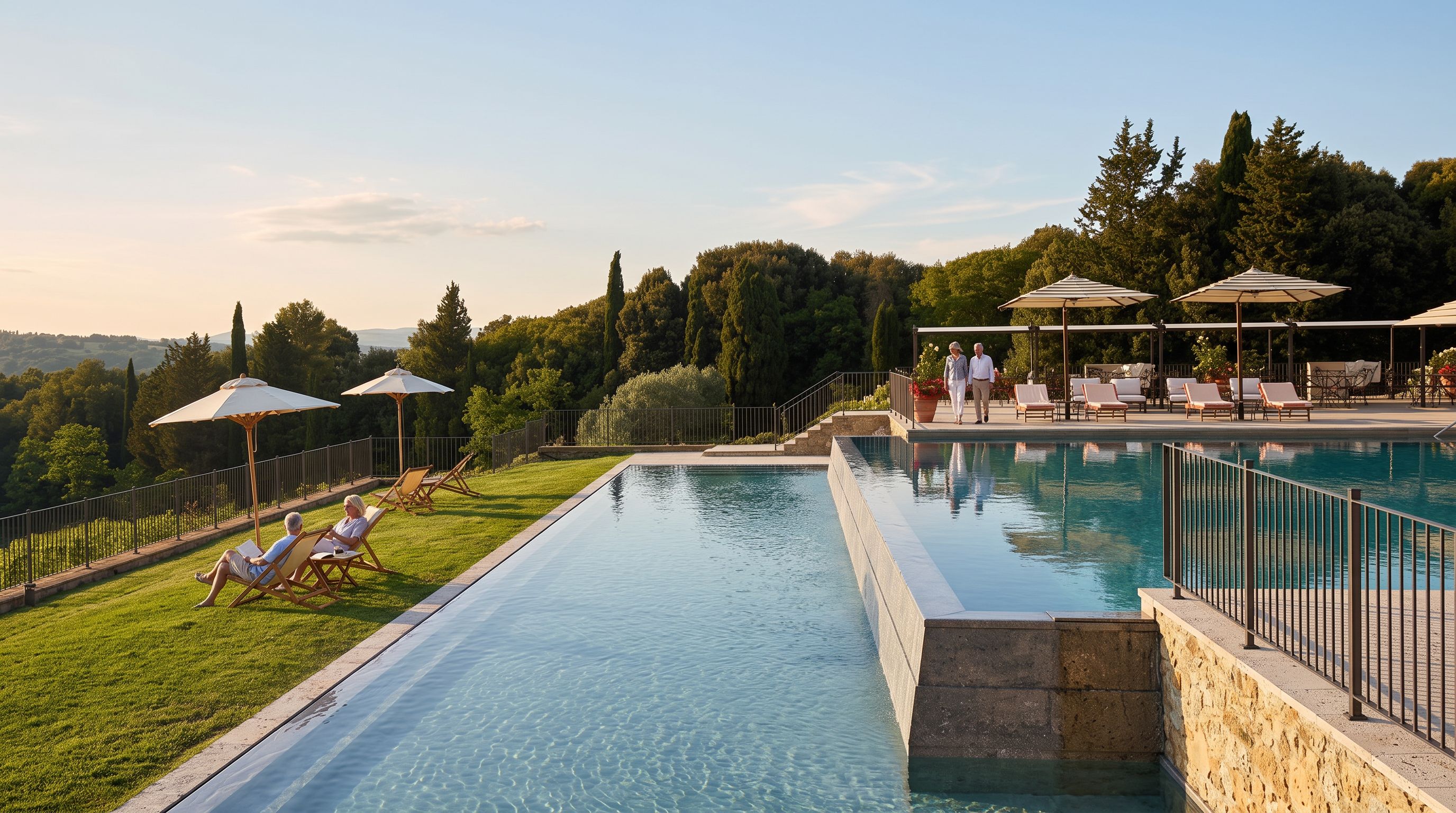
The estate feels like a private nature reserve with a castle at its heart. Expect rolling vineyards, olive groves, walking trails, and an infinity pool with valley views — a setting designed for slow mornings and unhurried afternoons.
The property spans a large area, and guests consistently describe the grounds as extensive and well-maintained. Walking and hiking trails crisscross the estate, and the hotel has become an official Terra Eroica bike point with a bike hub, e-bike charging, and gravel routes across the property, as reported by The Florentine in March 2024. For active older travellers, this opens up gentle cycling and walking opportunities without leaving the estate.
The amphitheatre on the property hosts a 2026 summer series of music, theatre, and dance events running from June through 14 August, according to Repubblica Firenze. This adds a cultural layer to the stay that many guests appreciate, especially those who prefer to enjoy performances without travelling into town at night.
Recent guests note the estate's quiet atmosphere is its greatest asset. There is no urban noise, no traffic, and no sense of rush. The property is described as a "solid luxury hotel" in one review, with another guest noting it is "definitely worth staying a night or two" if you choose the right room category. The seclusion means you will not find nightlife or bustling piazzas on your doorstep — but that is precisely what many travellers in this age group are seeking.
What are the rooms like and which should I book?
Rooms are spacious, exceptionally clean, and many offer scenic views of the Tuscan countryside. However, the castle's historic structure means upper floors are accessible only by stairs, so ground-floor rooms are essential for travellers with mobility concerns.
Belmond reported in April 2024 that the property welcomed two new private villas and eighteen restyled suites designed by Alessandro Moriconi. The restyling has brought modern amenities and comfortable beds, with guests describing "exceptionally clean and spacious rooms" and "huge bathroom." Sleep quality is rated very highly in aggregate reviews, with guests commenting on the comfort and quiet of the rooms.
Some rooms are described as dark, which may matter for older travellers who prefer brighter interiors or easier visual contrast. When booking, ask for a room with more natural light if this is a priority for you.
For older travellers, the recurring advice from similar high-end Italy discussions is to ask for the least stair-heavy room and to confirm whether you can avoid long interior or exterior walks. The castle dates to the 11th century, and its historic character means some compromises on modern convenience. A Tripadvisor FAQ response confirms there is no elevator or lift, and Expedia's listing notes upper floors are accessible by stairs only.
Belmond states that wheelchair-accessible rooms are available in the hotel building and that staff can help arrange suitable accommodation. However, you should contact the property directly before booking to confirm exact room location, distance from reception, and whether luggage assistance is available. The hotel's team is described as extremely helpful, with guests noting staff remember names, anticipate needs, and accommodate special requests such as bringing a pillow for a guest with a bad back.
How is the dining and service?
Breakfast and dining quality are consistently praised as high-end and memorable. Guests describe the food as "out of this world," "exceptional," and "high quality," with breakfast called "extensive" and "of high quality." Service is the property's strongest suit.
The hotel has two restaurants: Tosca and Emporio Del Castello. Both receive high praise for quality and locally sourced ingredients. For travellers who enjoy Tuscany hotels worth booking for the food, this property delivers on that promise. The wine list draws on the region's strengths, and guests can arrange wine tastings through the concierge — a natural complement to wine tasting in Chianti, Montalcino and Montepulciano.
Service is where Castello di Casole truly excels. Guests repeatedly describe staff as "exceptional," "extremely helpful," and "very attentive," with one noting "every need was met and then some." Another guest wrote on Google in 2026, "This is my second stay and everything is just as perfect as it was," while another mentioned a return visit with family to their "beloved Castello di Casole."
One Tripadvisor reviewer reported that at a 9 p.m. seating, waiters were "really rushing us," clearing plates and glasses before guests had finished, though the same review noted this may have been an exception. Another Expedia review said the service was superb but "the kitchen is not equal," suggesting some variability in dining execution. For a relaxed evening, consider booking an earlier dinner seating when the pace is likely to be more leisurely.
"Every need was met and then some." — a guest wrote on Google in 2026, describing the level of service at Castello di Casole.
How accessible is the property for travellers with mobility concerns?
Castello di Casole is not fully barrier-free. Wheelchair-accessible rooms exist in the hotel building, but there is no elevator, upper floors are stairs-only, and step-free routes across the wider estate are not clearly documented. This property suits travellers with moderate mobility who can manage some walking and stairs.
Belmond's factsheet confirms wheelchair-accessible rooms are available and that the team can provide assistance and suitable accommodation. However, third-party listings note upper floors are accessible by stairs only, and Expedia's hotel information states the property does not have an elevator. A Tripadvisor FAQ response echoes this, confirming the 11th-century castle has no elevator or lift.
Step-free access throughout the resort is not confirmed in official materials. Given the estate layout and the no-elevator report, step-free access is likely limited in some areas. Guest guidance mentions "gradini qua e la" (steps here and there), gravel common areas, and rooms that may be easier only on the ground floor. One reviewer with mobility problems said they could manage the restaurant and room but "not everything" was accessible, and advised contacting the property directly.
Walk-in showers are not explicitly confirmed for the accessible rooms, and bed-height information is not provided. If these matter for your mobility or transfers, request exact measurements from reservations before booking. The recurring advice in luxury-Italy accessibility discussions is to confirm exact room location, bag handling, lift availability, path gradients, and whether staff can arrange transport inside the property if needed.
For a broader perspective on what to expect across the region, our guide to how accessible Tuscany is for older travellers offers practical screening criteria, including lifts, ground-floor rooms, walk-in showers, and step-free entrances. Castello di Casole meets some of these criteria but not all, so it is essential to verify the specifics with the hotel before committing.
What about the spa, pool, and activities?
The Essere Spa is open daily on request from 11am to 6pm, and the large infinity pool offers valley views. The estate provides walking trails, e-bike rentals, tennis, truffle hunting, cooking classes, and wine tastings — enough to fill several days without leaving the property.
The spa offers massages and facials, and guests consistently praise the treatments. The infinity pool is a highlight, with its position overlooking the Tuscan countryside. For older travellers, the pool area is a peaceful spot to spend an afternoon, though you should confirm the path from your room to the pool is manageable for your mobility level.
The hotel's activities programme is extensive. Cooking and pizza-making classes, truffle hunting, and wine tastings are popular with guests, and staff assist with booking arrangements. The bike hub, added as part of the 2024 reopening, offers e-bikes for exploring the estate's gravel routes. For those who prefer gentler pursuits, the walking trails across the nature reserve provide ample opportunity for slow exploration.
Given the remote location, the hotel's activity programme becomes a central part of the stay. Guests who embrace the on-property offerings tend to rate their experience more highly than those who expected to use the hotel purely as a base for exploring the wider region.
What price range should I expect?
Castello di Casole sits firmly in the luxury bracket. Expect to pay roughly EUR 600–1,200 per night for a standard room in high season, with suites and villas commanding significantly more. Rates are indicative and vary by season and booking channel.
As a Belmond property, pricing reflects the brand's positioning at the top of the luxury market. The seasonal calendar — mid-March through October, extending to 29 November in 2026 — means shoulder-season rates in May, June, and September offer the best balance of weather and value. July and August are the peak months, with temperatures averaging 30°C and the highest rates.
For travellers considering the investment, the question is whether the experience justifies the cost. Guests who prioritise ambience, service, and a quiet countryside retreat generally say it is worth it. Those who judge hotels mainly by easy access, walkability, or town-centre location find less value. One guest noted the property is "definitely worth staying a night or two" if you choose the right room category, which suggests the experience varies by room choice.
Consider the total cost of the stay, including transfers, meals, and activities. The remote location means you will likely dine on property most evenings, and the two restaurants are priced accordingly. Budget for a private driver or rental car, as this is not optional for exploring the surrounding area.
Who is this hotel for — and who should look elsewhere?
Castello di Casole suits travellers who value quiet luxury, attentive service, excellent dining, and a scenic retreat over easy access to town amenities. It is less ideal for guests who need reliable elevator access, fully step-free circulation, or walkable access to restaurants and shops.
This property is best for active older travellers who are comfortable with some walking and stairs and can plan ahead. The estate's scale means you will do some walking between your room, the restaurants, the pool, and the spa. If you use a walker or cane and can manage moderate distances, the hotel's staff will support you — but you should confirm the specifics of your room location and routes before booking.
For wheelchair users or travellers with limited mobility, this is not the easiest choice. The lack of an elevator, the stairs-only upper floors, and the undocumented step-free routes across the estate create significant barriers. While wheelchair-accessible rooms exist, the wider property is not fully barrier-free, and you would need to verify every route and access point with the hotel in advance.
Travellers who prefer to step out of their hotel and walk to restaurants, shops, or public transport will find the remote location frustrating. The nearest town, Casole d'Elsa, is a short drive away, but the hotel is not walkable to any amenities. If you want a more self-contained resort experience, other options in Tuscany may serve you better.
For those who do choose Castello di Casole, the rewards are substantial. The setting is genuinely special, the service is exceptional, and the food is memorable. As one guest wrote on Google in 2026, "This is my second stay and everything is just as perfect as it was." That sentiment captures the property's appeal: it is a place guests return to, precisely because it offers something rare — a true escape from the everyday.
If you are planning a broader Tuscany itinerary, consider pairing this stay with a visit to Florence's cultural treasures at an unhurried pace — our guide to the museums and gardens of Florence offers a complementary perspective on the region's offerings. The contrast between the city's energy and the estate's calm is part of what makes a Tuscany trip memorable.


