
Santa Fe rewards the traveller who packs for two climates in one day. The city sits at roughly 7,000 feet above sea level, and the Inn of the Governors notes on its own weather page that early mornings and evenings can be cool even in the summer months (innofthegovernors.com/eat-drink-explore/santa-fe-weather-tips). Afternoons can push past 90°F in summer while nights fall into the low 60s, according to Tourism Santa Fe. Add more than 300 sunny days a year, humidity that can drop below 20 percent, and historic paving that is not always smooth, and the packing list writes itself: grip, layers, sun cover, water, balm.
This guide is about what goes in the bag and what goes on your feet. It is not a sightseeing plan and not a budget plan. For daily costs, our Santa Fe trip cost and daily budget guide covers that ground separately.
What should I pack for Santa Fe?
Pack three thin layers rather than one heavy garment, supportive shoes with grip for brick and cobblestone, a brimmed hat, high-SPF sunscreen, sunglasses, a refillable water bottle, lip balm and moisturiser. Add a compact rain shell for July and August, light gloves and a warm coat from November to April, and identification if you hope to claim a reduced bus fare.
Tourism Santa Fe's seasonal guidance is consistent on this point. For spring and autumn it recommends a light fleece or cardigan, a long-sleeved shirt and a compact windproof or rain jacket. For June to August it lists light daytime clothing, a hat, sunscreen and water, plus a fleece or light jacket for cool nights. For November to February it asks for a warm coat, gloves and a hat, while keeping sunglasses and sunscreen in the bag.
Local packing threads on Reddit in April 2026 describe the same formula in blunter terms: a thin base layer, an insulating layer and a wind-blocking jacket, with a hoodie or fleece for the evening. Santa Fe commenters repeatedly mention wind, and recommend a windproof outer layer, a warm hat and, in colder months, light gloves and thicker socks.
How much do temperatures swing between day and night?
Substantially. Tourism Santa Fe gives summer averages in the high 80s by day and the mid-50s at night, spring lows in the low 40s and autumn nights in the mid-30s. A Reddit thread on late April reported temperatures from 30°F to 80°F within the same trip, and forum visitors in early May reported needing both sweatshirts and tank tops.
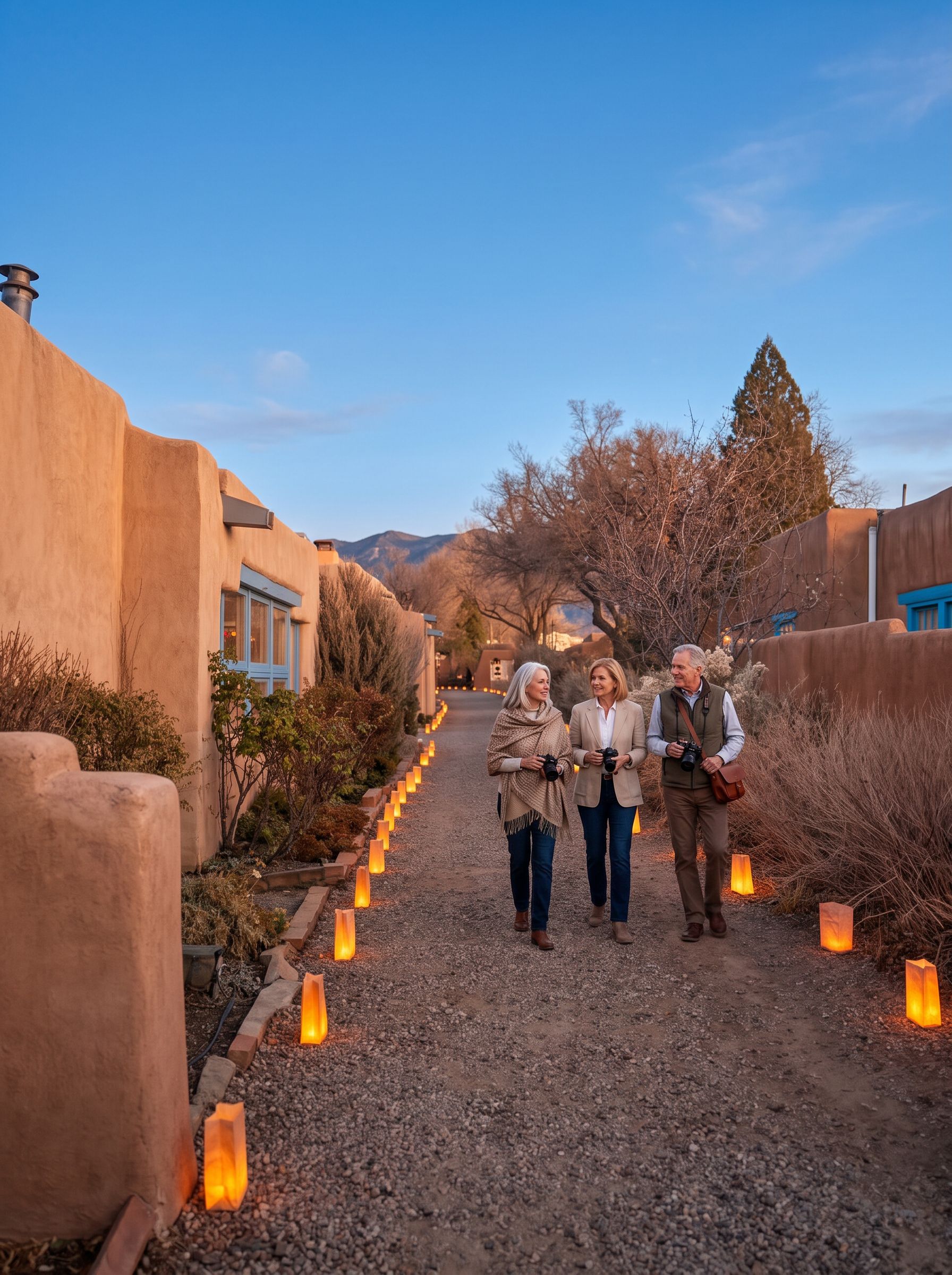
The practical consequence is that shade and sun feel like different seasons. A plaza bench in full afternoon sun and a gallery interior a few steps away can call for different clothing. The Inn of the Governors makes the same point on its weather page: mornings and evenings are cool even in summer.
Season by season, the official averages look like this:
| Season | Average high | Average low |
|---|---|---|
| Spring | Low 70s°F | Low 40s°F |
| Summer | High 80s°F | Mid-50s°F |
| Autumn | Low 60s°F | Mid-30s°F |
| Winter | Low 50s°F | Mid-20s°F |
Two seasonal caveats belong in the bag itself. Spring can be windy, according to The Discoveries Of, so a wind-resistant outer layer earns its place from March to May. And the rainy season runs July through August, when thunderstorms come through quickly in the afternoon, as the Inn of the Governors states on its weather page. A lightweight waterproof shell or compact umbrella covers both.
 AI-edited
What shoes do I need for Santa Fe's streets?
Supportive walking shoes with reliable grip. Tourism Santa Fe specifically advises seniors to wear sturdy walking shoes and warns that historic buildings may have uneven floors. The Plaza and downtown are compact, but the paving includes brick, flagstone, cobblestones and cracked sidewalks, and Canyon Road climbs gradually for roughly a mile.
Walking is the preferred way to see the centre. The Inn of the Governors puts the Plaza two blocks north of its door, a walk of roughly five minutes, and describes the streets as often having a subtle uphill slant. It gives the entrance to Canyon Road as approximately three-quarters of a mile from the hotel, with the road itself roughly a mile long and gradually leading uphill.
For anyone with limited stamina, there is a workable tactic. The Inn notes a pay parking lot near the top of Canyon Road, so a drop-off high on the road followed by a downhill walk is possible. Published traveller discussions also note that Canyon Road galleries and restaurants may have entrance steps, and that parking there can be difficult.
On trails, a Fodor's discussion of New Mexico hiking reports participants using hiking shoes or sneakers with good soles, with higher boots considered mainly for people prone to ankle problems or for rougher ground. The same discussion cautions that boots can be safer but are almost always less comfortable. For town use, local advice in Santa Fe discussions says no special footwear is needed beyond something comfortable.
How do I handle the sun and the dry air?
Treat sun protection as daily kit, not beach kit. The Inn of the Governors states that sunburns are possible even in winter, and Tourism Santa Fe advises sunscreen and a hat because of the altitude. For the dry air, pack lip balm and moisturiser, and drink more water than you would at sea level.
Santa Fe has over 300 sunny days annually, according to the Inn of the Governors, and averages only 14 inches of rain a year. Tourism Santa Fe describes the city as dry, sometimes with humidity below 20 percent. A Santa Fe packing discussion warns that the sun can burn quickly at roughly 7,000 feet, recommending a hat and sun protection.
Tourism Santa Fe's official material does not specifically prescribe lip balm or moisturiser, so their necessity is not documented by the official sources. A late-April Reddit discussion, however, advises bringing lotion and lip balm because Santa Fe is notably dry. Packing both costs nothing and settles the question.
Hydration is the one item every source agrees on. Tourism Santa Fe repeatedly advises visitors to stay hydrated at altitude and to bring plenty of water for walks and hikes, noting that restaurants serve water by request. The Inn of the Governors is direct: drink lots of water, it helps greatly with altitude sickness.
How should I pack and plan for the altitude?
Pack as if the first day is a rest day. Tourism Santa Fe says acclimatisation usually takes about 48 hours and advises taking it easy and staying hydrated, particularly after arriving from a lower elevation. The Inn of the Governors adds a caution about alcohol and about strenuous activity before you have adjusted.
The city's elevation is given as 7,000 to 8,500 feet depending on where you are in it, according to the Inn of the Governors, which also notes that alcoholic beverages will affect most people sooner. Its advice is to give yourself time to adjust before skiing, running or hiking. A Fodor's discussion makes the same planning point: visitors arriving from near sea level should not plan too much on their first day.
What this means for the suitcase is modest but real. Put the walking shoes in the carry-on rather than the checked bag, so a slow first afternoon does not depend on luggage arriving. Keep the water bottle accessible. Plan a short first-day loop around the Plaza rather than a Canyon Road climb. Tourism Santa Fe's guidance on adjusting to Santa Fe's altitude sets out the same advice in full.
For anyone who wants backup, the Inn of the Governors notes that A&R Medical Supply provides oxygen and related equipment to assist visitors adapting to Santa Fe's altitude. It also lists Ulti-med on 505.989.8707, open 9am to 5pm seven days a week. Neither is a substitute for medical advice; they are simply the local options the hotel documents.
What luggage works best in Santa Fe?
Lightweight luggage with good wheels, and not much of it. The official Santa Fe sources do not publish a luggage-weight recommendation, but historic streets and hotel approaches may involve brick paving, steps or uneven surfaces, and several properties have no lift. A lighter bag you can carry up a short flight is the practical choice.
Guest feedback gathered on Tripadvisor through 2026 repeatedly flags stairs or absent lifts at some historic and motel-style properties, so mobility needs should be checked before booking. At the Santa Fe Motel & Inn, reviews recommend requesting a ground-floor room if mobility is an issue.
None of that is a reason to avoid these properties. It is a reason to ask one question when booking, and to pack so that the answer does not matter. A soft-sided bag with a shoulder strap handles a short staircase better than a hard case with a broken wheel on cobblestones.
How do I get around without a car, and what should I carry for it?
The centre is compact enough to walk, and there is a free shuttle. Tourism Santa Fe describes a free Santa Fe Pickup Shuttle serving greater downtown, also available on demand, and the Senior Traveling Guide reports it links the Plaza, Canyon Road, the Railyard and Museum Hill. Carry small cash and a card, and keep the sun hat with you.
Tourism Santa Fe's getting-around pages describe downtown Santa Fe and the Railyard as particularly walkable. Beyond the centre, Santa Fe Trails serves the city, though Tourism Santa Fe warns that service may be limited and that visitors staying outside downtown may find a car more practical.
On fares, the sources disagree and the disagreement should be carried, not resolved. Santa Fe 101 states that Santa Fe Trails buses are free on fixed routes, while Best Time to Visit lists paid fares. Confirm the current fare and route information with the city before relying on either claim. Separately, a published senior rider guide describes reduced fares for riders aged 60 and over, generally with identification or a Medicare card, so pack that card if a reduced fare matters to you.
Two practical notes for the day bag. First, many local businesses do not accept out-of-state personal or business cheques, according to the Inn of the Governors, so carry a credit card. Second, the same source notes that parking at the hotel is complimentary for its guests and most downtown attractions are within walking distance, which is worth checking before you book anywhere.
What if I need a pharmacy or medical help?
What it does document is emergency numbers and urgent care. For police, fire or medical emergencies in Santa Fe, call 911. The city's non-emergency dispatch number is 505-428-3710.
For minor needs, the documented options are these. Railyard Urgent Care at 831 S. St. Francis Drive is reported open daily, 8am to 7pm, on 505-501-7791. Aspen Medical Center is on 505-466-5885. Christus St. Vincent DeVargas Health Center is on 505-913-4660, and Christus St. Vincent Entrada Contenta Health Center Urgent Care is on 505-913-3233.
The gap is worth naming plainly. No source identifies the nearest pharmacy to the Plaza, a particular hotel, Museum Hill or Canyon Road, and no source documents pharmacy opening hours, medication delivery or multilingual services. The practical response is to bring prescriptions in their original packaging with a few days' surplus, and to ask your hotel at check-in where the nearest pharmacy is. Our guide to health, pharmacies and peace of mind in Santa Fe covers the wider picture.
One more number belongs in the phone: the Santa Fe Crisis Response Hotline is listed as 505-820-6333 or 1-888-920-6333.
What should I wear in Santa Fe in November and winter?
A warm coat, hat and gloves for mornings and evenings, with lighter layers, sunglasses and sunscreen kept for sunny afternoons. Tourism Santa Fe gives winter averages in the low 50s by day and the mid-20s at night, and reports six to eight major snowfalls between November and April, with an average of 32 inches of snow in town.
The Inn of the Governors gives the snow season as November through April, with up to 300 inches in the ski areas. Reddit advice on early December describes daytime temperatures in the 40s and low 50s and nights in the 20s and 30s. Boots and a parka are what Tourism Santa Fe recommends when snow is expected.
The counter-intuitive part is the sun. The Inn of the Governors states plainly that sunburns are possible even in winter, so the sunscreen and sunglasses do not get packed away with the summer clothes. A November bag holds both a heavy coat and a sun hat, and that is not a contradiction in Santa Fe.
If your dates are flexible, the shoulder months are gentler on the suitcase. September and October are described by Tourism Santa Fe as often among the most comfortable months for walking, with warm days and crisp nights, and the guide to when to visit Santa Fe for comfortable weather sets out the trade-offs. If your trip coincides with a festival, the Santa Fe festivals and quiet seasons calendar is worth a look before you finalise dates.
The Santa Fe bag list, in one place
Everything below is drawn cited above. Nothing on it is speculative, and nothing on it is expensive. The list is short because Santa Fe's demands are simple: grip, shade, water and something warm for after four o'clock.
- Supportive walking shoes with good grip, worn on the travel day rather than packed.
- A thin base layer, a fleece or cardigan, and a windproof or rain shell.
- A brimmed hat, sunglasses and high-SPF sunscreen, for every season.
- Lip balm and moisturiser for the dry air.
- A refillable water bottle, filled before you leave the room.
- Light gloves and a warm coat from November to April.
- A compact umbrella or waterproof shell for July and August afternoons.
- A cane with a reliable rubber tip if uneven paving is difficult.
- Identification or a Medicare card if a reduced bus fare applies to you.
- A credit card, since out-of-state cheques are often not accepted.
- Lightweight luggage you could carry up one flight of stairs.
Pack for the day you will actually have: a cool morning, a bright and burning afternoon, a cool evening, and a stretch of brick underfoot. That is Santa Fe in a suitcase.
---


