
Salzburg rewards the unhurried traveller. Its UNESCO-listed old town is compact, baroque, and remarkably walkable, while a dependable network of trolleybuses and buses extends your reach to the fortress, Mirabell Gardens, and Hellbrunn Palace without ever needing a car. For travellers aged 50 to 70, the city offers a rare combination: genuine walkability in the historic core and a public transport system that is low-entry, frequent, and well-integrated with the Salzburg Card. This guide focuses solely on moving around the city itself — on foot, by bus, by funicular, and by taxi — so you can plan your days with confidence and comfort.
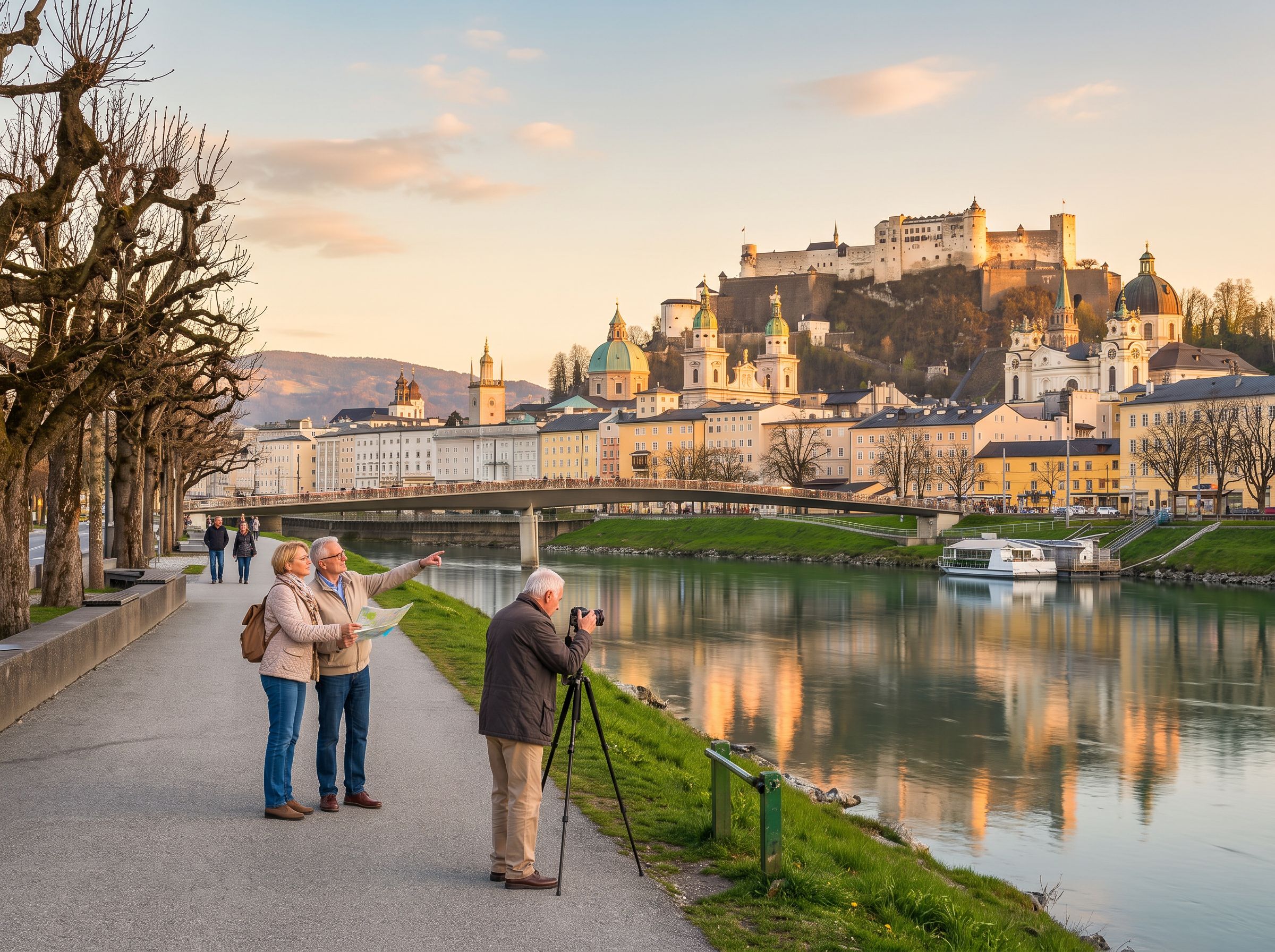
The old town’s flat central spine runs from Mirabell Gardens across the Salzach River to Getreidegasse and the Cathedral. Most visitors find they can cover this stretch comfortably in a morning, stopping for coffee and window displays. But Salzburg’s terrain changes quickly once you head toward the hills. Hohensalzburg Fortress looms above the rooftops, and the climb is steep. The city’s cobblestones, while charming, demand sturdy shoes and a measured pace. The trick is knowing when to walk and when to let the bus or funicular do the work.
 AI-edited
How walkable is the old town for someone aged 50 to 70?
Salzburg’s historic centre is highly walkable on flat ground, with most major sights within a 20-minute stroll of one another, but cobblestones and bridge crossings require comfortable footwear and a realistic sense of your own stamina.
The pedestrianised heart of Salzburg — Getreidegasse, Residenzplatz, and the Cathedral — is level and traffic-free. You can wander from Mozart’s Birthplace to the DomQuartier in under ten minutes. Mirabell Gardens, across the river, is a level, scenic starting point for many walking routes. The Salzach bridges are level and short, so crossing between the two banks adds little effort if you are travelling light. The Salzach river paths are flat and well-maintained, offering a pleasant alternative to the busier streets.
However, the terrain changes quickly. The climb to Hohensalzburg Fortress is steep and involves many stairs, and the fortress states plainly that its footpath is not barrier-free because of the gradient. The Mönchsberg and Kapuzinerberg hills also present challenges. For a packing list that addresses cobbles and weather, see our dedicated guide. The practical strategy is to enjoy the flat core on foot and use public transport for anything uphill or beyond the immediate centre.
How does the bus and trolleybus network work?
Salzburg’s public transport is a network of trolleybus lines 1–14, Albus city buses, and selected regional Postbus routes; the vast majority of vehicles have low-entry doors and a fold-out ramp for easier boarding.
The system is straightforward. Trolleybuses run frequently through the city centre, with stops clearly marked and digital displays showing next departures. The main interchange is at the Hauptbahnhof (main station), while F.-Hanusch-Platz is the hub on the old town side; the closest stops to Mozartplatz are Rathaus and Mozartsteg, as no stop carries the Mozartplatz name. Buses are practical for longer hops — from the station to your hotel, or out to Hellbrunn Palace on line 25.
Tickets can be purchased from machines at major stops, at the main station, or from tobacconists (Trafiken). Buying in advance is cheaper than paying the driver. Under the fares valid from 1 January 2026, a one-hour ticket costs €2.60 from a machine, the app or the website and a 24-hour ticket €5.20; the same 24-hour ticket bought from a driver costs €6.40. The core-zone single ride is not sold at machines at all — tobacconists sell it only in packs of five at €12.50. The Salzburg Verkehr website has a journey planner that shows walking, cycling, and bus times side by side.
| Ticket type | Machine, app or online | From the driver |
|---|---|---|
| 1-hour ticket | €2.60 | — |
| 24-hour ticket | €5.20 | €6.40 |
| Single ride, pack of five (tobacconists only) | €12.50 | — |
| Single ride, regional and selected Albus lines | — | €3.00 |
| myRegio weekly pass, Salzburg City region | €23.00 | — |
What senior discounts are available on public transport?
Travellers aged 65 and over with a valid ÖBB-VORTEILSCARD Senior receive approximately 20% off single, one-hour, day, and 24-hour tickets, but this discount is not automatic — you must present the card with photo ID.
This is a crucial detail for older visitors. The senior fare is tied to the Austrian rail discount card, not simply to age. If you do not hold a Vorteilscard Senior, you will pay the standard fare, and showing a passport does not qualify. One further catch: reduced tickets are not sold on board the trolleybuses, so buy the senior fare at a machine or in the app before you board. For residents of Salzburg, a senior annual network pass (KlimaTicket Salzburg SENIOR | EDELWEISS) is available for €299 per year, but this is aimed at locals, not short-stay visitors.
For most travellers aged 50 to 70, the Salzburg Card is the more practical option. It bundles free public transport within the city with admission to major attractions. The card is valid for 24, 48, or 72 hours from first use — not from purchase — and includes trolleybus lines 1–14, Albus lines, the local railway S1 to Acharting, and selected Postbus routes. It does not cover ÖBB long-distance trains or S-Bahn services. The official Salzburg Card page from Tourismus Salzburg lists the full coverage.
Is the fortress funicular worth taking, or should I walk up?
The Festungsbahn funicular is included with the Salzburg Card and saves a steep climb of roughly 15–20 minutes and 100 metres of ascent; it is also the only barrier-free way up, since the fortress footpath is not accessible.
The funicular departs from Festungsgasse 4, just off Kapitelplatz, and covers the 198.5 metres to the fortress in 54 seconds. It runs every ten minutes, and the Salzburg Card covers both the ride and fortress admission. Without the card, the basic ticket including the funicular costs €15.50 and the all-inclusive ticket €19.20. Two maintenance windows are worth noting, when the funicular stops and the fortress can be reached only on foot: 9 to 13 November 2026, and 11 January to 14 March 2027. As of August 2026, Hohensalzburg Fortress holds a Google rating of 4.6 out of 5 from more than 53,900 reviews, with panoramic views from the terraces consistently praised as the highlight.
If you do choose to walk, allow extra time: the fortress describes the path as partly gravelled and steep in places. The interior involves many steps and inclines and is not barrier-free, though a lift in the bell tower reaches the castle courtyard, the armoury exhibition, the tavern and the marionette museum, and the panorama terrace by the mountain station is fully accessible. There are cafes and restaurants within the fortress where you can rest and enjoy the views, though prices reflect the location. For a broader look at guided options that include the fortress, see our guide to small-group tours in Salzburg.
“Taking the funicular railway up the mountain is quick, smooth, and gives you great glimpses of the city as you ascend.” — a guest wrote on Google in August 2026
How do I get to Hellbrunn Palace without a car?
Hellbrunn Palace is reachable on bus line 25 from the city centre, a ride of about 16 minutes from Mirabellplatz, and the Salzburg Card covers both the bus fare and palace admission.
Hellbrunn is Salzburg’s most popular excursion beyond the old town, famous for its trick fountains and expansive parkland. The palace park is level and low-strain, making it an attractive option for a relaxed afternoon. Bus 25 departs from several central stops, including Mirabellplatz, Rathaus and the main station, running every 15 minutes on weekdays between roughly 7am and 7pm and every 20 minutes at weekends and on public holidays.
The Salzburg Card includes the ride on line 25, which is a practical saving. The palace exhibition and the trick fountains open together, daily from 28 March to 1 November 2026, while the park stays open all year and costs nothing to enter. The park and the trick fountains are wheelchair-accessible; the palace exhibition is reached only by stairs. Allow at least three hours for the visit, including travel time. The park is free to enter, but the palace and fountain tours require tickets. For a full four-day plan that includes Hellbrunn, consult our Salzburg itinerary for the over-50s.
Are taxis and river paths good alternatives?
Taxis are readily available for short hops, especially after buses stop running in the late evening, while the flat river paths on both banks of the Salzach offer a scenic walking route between the old town and Mirabell.
Salzburg’s taxi ranks are located at the main station and Mirabellplatz. Fares follow the provincial tariff: a base charge of €4.90 on weekdays between 6am and 9pm, €6.20 at night and all day on Sundays and public holidays, then €0.30 for every 110 metres. For late returns there is a cheaper option than a taxi. The BusTaxi leaves F.-Hanusch-Platz and Theatergasse on the hour and the half hour for a flat €4.50 per person regardless of distance — Monday to Friday between 00:05 and 01:50, and until 04:10 on Fridays, Saturdays and the nights before public holidays.
The river paths are a quieter alternative to the streets. Both the left and right banks have continuous pedestrian walkways, with several bridges connecting the two sides. The walk from Mirabell Gardens to the old town along the river takes about 15 minutes at a leisurely pace. The paths are flat, well-lit in the evenings, and offer lovely views of the fortress and the Kapuzinerberg hill. For those staying near the river, this is often the most pleasant way to reach the old town, avoiding the busier shopping streets.
Where are cobbles, hills, and steps an issue?
Cobblestones dominate the old town, hills rise sharply toward the fortress and both city mountains, and steps are common at church entrances and along the Mönchsberg paths — plan your routes with these in mind.
The old town’s charm comes with a physical cost. Getreidegasse and the surrounding lanes are paved with uneven cobbles that can be tiring after an hour of walking. The Cathedral and most historic churches have steps at their entrances, though many have ramps available. The Mönchsberg and Kapuzinerberg hills offer excellent viewpoints but involve significant climbs; the Kapuzinerberg, in particular, has a steep, stepped path that is not suitable for anyone with limited mobility. The Mönchsberg has a step-free alternative: the MönchsbergAufzug at Gstättengasse 13 rises 60 metres in 30 seconds and sets you down at the Museum der Moderne and its terrace. A single ride costs €3.40 and a return €4.80, and the Salzburg Card includes one free trip — the Guest Mobility Ticket does not.
Not every stop is fully step-free, and Salzburg’s tourist board says only that the vast majority of vehicles have low-entry doors with a fold-out ramp. Salzburg AG documents 108 low-floor articulated trolleybuses with a kneeling function and a ramp at the second door, which the driver operates on request — raise a hand as the vehicle arrives and the driver will lower the bus and put out the ramp. The free Salzburgmobil app marks low-entry departures with a wheelchair symbol, and the Salzburg Verkehr hotline on +43 662 632900 answers route questions around the clock. For a hotel that addresses these considerations, see our dossier on the Hotel Goldener Hirsch.
Is the Salzburg Card worth it for transport alone?
The Salzburg Card is worth it when you combine transport with attraction admissions, but for transport alone, standard day tickets are cheaper — and if you are staying overnight in the province, the Guest Mobility Ticket already covers the city buses, so the card has to earn its price on admissions alone.
A 24-hour Salzburg Card costs €38 between 1 April and 31 October 2026 and €35 in the winter months. A 24-hour transport ticket costs €5.20 from a machine. The card therefore pays off only once you take in several paid attractions in a day: the fortress with the funicular is €15.50 on the basic ticket and Mozart’s Birthplace €18, or €15 for seniors on presentation of ID. Add a third sight such as the DomQuartier at €15 and the card is comfortably ahead.
The card’s time logic catches some travellers off guard: it begins when you first scan it and runs continuously for the chosen period. You cannot split a 48-hour card across non-consecutive days. Plan your first use for a morning when you have a full day of sightseeing ahead. Note also that the Salzburg Card is distinct from the Guest Mobility Ticket, which launched on 1 May 2025. If you are staying overnight anywhere in the province, your accommodation issues that ticket at check-in and it already covers the city buses for your whole stay, so the Salzburg Card only has to earn its price on admissions. The mobility fee behind it is €0.50 per person per night for guests aged 15 and over, rising to €1.10 on 1 May 2027.
| Item | Without card | With 24h card |
|---|---|---|
| Fortress, basic ticket with funicular | €15.50 | Included |
| Mozart’s Birthplace | €18.00 | Included |
| DomQuartier, full access | €15.00 | Included |
| 24h public transport, from a machine | €5.20, or nothing if you hold the Guest Mobility Ticket | Included |
| Total | €53.70, or €48.50 if you are staying overnight | €38.00 |
What changes are coming to old town traffic in 2026?
From 1 July to 31 August 2026 the city restricts certain car journeys through the centre; this is not a full closure, and walking and public transport remain the easiest way to sightsee.
Salzburg’s official travel information describes the historic centre as “largely closed to regular traffic” from 1 July 2026. The city itself puts it more precisely: this is not a complete closure but a rule aimed at particular car journeys, and trips for work, deliveries, hotel guests and holders of a disabled parking badge remain permitted. The measure targets through and search traffic and is expected to remove around 1,000 car journeys a day. For visitors on foot, the streets will be quieter and safer.
If you are arriving by car and are not covered by one of those exemptions, park-and-ride on the outskirts is the intended way in. Throughout July and August a single day rate of €7.50 per car covers parking and public transport for up to five people. Allow extra time for any car-based arrangements during this period. For those already planning a car-free visit, the change simply reinforces the wisdom of your approach. The bus network and the Salzburg Card remain the most reliable ways to navigate the city, and the summer 2026 restrictions make them even more attractive.
What should I remember for a smooth visit?
Buy bus tickets in advance from machines or Trafiken, carry the Salzburg Card from first use, wear supportive shoes for cobbles, and use the funicular for the fortress — these four habits will make your visit noticeably more comfortable.
Salzburg is a city that rewards preparation. The transport system is reliable and easy to navigate, but small decisions — where to buy tickets, when to start your Salzburg Card, which shoes to wear — can significantly affect your comfort. The old town is compact enough to explore on foot, but the hills and cobbles demand respect. The bus network extends your reach without effort, and the funicular removes the one genuinely strenuous climb most visitors face.
As of August 2026, Salzburg AG runs 108 low-floor articulated trolleybuses with a kneeling function and fold-out ramps, and the city recorded 3,138,434 overnight stays in 2024, indicating a busy but manageable visitor volume. The summer 2026 traffic restrictions will make the old town even more pedestrian-friendly. With a little planning, you can enjoy Salzburg’s baroque beauty, musical heritage, and alpine views without ever needing a car — and without exhausting yourself in the process.


